

Key Takeaways:
- Data security solutions protect information from unauthorized access, corruption, or loss.
- Effective solutions span prevention, detection, and recovery, which means organizations must protect, detect, and recover with confidence.
- The foundation of modern protection is formed through encryption, access control, immutability, and verified resilience.
- Modern ransomware resilience and compliance frameworks, like DORA, NIS2, and zero trust, are driving security innovation across hybrid and SaaS environments.
- Veeam Data Platform unifies these capabilities with intelligent monitoring, clean recovery, and continuous compliance for hybrid and multi‑cloud deployments.
What is Data Security in 2026?
Data security is easy on a conceptual level: protect your data while maintaining availability. This means protecting your data from malicious outside forces and restricting access to that data based on user roles. For example, someone in sales does not need access to the HR financial and disciplinary records and vice versa. Also, consider that no protection is perfect or impervious to attacks. To limit the potential damage of authorized and unauthorized people, organizations should look at using a layered approach. This is the only way to ensure optimal data security. Locking down a network is equally as important as educating your users and encrypting data.
Traditionally, security teams defined data security through the CIA Triad: Confidentiality, Integrity, and Availability. These pillars still matter, but the environment surrounding them has changed dramatically. Today, data spans hybrid clouds, SaaS platforms like Microsoft 365 and Salesforce, and AI‑driven workflows that interact with sensitive repositories in real time. Every new integration, automation, and AI assistant expands the attack surface, too.
Where older strategies focus on perimeter defense and encryption, modern data security solutions demand resilience by design, or the ability to recover cleanly and confidently immediately after an incident.
That’s why the data security conversation has evolved from “how do we protect data?” to “how do we prove data integrity and recoverability?”
Data Security vs. Data Protection and Privacy
While these terms often overlap, they serve the following distinct purposes:
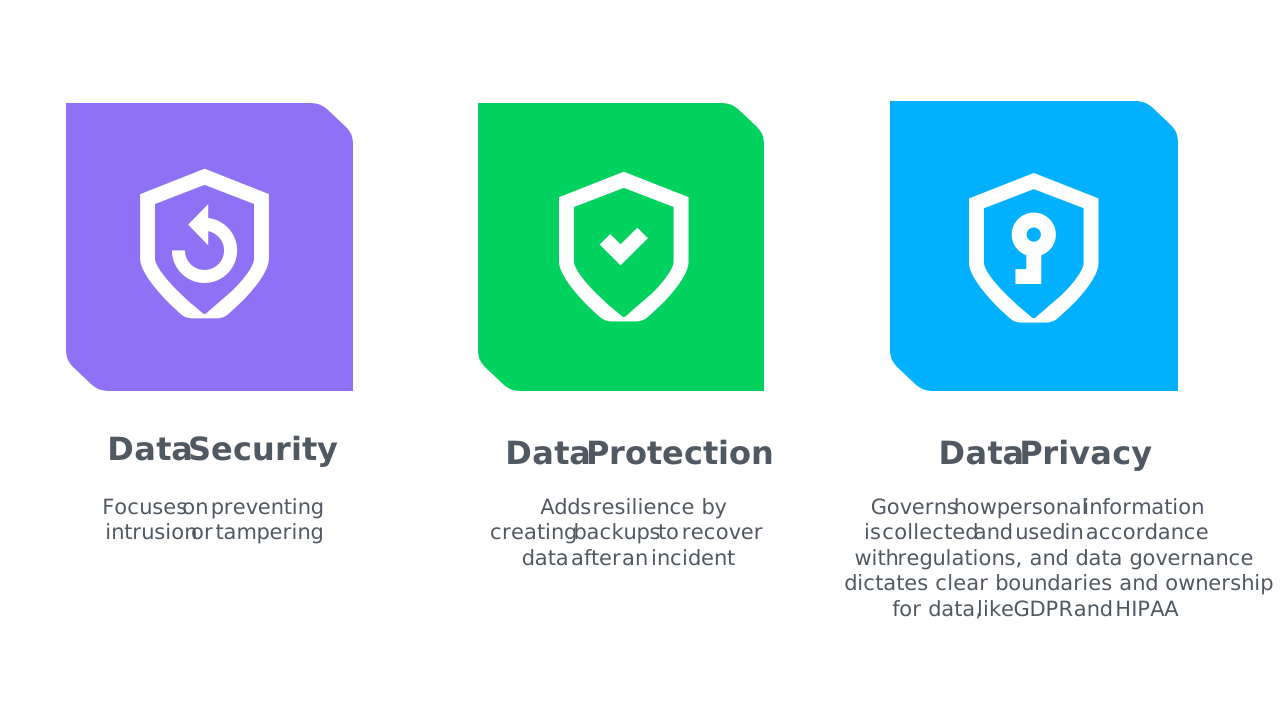
- Data security focuses on preventing intrusion or tampering.
- Data protection adds resilience by creating backups to recover data after an incident.
- Data privacy governs how personal information is collected and used in accordance with regulations, and data governance dictates clear boundaries and ownership for data like GDPR and HIPAA.
Together, they form a complete strategy for maintaining trust in digital operations.
Evolving Threats Require Integrated Solutions
Over time, our threat landscape has shifted dramatically. Ransomware now targets backups, insider risk has grown, and AI‑driven automation introduces new vectors for data exfiltration and reliability. As a result, point solutions alone can’t keep pace. Organizations need integrated data security platforms that combine protection, detection, and recovery under a unified resilience model.
Veeam Data Platform embodies this approach by bringing together immutable storage, encryption, least-privilege access control, and verified recovery to deliver confidence that your data remains secure and recoverable across hybrid and multi‑cloud environments.
Why Data Security Solutions Matter
Every organization depends on data to operate, serve customers, and maintain compliance. When that data is compromised or inaccessible, the impact extends far beyond IT; it affects revenue, reputation, and regulatory standing.
We live in a time where our most valuable assets are not physical components you can hold in your hands, but intangible assets composted of 1s and 0s electronically zipping from physical to virtual places in a blink of an eye. These virtual bits of data can be worth far more than any building or company car. The value of employees are measured in the generation of intellectual property, which directly affects a company’s bottom line. It’s not just businesses that understand how valuable this data is, but also malicious attackers who wish to profit from this commodity.
In 1989, the IT world was stunned by the first recorded ransomware attack. It was delivered via a floppy disk that was sent to thousands of hospitals and health care institutions, disguised as research for arguably one of the scariest diseases at the time, AIDS. This attack’s sophistication did not stop there; it was also a timebomb attack. Meaning, it did not release the attack right when the disk was inserted but timed the release after the machine had been rebooted 90 times. It was reported that out of the 20,000 floppy disks that were sent out, about 90 companies admitted being infected. Years later, the attack types and delivery methods have grown exponentially, and beyond anything we could have imagined in ‘89.
The Business Impact of Data Breaches and Downtime
Loss of access to critical systems can halt operations for days or weeks, and the public disclosure of sensitive information can lead to fines, lawsuits, and loss of trust. IMB reports that the global average cost of a major data breach now exceeds $4.4 million, not including long‑term reputational damage.
For regulated industries, the stakes are even higher: Healthcare and financial services must demonstrate proof of recoverability and data integrity to satisfy frameworks such as HIPAA, PCI DSS, and DORA. Failure to do so can result in penalties and loss of certification.
Rising Ransomware and Insider Threats
Ransomware remains the most disruptive cyberthreat for businesses worldwide.
Attackers target backups, cloud repositories, and credentials to eliminate recovery paths before attacking production data and infrastructure. At the same time, insider risks, whether through human error or malicious intent, continue to be one of the leading causes of accidental data loss and exposure.
Modern data security solutions must address both external and internal risks through granular access control, immutability, zero trust architecture, and the continuous monitoring of user behavior and backup activity.
Core Components of Modern Data Security Solutions
Modern data security depends on a layered zero trust approach that combines preventive, detective, and corrective controls. Each component contributes to protecting data’s confidentiality, integrity, and availability across hybrid, cloud, and SaaS infrastructures.
Encryption: Data Confidentiality at Rest and in Transit
Encryption converts information into an unreadable format to prevent unauthorized access and provide confidentiality even if data is intercepted or stolen.
Strong encryption policies should include both data‑at‑rest and data‑in‑transit protection.
At rest, encryption secures databases, file systems, and storage volumes using algorithms such as AES‑256 or ChaCha20‑Poly1305.
In transit, encryption relies on Transport Layer Security (TLS 1.2 or higher) to protect data as it moves between endpoints.
Organizations must also manage encryption keys securely through Key Management Services (KMS) or Hardware Security Modules (HSMs) to prevent compromise and meet compliance requirements under frameworks such as NIST SP 800‑57, FedRAMP, and ISO 27001.
Access Control and Zero Trust: Authentication, Segmentation, and Least‑Privilege Access
Access control ensures that only authorized users and systems can view or modify information.
Modern architectures increasingly follow zero trust principles, which include verify explicitly, assume breach, and grant least privilege access.
- Strong authentication mechanisms include multi-factor authentication (MFA), identity federation, and adaptive access policies based on context and risk.
- Network segmentation and micro‑segmentation limit lateral movement by isolating workloads and enforcing security boundaries.
- Least‑privilege access minimizes exposure by only granting users the permissions required to perform their tasks.
These controls collectively reduce insider threats, prevent privilege escalation, and align with compliance standards like OMB M‑22‑09, CISA Zero Trust Maturity Model, and NIST SP 800‑53 (AC family).
Immutable Backup: Protection Against Ransomware and Accidental Deletion
Immutable backup creates a write‑once, read‑many (WORM) state in which data cannot be changed, encrypted, or deleted until its retention period expires.
This resilience is critical against ransomware, which often targets backups and archives to prevent recovery.
It also safeguards against accidental deletion or modification caused by human error.
Regulatory frameworks such as SEC Rule 17a‑4(f) and FINRA 4511(c) explicitly require immutable records for certain industries, making this a compliance and security measure.
Backup and Recovery: Verified Restore Points Using Veeam SureBackup
Backup and recovery are the cornerstone of operational resilience.
Regular backups ensure that data can be restored following corruption, loss, or attack.
However, resilience depends on validation, knowing that backups are complete and recoverable.
Using automated validation processes, like Veeam SureBackup, helps alleviate the burden by testing and verifying restore points in isolated environments to confirm that your applications start correctly and data remains intact.
Combined with Veeam Recovery Orchestrator, organizations can create auditable recovery plans, maintain clean restore points, and prove compliance to regulators or auditors.
This transforms backup confidence into a complete business impact analysis.
Monitoring and Detection: Anomaly and Threat Detection Through Integrations
Continuous monitoring identifies suspicious activity before it becomes a full‑scale incident.
Modern detection strategies combine behavioral analytics, machine‑learning models, and security‑information and event‑management (SIEM) systems to correlate signals from endpoints, networks, and cloud workloads.
Anomaly detection can reveal ransomware patterns such as sudden encryption bursts, unusual file changes, or spikes in backup errors, but this can leave gaps for more resilient ransomware families. AI advancements that are used by threat actors have led way to a new wave of transmorphic ransomware that evolves rapidly and adapts to traditional pattern recognition systems. To counter this, integrated protection systems require a deeper understanding of user data and behavioral deviations.
Integrations with external threat‑intelligence feeds enhance visibility and enable faster incident response.
Effective monitoring supports continuous improvement by feeding insights back into access‑control and protection policies.
Compliance, Governance, and Auditability: Meeting Regulatory Frameworks
Compliance and governance ensures that data security controls meet legal, regulatory, and contractual obligations. Frameworks like GDPR, HIPAA, CCPA, PCI DSS, and DORA require demonstrable safeguards for data integrity, confidentiality, and availability. Let’s take a closer look at these frameworks:
| HIPAA | HIPAA stands for the Health Insurance Portability and Accountability Act. This regulation is the standard in the U.S. to protect the confidentiality of a patient’s health records. Unless patients consent to share their personally identifiable information (PII), the records cannot be read. If there is a security breach that leads to an unauthorized entity reading a medical record, then the company that houses that information, including the data owners are open to litigation and fines. There are also some loopholes where data obfuscation can cover PII to share findings. |
| CCPA | CCPA stands for California Consumer Privacy Act, and this law was initiated to protect how residents of California’s personal data are handled worldwide. This regulation protects individuals’ rights to their information in all aspects. Any California resident can request a copy of their data from a company, have the company delete their data from their database, and ensure no personal information is sold to a third party. This regulation also prevents discrimination based on exercising these rights. |
| GDPR | GDPR stands for General Data Protection Regulation. GDPR is very similar to CCPA for California, but GDPR applies to all of the EU. GDPR gives the control over an individual’s information back to that individual. This standard also requires assigning a data owner to ensure the data is properly handled. |
| PCI DSS | PCI DSS stands for Payment Card Industry Data Security Standard. It is a global framework created by major credit card brands to protect cardholder data and payment transactions. PCI DSS establishes technical and operational requirements for organizations that store, process, or transmit credit card information, including the encryption of payment data, secure network design, and regular vulnerability assessments. Compliance is mandatory for merchants and service providers who handle card payments, and failure to meet PCI DSS standards can result in fines or suspension of payment processing privileges. |
| DORA | DORA stands for Digital Operational Resilience Act, a regulation adopted by the EU to strengthen IT security and operational resilience in the financial sector. DORA requires banks, insurers, and other financial entities to ensure the integrity, availability, and recoverability of their digital services. It mandates continuous testing of incident response and disaster recovery (DR) capabilities, including backup validation and secure data restoration procedures. |
What does all this mean for your organization? You must maintain verifiable records of who accessed data, when, and how it was protected or recovered. Key audit artifacts usually include access logs, backup job reports, encryption key rotation schedules, and recovery test documentation.
Having a strong compliance posture will help your organization avoid penalties and build trust with customers, partners, and regulators
IT Security Standards
Keep in mind these standards are constantly changing and adapting to meet the onslaught of attacks from threat actors. It quickly starts to feel overwhelming; my recommendation is to first figure out what regulations your company is subject to and your internal policies. Once you have an understanding of your scope, find an RSS feed that keeps up with the changes, like NIST RSS. Next find a blog or podcast that digs deeper to keep you informed, like Darknet Diaries and The Hacker News.
Types of Data Security Solutions
Modern data security strategies rely on a combination of technologies and operational practices that protect information at every layer of the environment, from physical infrastructure to cloud applications. Understanding the categories of data security solutions will help your organization design a defense‑in‑depth architecture that’s tailored to your specific risks, appetite, and regulatory requirements.
Infrastructure‑Level Solutions: Firewalls, Network Segmentation, and Endpoint Protection
Infrastructure‑level solutions secure the underlying hardware, networks, and operating systems that store or transmit data.
- Core components include stateful firewalls, which filter traffic and block malicious connections, and intrusion‑prevention systems (IPS) that detect and stop exploit attempts in real time.
- Network segmentation divides environments into smaller, isolated zones, limiting lateral movement when a breach occurs.
- At the endpoint level, modern solutions integrate antivirus, Endpoint Detection and Response (EDR), and patch‑management tools to prevent unauthorized access and maintain system integrity.
Storage‑Level Solutions: Encryption, Immutability, and Replication
Storage‑level solutions protect data where it resides, including on disks, databases, or cloud storage.
- Encryption safeguards data confidentiality, while immutability ensures that stored information cannot be changed or deleted during its retention period.
- Replication adds redundancy by maintaining synchronized copies of data across locations, supporting availability, DR, and business continuity.
- Storage‑level protection is critical for meeting compliance mandates that require proof of data integrity, such as SEC 17a‑4, GDPR, and FINRA 4511(c).
Application‑Level Solutions: Secure APIs, Validation, Permissions, and Data Masking
Application‑level security focuses on protecting data during processing and interaction with users or external systems.
- Secure APIs use authentication tokens and encryption to prevent interception or misuse of application data.
- Input validation is used to normalize and sanitize user input to prevent unintended actions from taking place on the backend.
- Granular permissions control which users or services can access particular datasets, reducing the exposure of sensitive information.
- Data masking replaces identifiable values with fictitious or obfuscated data for testing, analytics, or sharing, ensuring privacy without sacrificing utility.
Properly implemented, these measures can defend your organization against injection attacks, privilege escalation, and unauthorized data retrieval in web and enterprise applications.
Cloud‑Native Solutions: Secure Backup, Encryption Keys, and Compliance Management
As organizations migrate to hybrid and multi‑cloud environments, cloud‑native security solutions address the unique challenges of distributed data.
- These include secure backup and snapshot isolation to protect workloads from accidental deletion or ransomware, along with cloud‑key‑management services (KMS) that control encryption keys.
- Compliance management tools within cloud platforms can help map configurations to standards such as ISO 27001, CIS Benchmarks, and FedRAMP.
- Cloud‑native solutions also offer shared responsibility frameworks that clarify which security tasks are handled by the cloud provider and which remain with the customer.
Operational Solutions: Policy Automation, Access Governance, and Audit Trails
Operational solutions translate security policies into repeatable, enforceable processes.
- Policy automation can ensure that data handling and retention rules are applied consistently across all systems.
- Access governance provides visibility into user entitlements and helps detect anomalies, such as overprivileged accounts or orphaned identities.
- Detailed audit trails record every access or modification event, supporting forensic analysis and regulatory reporting.
How Veeam Data Platform Enhances Data Security
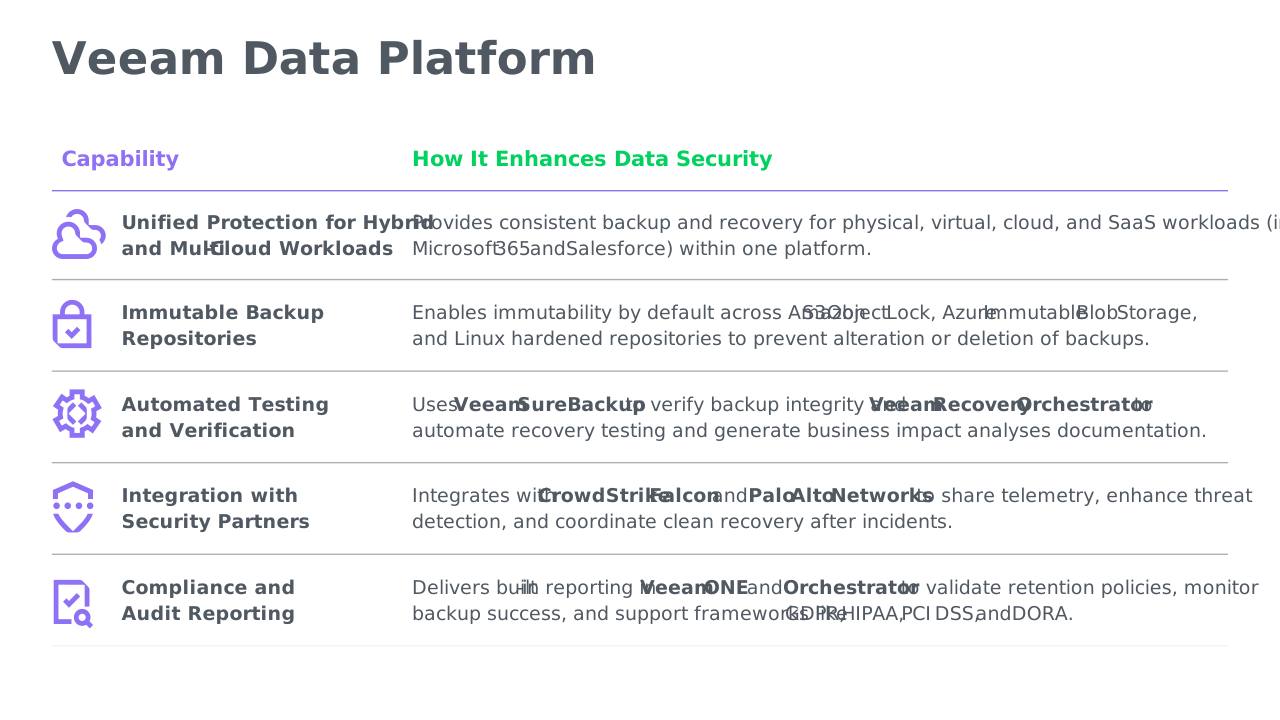
Veeam Data Platform delivers unified data protection, recovery confidence, and intelligent monitoring across hybrid and multi‑cloud environments. It combines Veeam Backup & Replication, Veeam ONE, and Veeam Recovery Orchestrator to help organizations protect, detect, and recover data with confidence.
Building a Resilient Data Security Framework
A resilient data security framework combines prevention, detection, and recovery. That means data remains protected, verifiable, and recoverable under any circumstance.
The following steps outline how your organization can build and maintain a modern resilience strategy that’s aligned with frameworks such as NIST Cybersecurity Framework (CSF) and ISO 27001.
| Step 1: Assess Risk and Define Data Security Objectives | Begin by identifying where critical and sensitive data resides across on‑premises systems, cloud platforms, or SaaS applications. Perform a risk assessment to evaluate potential threats such as ransomware, insider misuse, and compliance gaps while maintaining your business goals. Define clear security objectives that align with business priorities, including confidentiality, integrity, and availability. Use standardized models like NIST CSF Identify and ISO 27005 Risk Assessment to ensure consistency. |
| Step 2: Establish Preventive Controls | Deploy preventive measures that protect data at its source. Key controls include encryption, access governance, zero trust segmentation, and immutable storage. Ensure that policies enforce least‑privilege access and multi-factor authentication (MFA) across all administrative accounts. Document these controls and map them to compliance frameworks such as GDPR, HIPAA, and PCI DSS. |
| Step 3: Implement Continuous Detection and Monitoring | Resilience requires awareness. Integrate security‑information and event‑management (SIEM) tools or AI‑driven anomaly detection to continuously monitor for unusual patterns. Establish alerting thresholds for failed backups, unauthorized access attempts, or unexpected encryption activity. Feed detection insights into response workflows to minimize dwell time and improve recovery readiness. |
| Step 4: Validate Backup and Recovery Processes | Regularly test recovery procedures to confirm that backups are functional and clean. Automated verification tools such as Veeam SureBackup and Recovery Orchestrator can validate restore points and generate documentation for auditors. Schedule routine DR tests and include both technical validation and business impact analysis. Verified recovery ensures that resilience is not theoretical; it’s proven. |
| Step 5: Integrate Compliance and Reporting | Embed compliance into daily operations rather than treating it as a one‑time exercise. Maintain audit trails, policy‑enforcement logs, and recovery test reports as evidence of control effectiveness. Leverage automated reporting capabilities to align with DORA, ISO 27001, and NIST CSF Recover functions. Continuous compliance builds trust and demonstrates accountability to regulators, partners, and customers. |
| Step 6: Review, Improve, and Adapt | Resilience is an ongoing process. Regularly review the framework against new threats, technology changes, and regulatory updates. Conduct post‑incident reviews to identify lessons learned and update response playbooks. Use metrics such as mean time to recovery (MTTR) and backup‑success rates to measure improvement over time and ensure business continuity goals are being met. |
Outcome: Operational Confidence and Verified Resilience
Data Security Risks and Challenges
There are numerous risks around data security, but arguably, the number one risk will always be people. Every network will need access points to allow employees to do their job and access information. Every company needs to collaborate with external parties at some point to grow.
The number one way to combat the people risk to a company is security awareness training. Not all security training is made equal, and no single yearly training is a one-time fix for human threats. To ensure training is understood and put into practice, consider instinctive programs for catching security pitfalls or potential threats to the company. Starting an internal newsletter is also a great way to get quarterly security updates to employees throughout the year.
Next is to ensure proper privilege control; if a user does not need permissions or access to information, do not provide it. This might seem like a simple concept but without proper provisioning and deprovisioning permission policies in place this can quickly get out of hand. Even when these policies are in place with regular permission, audits can greatly improve security.
Lastly, do not do it alone. Many companies have hardware and software from many different vendors creating a sprawl of security permissions and configurations that makes it impossible to know every security setting. The best solution is to contact each of your vendors and ask for the documentation they have for security by design setting and resilience configurations. This ensures that your company’s defense is layered for any attack that you can encounter.
Take Action: Build Resilience with Confidence
With the right framework and tools you can safeguard data, detect threats early, and restore clean systems with confidence.
Start strengthening your organization’s resilience today with the Veeam Data Platform, built to protect, detect, and recover across hybrid and multi‑cloud environments.
Learn more at
FAQs
What are data security solutions?
Data security solutions are technologies and practices designed to protect digital information from unauthorized access, corruption, or loss.
They include encryption, access controls, immutable storage, monitoring, and verified recovery — all working together to maintain confidentiality, integrity, and availability.
How do data security and data protection differ?
Data security focuses on preventing unauthorized access or tampering, while data protection ensures data can be restored after loss or compromise.
In practice, protection and security are complementary: Security prevents incidents and protection enables recovery.
What is immutable storage and how does it mitigate ransomware?
Immutable storage creates write‑once, read‑many (WORM) backups that cannot be changed or deleted during a set retention period.
Because attackers cannot encrypt or erase immutable data, it serves as a clean recovery source after a ransomware event.
How does encryption protect data at rest and in transit?
Encryption converts readable information into coded form using algorithms and keys.
At rest, it secures stored data on drives or cloud repositories; in transit, it protects data moving across networks using protocols such as TLS.
Only authorized users with the correct keys can decrypt and access the data.
