

Key Takeaways:
- Hybrid cloud combines on‑premises/private cloud with public cloud and is typically designed to work as one environment for apps and data.
- Multicloud means using two or more public cloud providers (for example, AWS and Microsoft Azure) to run workloads or consume services.
- They’re not mutually exclusive. Many organizations end up with a hybrid multicloud approach (on‑premises and multiple clouds).
- The “best” choice depends on compliance/data residency, latency needs, vendor strategy, team skills, and cost model (including egress and operational overhead).
- Regardless of strategy, resilience fundamentals still apply: Reduce access risk, limit blast radius, and follow proven backup practices (like the 3-2-1-1-0 backup rule).
Hybrid cloud and multicloud are often used interchangeably but they solve different problems. Mixing up the terms can lead to the wrong architecture (and misguided expectations about cost, security, and manageability).
At Veeam, we see this confusion frequently when teams are planning cloud migrations, modernizing apps, or building a more resilient backup and recovery strategy across environments.
In this guide, we’ll define hybrid cloud and multicloud, show where they overlap (including hybrid multicloud), and break down the practical trade-offs: Integration complexity, operational overhead, compliance constraints, and recovery considerations.
What is Hybrid Cloud?
Hybrid cloud connects private environments (like on‑premises infrastructure or a private cloud) with public cloud services, so applications and data can be run, managed, and moved across both as needed. The key is integration and portability so the environments work together rather than operating as completely separate islands.
Why Do Companies Choose Hybrid Cloud?
Most organizations don’t start with a blank slate. Hybrid cloud is often the practical middle ground when you need cloud agility without abandoning existing on-premises systems. Common drivers include regulatory or data residency requirements, low-latency needs, cost control for steady workloads and infrastructure, a desire to modernize gradually (moving the right workloads to the cloud over time instead of attempting a “big bang” migration).
Example: A healthcare provider keeps protected health information (PHI) and core clinical systems on‑premises to meet internal risk and compliance requirements but runs patient portals and analytics in the public cloud to scale during peak demand. They also replicate backups off-site to support disaster recovery if the data center is unavailable or compromised
Key Characteristics and Benefits
- Mixed environments: Combines private/on‑premises resources with public cloud services in one operating model.
- Workload mobility: Supports moving or extending workloads between environments (for example, modernizing an app tier to the cloud while keeping a database private).
- Better alignment to compliance needs: Allows you to keep sensitive or regulated data in the right place while still using cloud services to scale when needed.
- Elastic capacity when needed: Use public cloud to scale out for temporary demand (without permanently expanding data center hardware).
- Lower latency options: Keep certain workloads closer to users or data sources when performance matters.
- Resilience and recovery flexibility: Enables additional recovery options (e.g., recovering workloads to a secondary environment when a primary site is down).
- Gradual modernization: Lets teams adopt cloud services at a controlled pace, reducing disruption and migration risk.
What is Multicloud?
Multicloud means an organization uses more than one cloud provider, most commonly two or more public clouds such as AWS, Microsoft Azure, and Google Cloud. The important nuance: Multicloud is about provider choice, not whether you still run on‑premises. You can still be “multicloud” even if everything you run is in public cloud as long as it’s spread across multiple vendors.
Multicloud strategies typically show up in two ways:
- Deliberate multicloud: A planned approach to place workloads where they fit best.
- Accidental multicloud: The result of mergers, different teams choosing different clouds, SaaS adoption over time, or for disaster recovery.
Why Do Companies Choose Multicloud?
Organizations usually go multicloud when they want to avoid dependence on a single vendor, take advantage of best-of-breed services, improve resilience, or meet regional availability needs. In practice, multicloud is often driven as much by business reality as by technical design: Different departments, acquisitions, or product teams may standardize on different clouds.
Example: A global software company runs core customer-facing services in AWS for scale but uses Azure for Microsoft-native tooling and identity integration. They standardize data protection policies, so backups are recoverable even if one cloud region (or one cloud provider) has a major disruption.
Key Characteristics and Benefits
- Two or more cloud providers: Workloads and services span multiple vendors, not just multiple regions.
- Reduced vendor lock-in risk: More flexibility if pricing changes, capabilities shift, or contracts evolve.
- Best-fit service selection: Teams can choose the platform that best supports a workload (e.g., analytics, AI, databases, Kubernetes).
- Stronger resilience options: Potential to design around provider-specific outages (though this requires planning and multicloud doesn’t automatically equal resilience).
- Global footprint flexibility: Easier to place workloads closer to customers or comply with regional needs by using the right provider/region combination.
- Pricing and leverage: Ability to optimize costs and negotiate, balanced against added operational or infrastructure overhead.
- Innovation access: Faster adoption of new services when one provider leads in a specific area.
Hybrid Cloud vs. Multicloud: Key Differences
Hybrid cloud and multicloud describe different dimensions of an environment. Hybrid cloud is about where workloads run (private/on‑premises plus public cloud), while multicloud is about who provides the cloud services (two or more cloud vendors). In other words, an organization can be hybrid, multicloud, or both at the same time.
Below is a direct comparison of the two models across the factors that typically matter most:
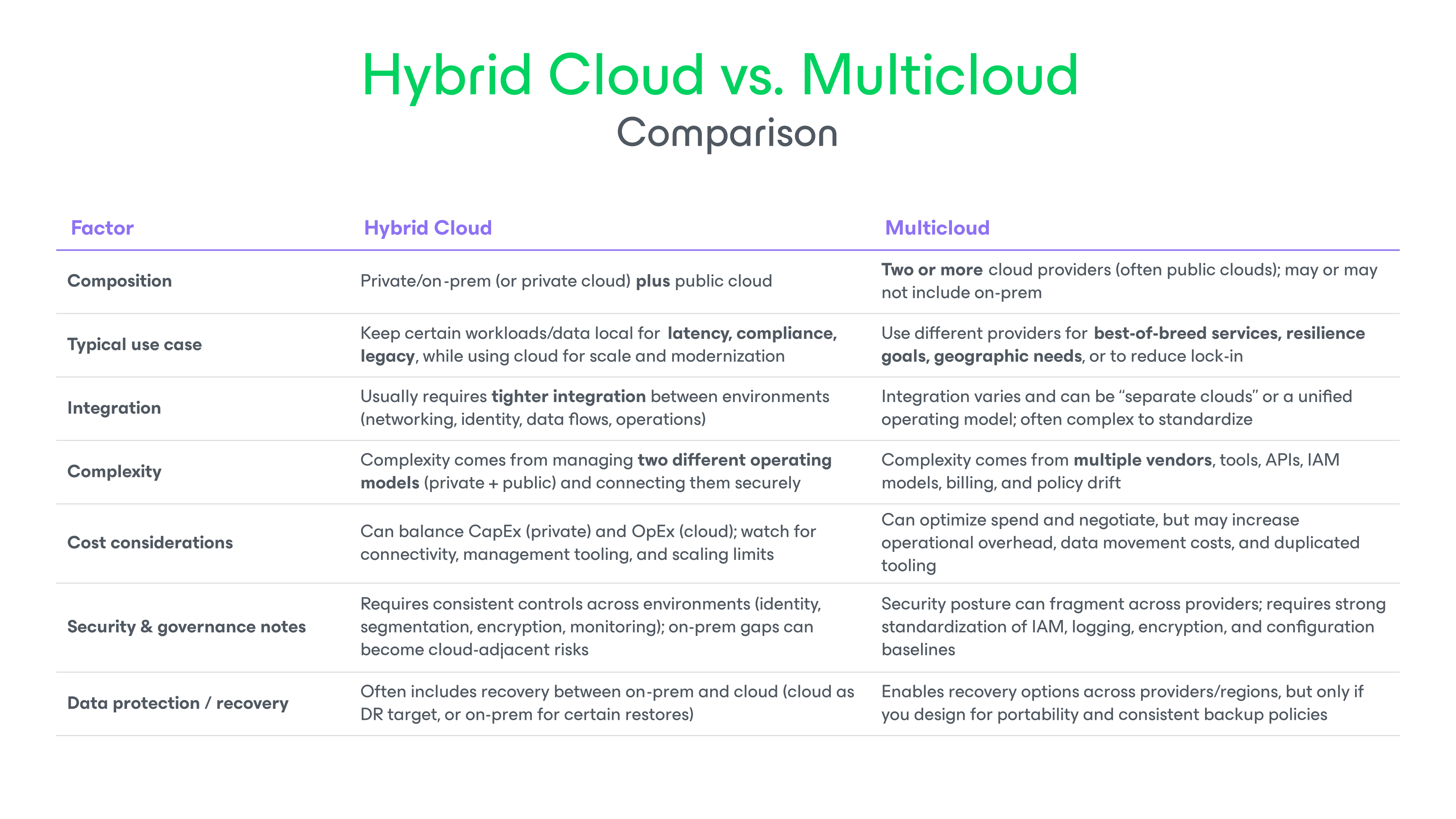
Bottom line: Choose hybrid cloud when you need to blend on‑premises/private with public cloud for practical constraints or phased modernization. Choose multicloud when provider flexibility, regional reach, or best-of-breed services are primary drivers, and be prepared to invest in maintaining operational consistency across clouds.
Pros and Cons of Hybrid Cloud
Hybrid cloud can be a great “best of both worlds” approach but it only pays off when you’re prepared to operate two environments with consistent security, governance, and recovery practices.
Pros of hybrid cloud:
- Enhanced security and control for sensitive workloads: You can keep regulated or high-sensitivity data in a private environment while still using public cloud services where and when they make sense.
- Optimized cost for steady vs. burst workloads: Run predictable workloads on existing infrastructure and “burst” to the cloud for spikes, instead of overbuilding the data center.
- Flexibility in workload placement and modernization: Hybrid supports gradual modernization: Move the right apps first, integrate what must stay on-premises, and avoid forced migration timelines.
- Lower latency for local data: Keeping data or key systems close to users, plants, or branch locations can reduce latency and improve performance consistency.
- Gradual cloud adoption (less disruption): It’s often the most realistic path when legacy systems, specialized hardware, or organizational constraints make an all-in cloud move impractical.
Cons of hybrid cloud:
- Complex implementation and integration: Networking, identity, access control, and data movement across environments can be difficult to design and easy to misconfigure.
- Ongoing maintenance of two operating models: You’re effectively managing two stacks (tooling, patching, monitoring, and skills) without doubling your team size.
- Cost overhead and hidden expenses: Connectivity, management tooling, and duplicated controls can add cost, especially if data movement grows over time.
- Potential reliance on a single public cloud vendor: Many “hybrid” deployments still standardize on one primary cloud provider, which can limit flexibility later unless you plan for portability.
- Broader security surface area: More platforms, endpoints, and identity paths mean more to secure and more places for policy drift to creep in.
Pros and Cons of Multicloud
A multicloud approach can increase flexibility and reduce dependency on any single provider. It also introduces real operational complexity. The key is to treat multicloud as an intentional strategy, not just a byproduct of growth.
Pros of multicloud:
- Avoid vendor lock-in (and choose best-fit services): You can select the cloud services that best match each workload instead of forcing everything into one provider’s model.
- Resilience and uptime options: Spreading workloads and recovery plans across providers can reduce concentration risk, though it only works if you design and test for failover and recovery.
- Competitive pricing and cost optimization: Multiple vendors can give you leverage and more options for optimizing compute, storage tiers, and commitments.
- Global footprint flexibility: Various providers have different regional strengths, which can help with latency, customer experience, and regional requirements.
- Access to faster innovation: Teams can adopt new capabilities where they’re strongest (analytics, AI, or managed databases, for example) without waiting for parity elsewhere.
Cons of multicloud:
- Complex management and skills gap: Each cloud has its own identiy access management (IAM) models, tooling, APIs, and operational patterns, requiring broader expertise and stronger standardization.
- Integration and data consistency challenges: Keeping networking, identity, and data flows consistent across clouds can be difficult, especially as architectures evolve.
- Higher operational overhead (including storage costs): Duplicated tools and controls, along with the effort to run consistent policies across clouds, can raise day-to-day costs.
- Security and compliance complexity: Posture can fragment across providers, increasing the chance of misconfiguration or uneven enforcement of encryption, logging, and access controls.
- Network costs and latency: Data movement between clouds can be slow and expensive (ingress and egress fees, plus cross-cloud transfers), which can directly impact recovery speed and cost predictability.
Hybrid vs. Multicloud: How to Choose
The right model depends less on what’s “better” and more on what your business and workloads actually require. Use the checklist below to pressure-test your direction. And remember that many organizations evolve to hybrid multicloud over time (on‑premises plus more than one cloud), even if they don’t start there.
Decision Checklist (Use This to Pick a Strategy)
- Do you have legacy systems or on‑premises dependencies you can’t move yet? If yes, hybrid cloud is often the most practical path while you modernize gradually.
- Is avoiding reliance on a single cloud provider a top priority? If yes, lean toward multicloud (plan for portability and consistent governance from day one).
- Do you have strict compliance, residency, or sovereignty requirements? If some data must stay in a specific location or under tighter control, hybrid can help keep those workloads private while still using public cloud where allowed.
- How integrated do your apps and data need to be across environments? Hybrid typically needs a tighter integration between private and public resources; multicloud often requires stronger standardization to avoid fragmentation.
- What are your recovery objectives (RTO/RPO) and resilience requirements? If fast, predictable recovery is non-negotiable, prioritize environments that simplify restores and reduce dependency on cross-cloud transfers.
- Do you have the staff and skills to operate multiple platforms? If your team is lean, starting with hybrid or single-cloud and expanding deliberately can be safer than jumping straight into multicloud complexity.
- What’s your cost model, especially data movement and operational overhead? Multicloud can increase ingress, egress, tooling, and management costs; hybrid can carry overhead in running two environments and the connectivity between them.
- How will you apply consistent data protection across locations? A good litmus test is whether you can still follow proven resilience guidance like 3-2-1-1-0 (multiple copies, different media/locations, one offsite, one immutable/offline, and zero restore errors through verification).
How Veeam Supports Hybrid and Multicloud Environments
Whether you’re running workloads on-premises, in a single public cloud, or across multiple providers, the goal is the same: Keep your data protected, recoverable, and portable, without adding more complexity. Veeam helps organizations build data resilience for hybrid and multicloud by simplifying backup and recovery operations and strengthening security controls across mixed environments.
Key Ways Veeam Helps:
- Centralized backup and recovery operations
Standardize protection policies and day-to-day management so your team isn’t reinventing processes for each platform or location. - Portability and flexible recovery options
Support recovery scenarios that matter in hybrid and multicloud (restoring data quickly after an outage, accidental deletion, or a cyber incident). - Security and compliance support
Strengthen protection with controls that help reduce the risk of backup tampering and improve audit readiness (e.g., stronger access practices, protected repositories, and recovery verification). - Monitoring, reporting, and operational visibility
Improve visibility into protection status and risks so you can catch gaps earlier and validate that backups are meeting business requirements.
Running hybrid and multicloud environments shouldn’t mean accepting more security gaps or slower recovery. Get the Veeam Security Advantage for Hybrid and Multicloud guide to learn how to reduce risk, strengthen backup security, and recover with confidence, across on‑premises and every cloud you use.
FAQs
Is multicloud the same as hybrid cloud?
No. Hybrid cloud combines on‑premises/private infrastructure with public cloud, while multicloud means using two or more cloud providers. An organization can be both at the same time.
What are the challenges of managing a multicloud environment?
The biggest challenges are operational complexity, inconsistent security and governance, skills/tooling sprawl, and higher costs from data movement and duplicated controls.
Can I use both hybrid and multicloud together?
Yes, many organizations run a hybrid multicloud model, such as keeping sensitive workloads on‑premises while using AWS and Azure for different applications, regions, or recovery targets.
What is hybrid multicloud?
Hybrid multicloud is an environment that includes on‑premises/private infrastructure plus services from multiple public cloud providers, managed with consistent policies for security, operations, and recovery.
Which is better for disaster recovery: Hybrid cloud or multicloud?
Either can work, but the best choice depends on your RTO/RPO, data size, and network constraints. What matters most is having tested restores, secure backup repositories, and a design that avoids slow or expensive recovery paths.
Does multicloud automatically improve resilience?
Not by itself. Multicloud can reduce concentration risk, but resilience only improves when you implement portable recovery plans, consistent security controls, and regular recovery testing across environments.
