


Key Takeaways:
- Public sector cybersecurity requires a shift from simple defense to full cyber resilience, ensuring government agencies and defense organizations can recover rapidly after any cyberattack or disruption.
- Aligning security programs with proven frameworks such as the NIST Cybersecurity Framework, ISO 27001, and the CIA Triad strengthens compliance and operational readiness.
- Implementing immutable backups, recovery testing, and Zero Trust access controls significantly reduces the impact of ransomware and insider threats.
- Veeam Data Platform supports government IT and security teams with framework aligned solutions that protect critical data across on-premises, cloud, and hybrid environments.
- Continuous validation, clear recovery plans, and automated testing are the foundation of a resilient cybersecurity posture for public sector organizations.
Public sector agencies operate in one of the most complex threat environments in the world. Every day, government IT and security teams defend critical systems, such as citizen record databases and defense networks, against adversaries and ransomware campaigns.
Cybersecurity in the public sector must focus on resilience — the ability to recover quickly and maintain mission‑critical operations under any circumstance. Before we talk about advanced cyber strategies, we need to get the fundamentals right: The CIA Triad of confidentiality, integrity, and availability. These principles extend through modern data protection platforms that deliver immutable backup, verified recovery, and federal‑grade compliance.
This guide explores how government agencies and defense organizations can apply cybersecurity best practices to protect data, reduce risk, and ensure business continuity. Throughout, we will also demonstrate how Veeam Data Platform helps make those principles operational across hybrid and multi‑cloud environments.
Current Cybersecurity Threat Landscape
Government and defense networks are under constant pressure from cyber adversaries that seek to exploit aging infrastructure, vulnerable supply chains, and sensitive citizen data.
The public sector’s responsibility to maintain uninterrupted services — from emergency communications to national defense — makes cybersecurity and data protection mission critical priorities.
Top Cybersecurity Threats to Public Sector Agencies
- Ransomware and data exfiltration
Attackers encrypt or steal government data to disrupt services and demand payment. Regular backup verification and immutable storage are essential to neutralize the impact of ransomware. - Insider threats and credential abuse
Unauthorized access or misused credentials that often bypass perimeter defenses.
Implement least privilege policies and continuous monitoring to detect abnormal activities. - Supply chain and third party risks
Vendors and contractors introduce external vulnerabilities into government systems.
Use verified integrations that are compliant with frameworks like SOC 2 and ISO 27001. - Cloud misconfigurations and shadow IT
As agencies modernize, cloud permissions and configurations can expose data unintentionally. Enforce Zero Trust principles and automated configuration auditing across all environments. - AI‑driven attacks and social engineering
Malicious actors use AI to scale phishing campaigns and impersonate trusted sources. Combine advanced threat detection with verified data recovery to protect mission continuity.
Emerging Threats and Trends
The next wave of public sector cybersecurity challenges is already forming:
- AI and machine learning exploitation: Automated attacks that adapt in real time.
- Supply chain transparency: Pressure to validate vendor security practices.
- Quantum computing risks: Preparing encryption standards for post‑quantum security.
- Data sovereignty mandates: Government enforcing in country data residency and control.
- Cyber insurance requirements: Proof of immutable backups and tested recovery now required for coverage.
Key Principles for Public Sector Cybersecurity
Strong cybersecurity in the public sector is built on clear frameworks and fundamental security principles. Government agencies should start with the basics of frameworks like NIST, ISO 27001, and the CIA Triad of confidentiality, integrity, and availability. Now, let’s take a closer look at the key principles of public sector cybersecurity.
The CIA Triad: Confidentiality, Integrity, and Availability
The CIA Triad provides guiding principles for any cybersecurity framework and a practical guide for protecting government systems.
It defines the three core goals of public sector cybersecurity: protect data confidentiality, maintain integrity, and ensure availability for citizen and defense services.
- Confidentiality: Safeguard sensitive data from unauthorized access or exposure.
Governments handle some of the most sensitive information in existence, from personally identifiable information (PII) to classified defense data.
Encryption, access segmentation, and multi‑factor authentication (MFA) are non‑negotiable. - Integrity: Ensure data accuracy and prevent unauthorized changes.
Integrity loss through ransomware, human error, or insider tampering can cripple trust in public systems. - Availability: Maintain uninterrupted access to systems and data.
For agencies, downtime halts essential services. Whether it’s an attack or infrastructure failure, it’s critical to keep systems available.
Framework Alignment: Building Resilience Through Standards
Public sector cybersecurity starts with governance and standards.
Frameworks give agencies a common language for assessing risk, responding to incidents, and protecting mission critical data. They transform cybersecurity from a series of reactive actions into a disciplined, measurable practice that supports compliance and operational continuity.
For U.S. government and defense agencies, framework adherence is not optional. It’s a mandate driven by federal policies such as Executive Order 14306: Sustaining Select Efforts to Strengthen the Nation’s Cybersecurity, the Federal Information Security Modernization Act (FISMA 2014), and the Office of Management and Budget (OMB) Memorandum M‑22‑09, which requires agencies to adopt Zero Trust architecture by 2027.
These directives emphasize a shift from perimeter defense to continuous verification, which is exactly the mindset frameworks like NIST CSF, ISO 27001, and SOC 2 are designed to support.
Core Frameworks That Shape Government Cyber Resilience | |
| NIST Cybersecurity Framework (CSF) | Developed by the National Institute of Standards and Technology, the NIST CSF defines five key functions: Identify, protect, detect, respond, and recover. It’s used by nearly every federal agency as the foundation for cyber risk management. The framework’s modular design allows agencies to integrate emerging practices like Zero Trust and continuous monitoring into existing workflows. |
| ISO 27001 | The international standard for Information Security Management Systems (ISMS). ISO 27001 provides a globally-recognized structure for setting policies, monitoring controls, and auditing compliance. Many defense contractors and public sector partners use ISO 27001 certification to demonstrate data protection maturity across supply chains. |
| SOC 2 | Focused on trust principles like security, availability, processing integrity, confidentiality, and privacy. SOC 2 validation ensures service providers and cloud vendors meet consistent security expectations before interacting with government data. |
Together, these frameworks help agencies quantify risk, benchmark maturity, and ensure interoperability across complex ecosystems of contractors, cloud providers, and inter‑agency systems. For greater transparency, Veeam documents and updates our compliance status in our Trust Center.
Bridging the Modernization Gap
Despite policy mandates for Zero Trust and cloud adoption, many government agencies are navigating the complex process of modernizing their infrastructure. This often involves transitioning from legacy hardware and data protection systems, some of which date back to the 1990s and early 2000s, while adopting new cloud technologies.
That modernization gap introduces risk, but it also presents an opportunity for cyber transformation. This ongoing journey reflects the dedication of government IT teams as they balance operational needs with modernization goals — and Veeam is here to help.
Moving to modern data platforms like Veeam allows agencies to upgrade security without sacrificing control or compliance.
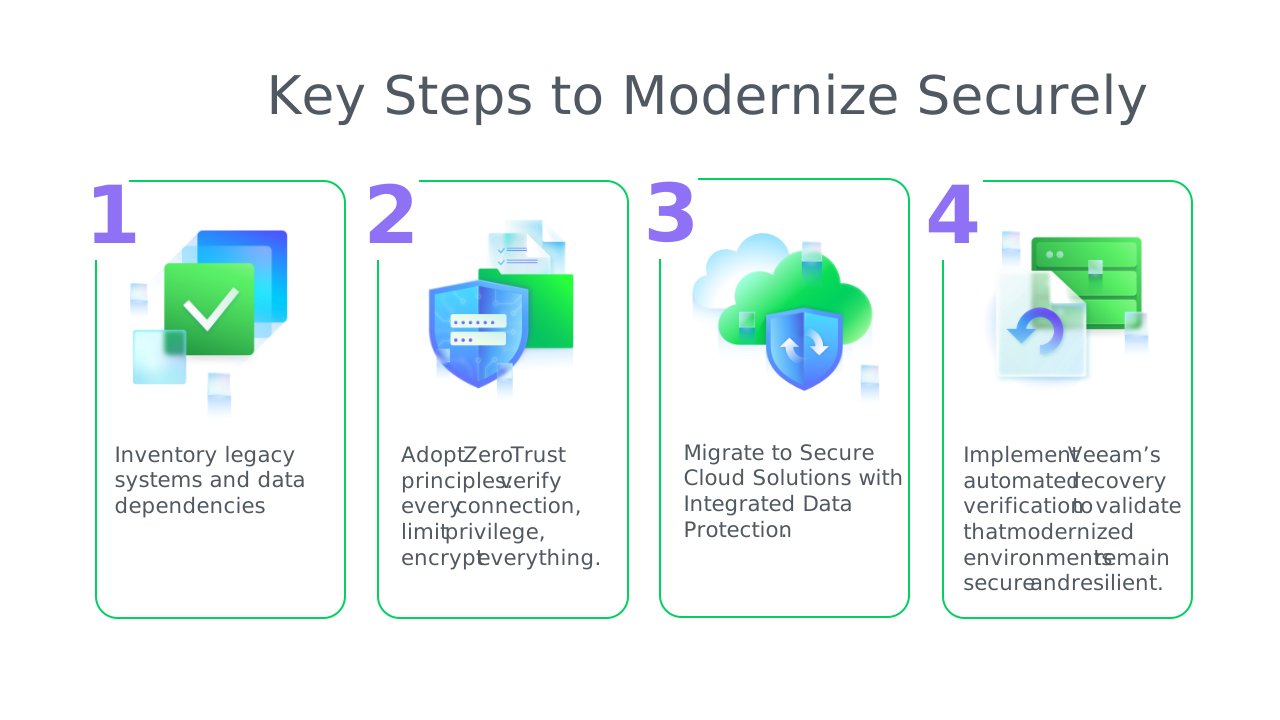
Key Steps to Modernize Securely
Modernization in the public sector includes eliminating technical debt without introducing new security risks. Government agencies often operate mission critical systems which were built decades ago, with complex data dependencies and outdated recovery processes. Transitioning to modern platforms must therefore combine security by design, compliance, and operational continuity.
The following steps outline a structured path agencies can follow to modernize securely while preserving data integrity and mission readiness.
1. Inventory Legacy Systems and Data Dependencies
Modernization begins with visibility. Before an agency can migrate, retire, or refactor anything, it needs a living inventory of its legacy applications, infrastructure, and data stores. Agencies also require a clear view of which of those systems are truly mission-critical versus simply “still running.” That inventory should capture ownership, support status, where the system runs (on-premises, cloud, hybrid), and what data it holds (sensitivity/classification, system-of-record status, and recovery requirements such as recovery point objectives (RPOs)/ recovery time objectives (RTOs).
Equally important is mapping data dependencies and flows that can silently break modernization efforts, including batch jobs, file transfers, APIs, message queues, shared databases, identity/authentication dependencies, and integrations with external partners or contractors. Many modernization failures happen when a legacy system isn’t retired, and it’s just discovered late as a dependency. Documenting these relationships early helps agencies prioritize risk, plan secure migration paths, and avoid unintended outages during cutovers.
2. Adopt Zero Trust Principles Across Modernization Projects
Zero Trust is now a core requirement for modernization. OMB Memorandum M‑22‑09 sets government-wide Zero Trust objectives and timelines that move agencies away from perimeter-based assumptions toward continuous verification of identity, devices, applications, and data. The key is to treat Zero Trust as an architecture and operating model that must be incorporated into modernization projects from the start and supported by multiple technologies and partners, rather than a single tool you “add on” later. Key Zero Trust principles include:
- Verify every connection: No network traffic or identity is inherently trusted; every request is authenticated and authorized.
- Limit privilege: Apply least privilege access and segment administrative roles to reduce lateral movement during attacks.
- Encrypt everything: Use end-to-end encryption for data in transit and at rest, including backup repositories and cloud storage.
Modernization projects that embed Zero Trust from the start inherently reduce risk.
Veeam Data Platform reinforces these principles through role-based access control (RBAC), MFA, and immutability, ensuring that even backup data cannot be modified or deleted without explicit authorization.
3. Migrate to Secure Cloud Solutions with Integrated Data Protection
Modern cloud environments should not only host data but also provide native backup, replication, and recovery capabilities. Veeam Data Platform integrates directly with AWS GovCloud, Azure Government, and leading FedRAMP-authorized partners, enabling hybrid or multi-cloud architectures that maintain consistent protection and compliance across all platforms.
4. Implement Veeam’s Automated Recovery Verification to Validate Resilience
Modernization is only successful if the new environment can recover rapidly and reliably.
Testing backups manually or sporadically is a valuable place to start; however, it is ultimately unsustainable and insufficient for mission critical systems.
Veeam’s automated recovery verification continuously validates the integrity and recoverability of backups across virtual, physical, hybrid, and cloud environments.
This automation confirms that every recovery point meets defined recovery time objectives (RTOs) and recovery point objectives (RPOs), key metrics in frameworks such as NIST SP 800‑34: Contingency Planning Guide for Federal Information Systems.
By operationalizing recovery validation, agencies gain measurable assurance that modernization efforts not only enhance performance but also strengthen resilience and compliance.
Backup and Disaster Recovery for Public Sector
In the public sector, recovery speed and data integrity define mission success.
When a breach, outage, or ransomware event occurs, agencies must restore critical systems within defined recovery time objectives (RTOs) and recovery point objectives (RPOs) without compromising data authenticity or compliance.
Disaster recovery (DR) and business continuity (BC) aren’t optional safeguards; they are mandated components of every federal and defense cybersecurity framework.
These disciplines ensure that essential services, from emergency communications to defense logistics, remain operational even under attack or infrastructure failure.
BEST PRACTICES FOR PUBLIC SECTOR DR/BC | |
| Apply the 3‑2‑1‑1‑0 rule with verified immutability | Maintain three copies of every data set, stored on two different media types, with one copy off‑site and one in an immutable repository. The final “zero” means zero backup errors after verification, achieved through Veeam’s automated recovery verification that validates the integrity of every restore point. |
| Establish continuous recovery testing | Move beyond annual tabletop exercises. Implement quarterly, automated recovery drills using Veeam’s verification tools. Automated testing replaces assumption with evidence, giving agency leadership measurable confidence in resilience. |
| Integrate instant recovery and replication for rapid service restoration | Combine Veeam Instant Recovery with replication to meet the most stringent federal RTOs. If a cyber event does disrupt operations, workloads can be spun up directly from backup images in minutes, ensuring continuity of operations (COOP). |
| Document, validate, and report recovery procedures | Maintain complete documentation of recovery workflows, SLAs, and verification results. |
Implementing Veeam Solutions in Government Agencies
Translating cybersecurity frameworks into daily operations requires platforms that are both technically robust and compliance ready.
For government agencies and defense organizations, Veeam Data Platform provides the foundation for that operational resilience, aligning with NIST CSF and Zero Trust mandates while simplifying backup, recovery, and compliance management across hybrid environments.
Veeam’s architecture is designed for secure modernization. It bridges legacy infrastructure and cloud-first strategies with immutable storage, automated recovery verification, and granular access control.
Step‑by‑Step Implementation Framework
- Assess current infrastructure and risk exposure
Begin with a full inventory of mission systems, data repositories, and inter‑agency integrations.
Map assets to the NIST CSF functions: Identify, protect, detect, respond, and recover.
This establishes a baseline for modernization planning and highlights gaps in recovery readiness.
Veeam’s DRMM and Quick Pulse features provide organizations with real-time visibility and automated monitoring to quickly assess and address recovery gaps as they’re identified. - Deploy Veeam Backup & Replication within FedRAMPauthorized environments
Veeam integrates natively with AWS GovCloud, Azure Government, and on-premises government data centers,
providing data protection and audit mechanisms that help agencies maintain continuous security requirements guide (SRG) compliance and Zero Trust readiness. - Implement immutable and air gapped storage policies
Configure immutable repositories and, where applicable, air gapped storage tiers to prevent ransomware modification or deletion of backups.
Veeam’s Object Lock capability enforces write once, read many (WORM) immutability for compliance. - Automate recovery testing and verification
Use Veeam’s automated recovery verification to validate backup integrity and confirm that workloads can be restored within required RTO/RPO thresholds.
Test results are logged automatically, producing audit-ready reports for compliance frameworks. - Integrate disaster recovery (DR) orchestration and Instant Recovery
Deploy Veeam Recovery Orchestrator to automate failover sequences and documentation.
Combine with Instant Recovery to restore entire virtual machines (VMs), databases, or NAS shares directly from backups, minimizing operational downtime and ensuring continuity of operations (COOP). - Monitor, report, and continuously improve
Leverage Veeam ONE for advanced monitoring, capacity planning, and predictive analytics. Use insights from performance dashboards to refine policies, optimize recovery times, and proactively address vulnerabilities before they impact mission delivery.
Operational Benefits for Government and Defense
- Verified recoverability: Automated testing ensures backups are always restorable and compliant.
- Ransomware resilience: Immutable storage and air‑gap design protect data from encryption or deletion.
- Compliance alignment: Audit friendly reporting simplifies meeting NIST, Cybersecurity Maturity Model Certification (CMMC), and Zero Trust requirements and compliance.
- Operational continuity: Instant Recovery and Veeam Recovery Orchestrator keep critical services running, even when cyberattacks strike.
- Modernization enablement: Supports migration from legacy systems to secure hybrid or multi‑cloud architectures without risk to data integrity.
Take the Next Step
Ensure your agency is ready to withstand and recover from any cyber incident.
See how federal, state, and defense agencies are using Veeam Data Platform to build trusted, resilient, and compliant data protection strategies that keep missions moving forward.
FAQs
How can government agencies improve their cybersecurity posture?
Government agencies can strengthen cybersecurity by aligning with NIST CSF and ISO 27001 frameworks, adopting Zero Trust architecture, and maintaining immutable backups that are verified regularly.
What is the difference between DR and business continuity in the public sector?
DR focuses on restoring systems and data after a cyber incident, while business continuity ensures essential services remain operational during and after disruption.
What are the top cybersecurity risks for defense agencies today?
Defense agencies face rising risks from ransomware, supply chain compromise, AI-driven espionage, and insider threats targeting classified data.
Implementing Zero Trust controls, along with immutable backups and continuous recovery validation using Veeam Data Platform, helps agencies mitigate these threats and protect mission critical assets.
How does Veeam enhance Zero Trust architecture in government networks?
Veeam Data Platform enforces least privilege access, MFA, and segmented backup repositories that support Zero Trust principles.
Each restore operation is verified and audited, providing agencies with the controls and evidence needed to address CISA’s Zero Trust Maturity Model and OMB M2209 requirements.
How often should agencies test their DR plans?
Best practice recommends testing recovery plans quarterly and after any major system change.
What role does Veeam Data Platform play in government modernization initiatives?
As agencies migrate from legacy infrastructure to hybrid or multi cloud environments, Veeam Data Platform provides the secure data protection layer that preserves compliance and continuity.
It supports U.S. government operations in FedRAMP-authorized cloud environments, including Azure Government and AWS GovCloud (U.S.). Agencies can modernize with verified disaster recovery across hybrid and cloud workloads, in line with broader federal modernization priorities around resilience and continuity.

