


Key Takeaways:
- A risk management framework provides a structured approach to identifying, assessing, mitigating, and continuously monitoring organizational risk.
- NIST frameworks are widely recognized as the industry gold standard for security best practices. Regulations and standards around the world follow NIST recommendations.
- Data resilience is central to effective risk management and ensuring critical data remains protected, compliant, and recoverable in any scenario.
- Implementing a risk management framework successfully requires clear ownership, cross‑team alignment, and a focus on people, processes, and technology.
Risk is an unavoidable reality for every organization, whether it comes from cyberattacks, regulatory changes, operational failures, or natural disasters. A risk management framework gives businesses a proven structure to reduce risk by identifying vulnerabilities, implementing controls, and monitoring their effectiveness over time. The most widely adopted model, the NIST Risk Management Framework, breaks this process into clear, repeatable steps that align with global compliance standards and industry best practices.
Yet even the strongest framework is incomplete without data resilience, or the ability to protect, detect threats, and recover access to critical information no matter what happens. That’s where Veeam strengthens the equation. By mapping our capabilities directly to the functions of a risk management framework, we help organizations reduce risk, ensure business continuity, and meet compliance requirements.
What is a Risk Management Framework?
Definition and Purpose
A risk management framework is a structured process for identifying, assessing, mitigating, and continuously monitoring risk across an organization’s people, processes, and technology. It provides a repeatable methodology for making informed decisions about how to safeguard sensitive data and critical infrastructures against threats ranging from cyberattacks, to compliance failures and natural disasters.
The most widely recognized model is the NIST Risk Management Framework, which consists of seven core steps: Prepare, Categorize, Select, Implement, Assess, Authorize, and Monitor. This approach encourages organizations to assume that risks are always present and to embed risk management into day‑to‑day operations rather than treating it as a one‑time project.
The purpose of having a risk management framework is twofold:
- Proactive defense: Anticipate and reduce vulnerabilities before they can be exploited.
- Resilient recovery: Ensure there is a tested and documented plan to respond quickly and effectively when incidents occur.
Key Benefits
Implementing an RMF gives you measurable advantages across multiple areas of your business, including:
- Operational continuity: Maintains the availability of critical systems and services even during disruptive events.
- Compliance alignment: Meets regulatory mandates and industry standards by documenting and verifying security controls.
- Financial integrity: Reduces the risk of costly downtime, fines, and reputational damage.
- Legal protection: Demonstrates due diligence in protecting customer, employee, and partner data.
- Cyber resilience: Integrates prevention, detection, and recovery capabilities to protect your data and keep it recoverable.
By embedding risk management framework principles into your organization, you create a stronger, more adaptable security posture that can evolve alongside emerging threats and regulatory changes.
Core Components of the NIST Risk Management Framework
The NIST Risk Management Framework provides a systematic, repeatable process for managing risk. While the full model includes seven steps, four core components form the foundation of effective implementation and can directly influence an organization’s cyber resilience. Let’s take a closer look at them.
Risk Identification
Risk identification is the process of investigating and recognizing potential threats to your organization’s assets, systems, and data. This includes external risks, such as cyberattacks and supply chain vulnerabilities, as well as internal risks, like misconfigurations or insider threats.
Following NIST guidance, organizations should:
- Have an inventory of all digital assets, systems, data repositories, and interconnections.
- Identify critical assets based on business impact and prioritize recovery.
- Consider operational, compliance, reputational, and financial risk categories.
Veeam reinforces this step by centralizing your data visibility. Our monitoring and reporting tools help you know exactly where your critical data resides, how it flows, and where vulnerabilities may exist. It’s a prerequisite for any effective risk management framework.
Risk Assessment
Risk assessment evaluates the likelihood and impact of identified threats. NIST recommends analyzing both qualitative factors (e.g., reputational harm) and quantitative measures (e.g., potential financial loss).
Key elements include:
- Assigning risk levels based on probability and severity.
- Prioritizing risks that threaten critical business functions.
- Incorporating compliance mandates, such as HIPAA, data sovereignty, or GDPR requirements.
Veeam supports accurate risk assessment by verifying recoverability through automated testing. Knowing which systems can be restored within recovery time objectives (RTOs) and recovery point objectives (RPOs) ensures realistic risk scoring and prioritization.
Risk Mitigation
Risk mitigation involves selecting and implementing controls to reduce the likelihood or impact of identified risks. In the NIST Risk Management Framework, this corresponds to the “Select” and “Implement” phases, where organizations choose security measures and document how they’re deployed.
Examples of mitigation strategies:
- Network segmentation and access control.
- Immutable backup storage to prevent ransomware encryption or deletion.
- Encryption to protect data confidentiality.
- Role‑based permissions to limit exposure.
- Four-eyes authorization controls.
- Multi-factor authentication (MFA).
Veeam’s immutable storage, logical air‑gapping, and secure role‑based access controls (RBAC) directly map to NIST’s implementation and authorization phases to reduce risk across backup and recovery environments.
Continuous Monitoring
Continuous monitoring ensures risk management controls remain effective over time. NIST emphasizes ongoing assessment, incident detection, and rapid response to emerging threats.
Best practices include:
- Real‑time alerts for anomalies or failed backups.
- Regular reviews of control effectiveness.
- Updating your risk management framework documentation as systems, regulations, or threats change.
Veeam enables continuous monitoring with centralized dashboards, automated alerting, and compliance reporting to ensure that your data protection controls remain aligned with your risk management framework requirements and evolving business needs. New GenAI-based capabilities that integrate with Veeam environments take IT and security team monitoring and assistance to the next level with contextual information, deeper insights and recommendations to protect, detect and recover effectively.
With these four components in place and supported by the right technology, organizations can create a dynamic, resilient risk management strategy that adapts to change and ensures data remains protected, compliant, and recoverable.
Veeam and the Risk Management Framework
Data Resilience
Being cyber resilient means you can recover quickly, completely, and securely when incidents inevitably occur. Veeam’s data resilience offerings are built on the principle that your backup and recovery environment must be as secure and resilient as your production systems.
This approach extends beyond traditional data protection by integrating:
- Prevention: Secure configurations, network segmentation, and immutable backups to block unauthorized changes.
- Detection: Continuous monitoring, anomaly alerts, malware, and ransomware detection tools that identify issues before they spread.
- Recovery: Verified, orchestrated restores that meet your RTOs and RPOs.
- Adaptation: Ongoing testing, reporting, and updates that keep pace with evolving threats and compliance requirements.
This philosophy aligns directly with the NIST Risk Management Framework’s emphasis on preparation, implementation, assessment, and continuous monitoring. This approach integrates your data protection strategy into your overall risk management posture.
How Veeam Complements Risk Management Frameworks
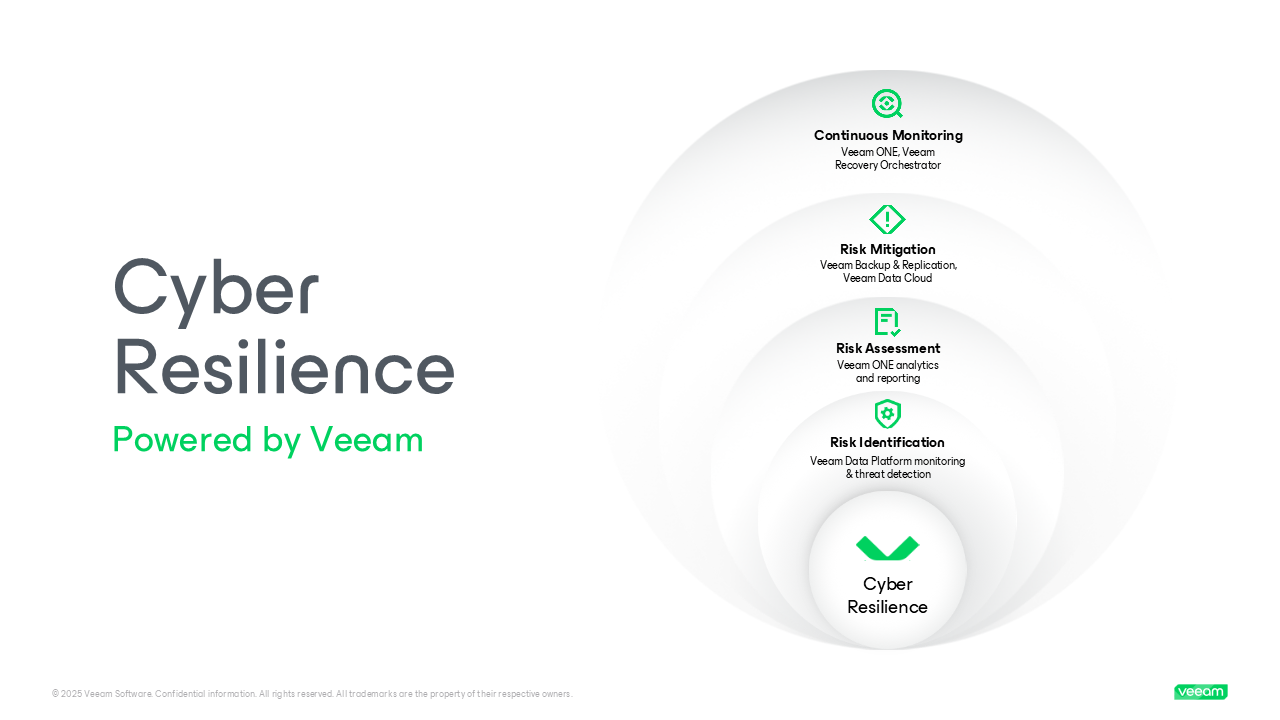 Veeam’s capabilities align with every stage of the NIST Risk Management Framework, turning compliance requirements into actionable, tested processes that strengthen cyber resilience. By combining Secure‑by‑Design architecture, Zero Trust principles, and deep integration with the broader security ecosystem, Veeam helps organizations not just meet risk management framework guidelines, but thrive under them.
Prepare and Categorize
- Security & Compliance Analyzer automates checks to ensure your backup environments meet defined policies.
- Veeam ONE dashboards provide real‑time visibility into backup health, compliance status, and security posture.
- Asset inventory and classification features, including data tagging and classification tools, help prioritize protection for the most critical workloads.
- Veeam Intelligence, a machine learning and natural language processing assistant, provides in-product operational statuses and guidance, including security best practices.
Select an Implement Controls
- Immutable backup storage and logical air‑gapping prevent ransomware encryption or deletion.
- Encryption in transit and at rest protects sensitive data while meeting regulations including GDPR and data sovereignty mandates.
- Guided recovery workflows in Veeam Recovery Orchestrator streamline plan creation and ensure repeatability.
Assess and Authorize
- Multi‑Factor Authentication (MFA) and four‑eyes authorization enforce least‑privilege access.
- SureBackup automated verification confirms backups are recoverable within your RTOs and RPOs.
- The security officer role in Veeam Data Platform maps directly to NIST Risk Management Framework’s “Authorize” step by providing formal approval for recovery operations in compliance‑driven environments.
Monitor and Detect
- Threat Center delivers real‑time alerts for anomalies, malware, or suspicious activity.
- Recon Scanner identifies suspicious behavior and maps it to known adversary TTPs to alert and prevent cyberattacks.
- Inline scanning with entropy analysis, including AI-powered in-process encryption detection and text artifacts for dark web links and ransom notes.
- IoC Tools Scanner expands the hunt for Indicators of Compromise (IoC) by spotting tools used by threat actors, ranging from exfiltration to credential dumping tools.
- Veeam Threat Hunter, a best-in-class machine learning and heuristic analysis signature-based backup scanner that’s designed to detect millions of malware variants.
- Seamless integration with SIEM and SOAR platforms extend monitoring to the broader security infrastructure.
Respond and Recover
- Clean room restores ensure isolated recovery environments are free from malicious code.
- Instant Recovery brings critical systems online within minutes, while Veeam Data Cloud Vault provides out‑of‑the‑box immutable backups that are ready for restoration.
- Veeam Intelligence, a built‑in AI assistant, delivers in‑product guidance on security best practices and recovery steps.
- Through the Veeam Cyber Secure program and Coveware Cyber Extortion Readiness & Response Retainer, organizations gain access to world‑class expertise in ransomware negotiation and recovery, which is a unique capability in the data resilience market.
Proof of Trust and Compliance
Veeam backs its platform capabilities with transparency and verifiable compliance through Veeam Trust Center, a dedicated resource hub where customers can access security attestations, compliance certifications, and “Secure by Design” principles. This portal reinforces Veeam’s commitment to risk management, helping organizations meet risk management framework requirements with confidence in both their technology and vendor integrity.
Implementing a Risk Management Framework in Your Organization
Steps to Get Started
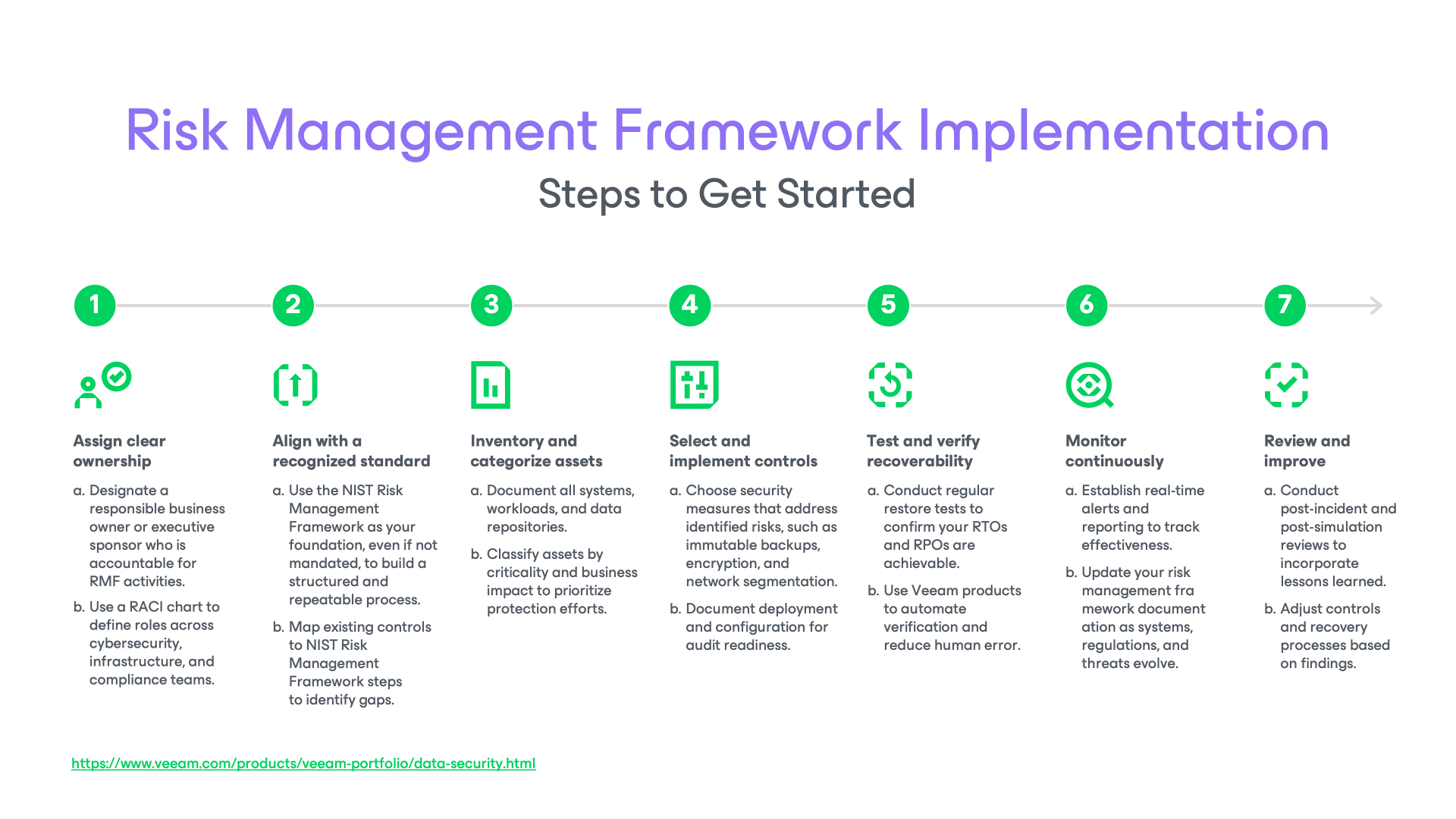
Implementing a risk management framework is not a one‑time project. It’s an ongoing commitment to security, compliance, and operational resilience. Following NIST guidelines, here’s a practical roadmap to get started:
Common Pitfalls to Avoid
Even well‑intentioned RMF initiatives can fail if certain issues aren’t addressed. SMEs identified the following common pitfalls:
- Lack of ownership: Without a designated accountable leader, risk management framework activities lose momentum and focus.
- Siloed teams: Cybersecurity and infrastructure teams often work in isolation, which creates gaps in coverage and communication.
- Incomplete asset inventory: You can’t protect what you don’t know you have. Missing systems or data repositories leave blind spots behind.
- Neglecting data resilience: Failing to plan for recovery is as risky as ignoring prevention. Risk management frameworks must include tested backup and restore capabilities.
- Static documentation: A risk management framework that isn’t updated regularly quickly becomes irrelevant in a changing threat landscape.
- Overlooking compliance requirements: Ignoring regulatory mandates like GDPR or data sovereignty can lead to costly fines and legal exposure.
By integrating immutable storage, automated recoverability testing, centralized monitoring, and compliance reporting, Veeam helps organizations avoid these pitfalls while keeping their risk management framework aligned with best practices and evolving threats.
Veeam is implemented and audited successfully in every type of compliance scenario around the world, for everything ranging from banks to hospitals and government agencies. Our flexibility to integrate into any governance, risk, and compliance (GRC) environment makes Veeam a natural complement to your risk management framework by reducing operational, legal, and reputational risk.
Ready to Put Your Risk Management Framework Into Action?
A strong risk management framework is only as effective as your ability to recover clean, compliant data when it matters most.
Download our free whitepaper, Building a Cyber‑Resilient Data Recovery Strategy, and discover how to integrate immutable backups, rapid restores, and continuous monitoring into your resilience plan. Learn proven strategies to protect against ransomware, meet compliance, and keep your business running.
Related Resources
- Whitepaper: Veeam Data Cloud for Microsoft 365 Technical White Paper: A Deep Dive into Architecture, Security and Compliance
- Whitepaper: Ransomware Recovery: A Comprehensive Guide
FAQs
A risk management framework is a structured process for identifying, reducing, and monitoring cybersecurity risks. The NIST Risk Management Framework is the most recognized model that guides organizations through preparation, control selection, implementation, and continuous improvement.
The NIST Risk Management Framework has seven steps: Prepare, Categorize, Select, Implement, Assess, Authorize, and Monitor, which provides a repeatable process to manage risk across your systems and data.
The NIST Risk Management Framework is a full risk management process that’s often used in regulated and federal environments to obtain authorization to operate. The NIST Cybersecurity Framework provides specific controls and guidance on every area of security. Recommendations are built around five functions: Identify, Protect, Detect, Respond, Recover.
The NIST Risk Management Framework is a methodology for managing security risks. ISO 27001 is a certifiable international standard for running an Information Security Management System (ISMS). The Risk Management Framework isn’t certifiable but aligns well with ISO practices.
A risk management framework doesn’t stop ransomware directly. Rather, it ensures your organization can respond quickly, recover clean data, and limit damage through asset visibility, tested backups, and continuous monitoring.
In the U.S., a risk management framework is required for federal agencies and many public sector organizations. In the private sector, it’s optional but highly recommended to improve compliance readiness and resilience.
