

TL;DR
- Compliance is now a core requirement for Kubernetes operations as regulated data moves into containerized and cloud‑native environments.
- Regulations like GDPR, HIPAA, and PCI DSS demand verifiable protection, recovery, and auditability across Kubernetes clusters.
- Open‑source tools often fall short when it comes to automation, audit logging, and policy enforcement.
- Veeam Kasten for Kubernetes delivers policy‑based compliance, FIPS 140‑3 encryption, role-based access control (RBAC), and immutable storage for resilient protection.
- Compliance enhances resilience, governance, and trust, turning regulatory readiness into a competitive advantage.
Kubernetes, an open‑source platform that automates the deployment, scaling, and management of containerized applications, has become the engine of modern application delivery. It powers everything from financial services to healthcare and government workloads. As organizations scale their container environments, Kubernetes compliance has evolved from a regulatory obligation into a strategic pillar of data resilience and trust.
Regulations such as GDPR, HIPAA, and PCI DSS demand verifiable data protection across dynamic, distributed systems. However, compliance in Kubernetes is complex. Workloads are transient, data moves between clusters and clouds, and manual controls often fail to meet audit requirements.
To navigate this challenge, you need solutions that combine policy automation, encryption, access control, and immutable storage which need to be validated against recognized frameworks like ISO/IEC 27001, NIST CSF, and FIPS 140‑3.
Veeam Kasten for Kubernetes delivers exactly that: A platform that’s designed to simplify compliance while strengthening your operational resilience. It transforms backup and recovery from just a technical safeguard into a verifiable compliance control that enables organizations to protect, govern, and recover data confidently across hybrid‑cloud environments.
Why Compliance Matters in Kubernetes Environments
Kubernetes platforms host regulated and sensitive data, including personally identifiable information (PII), financial transactions, and health records.
This makes Kubernetes compliance essential. Regulations such as GDPR, HIPAA, and PCI DSS require organizations to prove:
- How data is stored
- How it’s protected
- How it can be recovered
In containerized environments, where workloads are dynamic and distributed, you need automated policy enforcement and continuous validation to meet these standards.
Compliance also strengthens cyber resilience. By implementing auditable controls like encryption, RBAC, and immutable backups, teams reduce vulnerability to ransomware and accidental data loss. Verified recoverability becomes a measurable outcome of both security and regulatory readiness.
Compliance in Kubernetes is about ensuring that critical data remains secure, traceable, and recoverable no matter where it resides or how it scales.
Understanding Regulated Data Types
Compliance frameworks exist to protect different categories of sensitive information, each with distinct legal and operational requirements. In Kubernetes environments, you need to understand these data types in order to design effective security and recovery controls.
Let’s take a closer look at these data types:
- Personally Identifiable Information (PII): Includes names, contact details, and identification numbers governed by privacy laws such as GDPR and CCPA. Kubernetes clusters processing PII must support encryption, access control, and audit logging to prove lawful handling.
- Financial data: Transactions, payment credentials, and account details regulated by PCI DSS and SOX. These require strict key management, network segmentation, and verified recovery processes to prevent fraud or unauthorized disclosure.
- Health data: Protected under HIPAA and similar healthcare regulations worldwide. Compliance requires data integrity, encryption at rest and in transit, and secure backup strategies to maintain patient confidentiality.
- Customer and operational data: Includes application telemetry, usage analytics, and service logs that may contain sensitive business information. Retention and deletion policies must align with contractual and jurisdictional requirements.
- Government and public sector data: Subject to national data sovereignty laws and frameworks such as FedRAMP, DORA, and NIS2, which emphasize operational autonomy, access control, and verified resilience.
Mapping these data types to corresponding compliance frameworks ensures that Kubernetes security policies, from encryption and RBAC to backup and recovery, address both regulatory and business obligations.
Mapping the Compliance Landscape
There are three major categories of compliance that are relevant to Kubernetes operations:
- Sensitive data protection
- Secure development and governance
- Secure transmission and cryptography
Together, they define the standards that modern organizations must meet.
Sensitive Data Protection
Frameworks such as GDPR, HIPAA, and PCI DSS set strict expectations for privacy, consent, and data integrity.
- GDPR requires verifiable control of personal data processing, retention, and recovery.
- HIPAA mandates encryption and audit trails for protected health information (PHI).
- PCI DSS establishes secure handling of payment and financial data through encryption, key management, and access control.
In Kubernetes, these translate into automated policies for data classification, encryption, and immutable backups that can demonstrate compliance under audit.
Secure Development and Governance
Frameworks like ISO/IEC 27001, ISO/IEC 27701, NIST Cybersecurity Framework (CSF), and MITRE ATT&CK define how information systems should be managed and monitored for security and compliance.
- ISO/IEC 27001 outlines governance for data security and business continuity.
- NIST CSF provides a structure for identifying, protecting, detecting, responding to, and recovering from incidents.
- MITRE ATT&CK maps adversarial behavior and informs proactive countermeasures.
By aligning your organization’s Kubernetes policies with these frameworks, you can standardize access control, implement RBAC, and automate compliance reporting.
Secure Transmission and Cryptography
Modern compliance frameworks also require validated cryptographic standards to protect data in transit and at rest.
- FIPS 140‑3 governs the use of approved encryption algorithms and modules in government and regulated environments.
Veeam Kasten for Kubernetes leverages FIPS 140‑3‑validated encryption libraries when deployed on compliant environments, ensuring data confidentiality and integrity across clusters and backup targets. Combined with immutable storage through Veeam Data Cloud Vault and other S3‑compatible targets, your organization can prove adherence to both cryptographic and resilience requirements.
Enforcement and Audit
Data Protection Authorities (DPAs) and regulators enforce these frameworks through audits and breach reporting mandates. Kubernetes environments must demonstrate traceability, showing where data resides, how access is controlled, and how recovery is validated.
By grounding compliance strategies in these frameworks, your organization creates a unified governance model for Kubernetes, one that not only satisfies regulatory demands but also builds measurable resilience and trust.
Why Open‑Source Tools Fall Short
Open‑source backup and recovery tools have long supported Kubernetes adoption, offering flexibility and cost efficiency for developers and platform teams. However, when it comes to Kubernetes compliance, these utilities often fail to meet the rigorous demands of regulated environments.
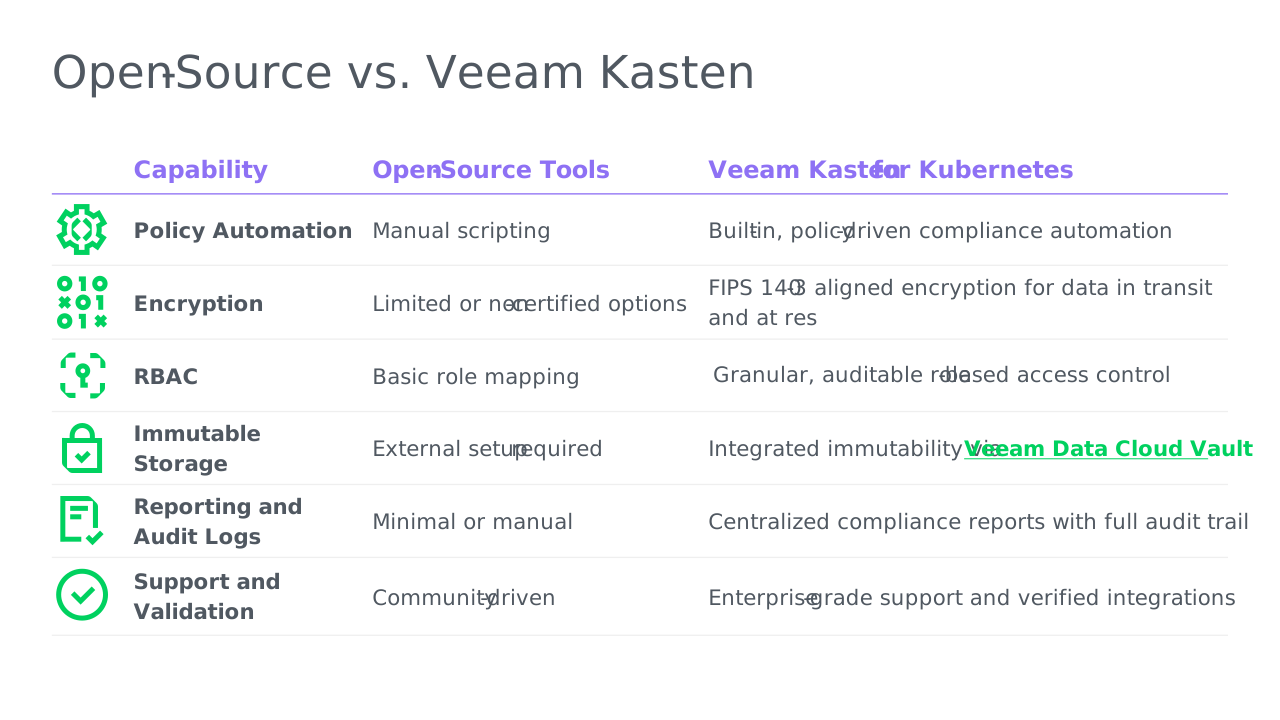
Here are five main recurring gaps that prevent open‑source solutions, such as Velero, from achieving enterprise‑grade compliance:
- Limited auditability: Most open‑source tools lack centralized audit logs and reporting capabilities. Without verifiable records of backup, restore, and access events, organizations cannot prove compliance to auditors or regulators.
- Insufficient RBAC: Basic permissions models do not provide the granular governance required under frameworks like ISO/IEC 27001, GDPR, or HIPAA. This increases the risk of unauthorized access and data movement across clusters.
- No validated encryption or FIPS alignment: Open‑source projects typically rely on default encryption libraries that are not certified under FIPS 140‑3, leaving compliance gaps for government and financial workloads.
- Manual compliance verification: Achieving and maintaining compliance with open‑source tooling demands extensive customization, scripting, and manual documentation which diverts time and resources from strategic resilience initiatives.
- Lack of enterprise support and integration: Without guaranteed support or tested integrations with SIEM, IAM, and backup validation systems, open‑source tools struggle to provide the assurance required for regulated operations.
For organizations facing audit obligations or managing sensitive data, these limitations translate into measurable compliance risk. The result is a growing shift toward commercial, policy‑driven solutions that embed auditability, encryption, and automation by design.
How Veeam Kasten Enables Kubernetes Compliance
Achieving compliance in Kubernetes depends on automation, auditability, and verifiable recovery. Veeam Kasten for Kubernetes is purpose‑built to meet those requirements, translating regulatory controls into measurable, repeatable outcomes.
| Policy‑Based Automation and Auditability | Compliance frameworks such as ISO/IEC 27001 and NIST CSF emphasize continuous control enforcement. Veeam Kasten automates this through declarative, policy‑driven workflows that define backup frequency, retention, encryption, and verification. All backup, restore, and policy operations are logged, creating an immutable audit trail that demonstrates compliance during inspections or certifications. |
| Encryption Aligned with FIPS 140‑3 | To meet cryptographic standards for government and financial sectors, Veeam Kasten supports FIPS 140‑3‑compliant encryption modules. These protect data in transit and at rest across clusters, ensuring the confidentiality and integrity of sensitive information such as PII, PHI, and financial records. |
| Granular Recovery and Namespace‑Level Restores | Regulations including GDPR and HIPAA require the ability to recover specific applications or datasets without affecting unrelated workloads. Veeam Kasten enables granular, namespace‑level recovery, allowing teams to restore only what’s necessary while preserving compliance boundaries and minimizing downtime. |
| RBAC Enforcement and Secure Access Control | RBAC is central to compliance frameworks from ISO 27001 to PCI DSS. Veeam Kasten integrates with Kubernetes native RBAC, enforcing least‑privilege access and preventing unauthorized operations on backup repositories and clusters. |
| Continuous Monitoring and SIEM Integration | For ongoing compliance verification, Veeam Kasten provides monitoring APIs and integrates with leading SIEM platforms. This enables centralized visibility into backup activity, anomaly detection, and incident correlation, ensuring security and compliance teams can demonstrate proactive governance. |
| Immutable Cloud Storage via Veeam Data Cloud Vault | The whitepaper emphasizes immutability as a cornerstone of compliance and ransomware resilience. With Veeam Data Cloud Vault, backups are stored in tamper‑proof, air‑gapped repositories. This ensures data cannot be deleted or modified within the retention period, meeting mandates for data integrity under DORA, NIS2, and HIPAA. |
| Alignment with Key Compliance Frameworks | Veeam Kasten’s architecture and operational model aligns with industry and regulatory standards, including: • ISO/IEC 27001 & 27701 – Information security and privacy management. • NIST CSF – Identify, protect, detect, respond, recover. • FIPS 140‑3 – Validated encryption. • GDPR / HIPAA / PCI DSS – Data protection, access control, and audit readiness |
From Compliance to Resilience
By embedding compliance controls directly into Kubernetes workflows, from FIPS‑aligned encryption and RBAC to immutable backups, your organization can turn regulatory requirements into everyday safeguards.
Veeam Kasten for Kubernetes helps you to automate these controls, proving recoverability and strengthening trust across regulated industries.
When compliance becomes part of your resilience strategy, every backup, restore, and audit log serves as evidence of readiness, ensuring your Kubernetes environments stay secure, compliant, and confidently recoverable.
Explore how Veeam Kasten for Kubernetes simplifies compliance and builds resilient operations across hybrid‑cloud environments.
FAQs
1. What is Kubernetes compliance and why does it matter?
Kubernetes compliance is the practice of aligning containerized workloads with security, privacy, and data‑protection regulations such as GDPR, HIPAA, and PCI DSS. It ensures that sensitive data in clusters is encrypted, traceable, and recoverable, maintaining both regulatory readiness and operational trust.
2. Which regulations apply to Kubernetes environments?
Depending on the data type and industry, organizations may fall under frameworks such as GDPR, HIPAA, PCI DSS, ISO/IEC 27001, NIST CSF, and FIPS 140‑3. Each introduces requirements for encryption, access control, auditability, and verified data recovery within Kubernetes.
3. Why are open‑source tools not enough for compliance in Kubernetes?
Most open‑source backup tools lack enterprise controls like centralized audit logs, granular RBAC, or validated encryption. Achieving compliance often requires manual documentation and custom integrations, increasing risk and complexity compared to policy‑driven platforms such as Veeam Kasten for Kubernetes.
4. How does Veeam Kasten support Kubernetes compliance?
Veeam Kasten automates compliance through policy‑based backups, FIPS‑aligned encryption, immutable cloud storage, and detailed audit logging. It aligns with standards including ISO 27001 and NIST CSF, helping organizations prove recoverability and maintain continuous compliance across hybrid‑cloud deployments.
5. What is immutable storage and how does it help meet compliance requirements?
Immutable storage prevents data from being modified or deleted within a defined retention period. This ensures backup integrity, supports ransomware recovery, and satisfies regulatory expectations for data preservation and auditability under frameworks such as DORA, HIPAA, and NIS2.
