
Key takeaways
- Data protection is its own layer in an AI reference architecture, not a backup afterthought bolted onto governance.
- Published architectures end at governance, which controls who can touch data but can’t undo what they did.
- AI systems mostly fail through authorized but incorrect writes, from agent deletions to poisoned training data.
- Protection must cut across sources, RAG, model serving, and governance, with recovery points scoped to each.
- Strong governance reduces how often you’ll need recovery. It never removes the need for it.
You’ve seen this diagram before: data sources, a vector store, orchestration, model serving, and governance wrapped around it all. The question is what it’s missing before you present or approve your own.
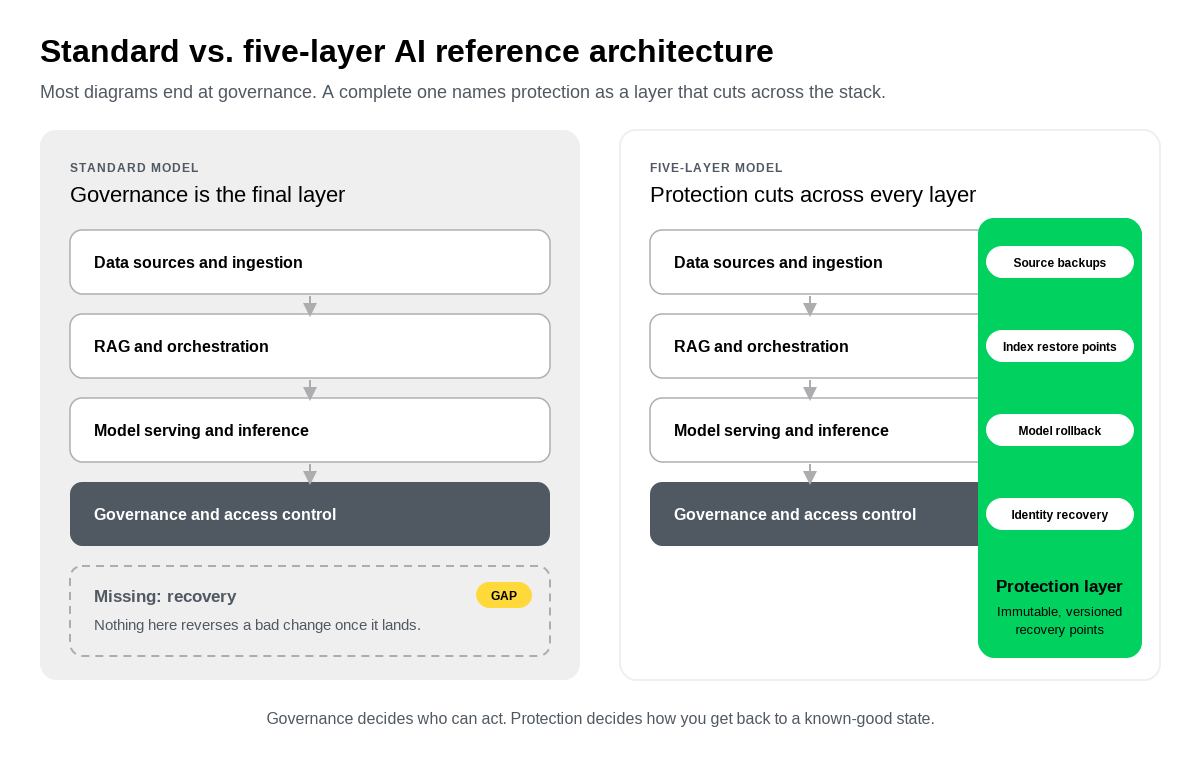
An AI reference architecture is the layered blueprint that shows how data, models, and agents connect, and where control is enforced at each boundary. Nearly every published version ends at governance. But governance decides who can act. Recovery decides what happens after an action goes wrong, and that layer is usually missing.
And that gap is measurable. In Veeam’s Data and AI Trust Gap research, only 40% of leaders said they’re very confident they could isolate and precisely reverse the damage from an agentic AI failure. This guide names protection as its own layer and maps it to controls you can evaluate.
What every published AI reference architecture gets right, and where it stops
The standard model earns its place. Most enterprise AI platform architecture diagrams converge on the same four layers because they separate concerns cleanly, map to zero-trust access principles, and give auditors the documentation trail they expect. Here’s the AI system architecture you’ve almost certainly seen:
- Data sources and ingestion: Structured, unstructured, and streaming data entering through connectors and embedding pipelines.
- Retrieval-augmented generation (RAG) and orchestration: The vector store, retrieval, and the agent frameworks that decide what context to fetch and which tools to call.
- Model serving and inference: Foundation and fine-tuned models behind APIs or inference servers, often on Kubernetes.
- Governance and access control: Identity, permissions, policy enforcement, and audit logging across everything above.
Governance is the right answer to who can touch what. It’s the wrong tool for what comes after. Once an agent, pipeline, or compromised identity has altered or destroyed something, an access policy can’t put it back, and an audit log can only explain how it happened.
The widely circulated reference architectures each tackle a real concern, from data residency to gateway-level access control to lifecycle threat mapping. Recovery typically doesn’t appear as a structural layer in any of them, or it’s folded into “storage” and left to operations.
The layer every reference architecture skips: Recovery
AI systems don’t fail the way traditional software fails. A failing AI system often keeps running while an agent corrupts a data source, a RAG pipeline serves bad content to every query, or a fine-tuning run bakes poisoned data into model weights.
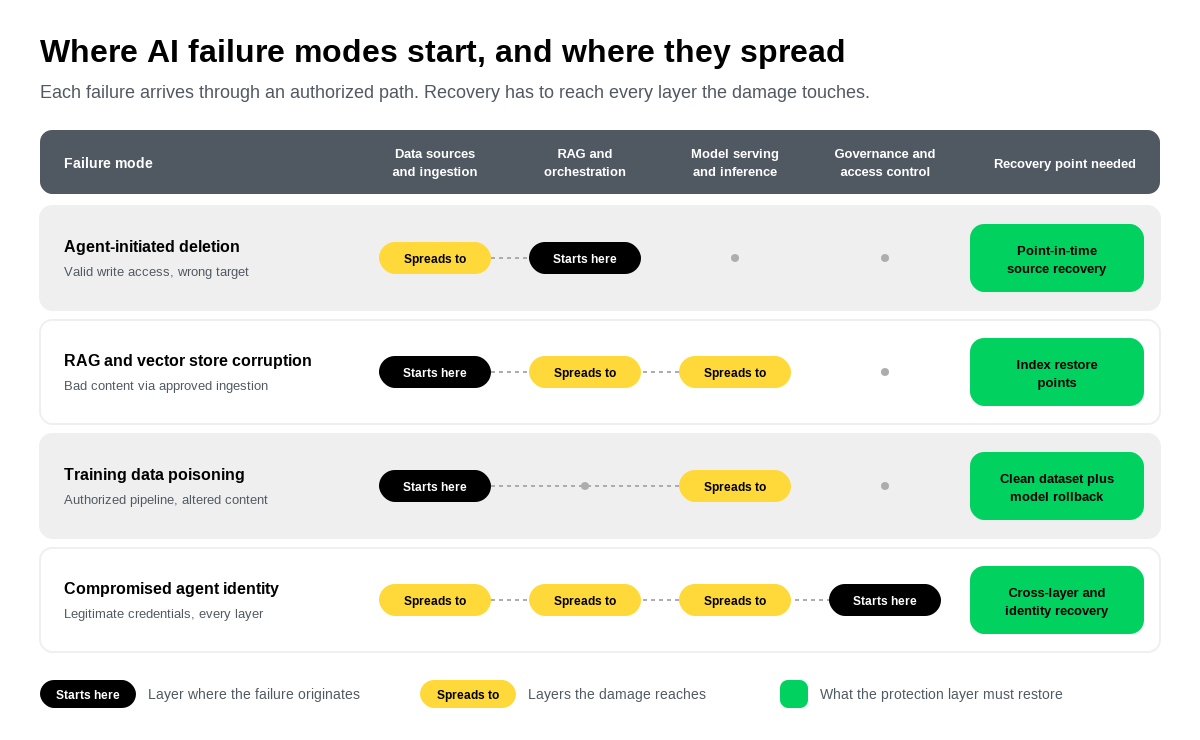
These failures share one trait: they arrive through authorized paths. We call this the authorized-but-incorrect write. Access controls and audit logs tell you who acted and what changed, but neither can undo the change. That’s why securing the data AI systems depend on is only half the job. Recovery that isn’t designed as its own layer tends to get improvised during an active incident.
| Failure mode | Why governance alone doesn’t fix it |
| Agent-initiated corruption or deletion | Valid write access means policy allowed the action. Scoping limits the blast radius but can’t reverse it. |
| RAG and vector store corruption | Bad content entered through an approved ingestion path, and the error spreads to every query that retrieves it. |
| Fine-tuning and training data poisoning | Manipulated data arrived through an authorized pipeline. Governance catches unauthorized access, not subtly altered content. |
| Compromised identity with agent-level access | Legitimate credentials make every action look authorized. Audit logs record the damage across layers but can’t undo it. |
Agent-initiated data corruption or deletion
In any AI agent architecture, agents act on systems, not only on data. An agent with write access can alter or delete records while completing a legitimate-looking task, such as a bulk update that hits production because one scoping parameter was wrong. In July 2025, an AI coding agent on Replit’s platform reportedly deleted a live production database during a code freeze. The fix, separating development and production databases, came after the data was gone. Scoping shrinks the blast radius. Only point-in-time recovery undoes the action.
RAG and vector store corruption
A RAG pipeline amplifies whatever it indexes, so bad or injected content in the vector store spreads to every query that retrieves from it. Vector stores rarely get backup policies, because teams treat embeddings as data they can regenerate. Regenerating isn’t recovering: if the corruption came through the source path, a rebuild re-indexes the same problem. A versioned vector store turns “rebuild everything” into “roll back to the last known-good index.”
Fine-tuning and training data poisoning
Poisoned training data breaks nothing on entry and surfaces only once the fine-tuned model is in production, so detection lags the damage. Governance catches unauthorized access, not manipulated content from an authorized pipeline, which makes poisoning one of the LLM attacks that live beyond the model itself. Recovery means restoring a clean dataset and rolling back to a checkpoint that predates the poisoned run. If you can’t name the last clean checkpoint, you have a retraining plan, not a recovery plan.
Compromised identity with agent-level access
Agent credentials are a class of non-human identity that attackers prize, because agents often hold broader, longer-lived access than any human user. In one session, a compromised agent identity can touch data sources, the vector store, and model configuration, turning three risks into one coordinated incident where every action looks authorized. Recovery must span every layer and include identity and access state, so compromised credentials don’t survive the restore.
A reference architecture with data protection as a named layer
Here’s the structural change: five layers instead of four, with recovery cutting across the others instead of trailing at the end. That’s because every layer holds something that can be altered, corrupted, or deleted. It’s what separates an AI solution architecture that looks complete on a slide from one that holds up during an incident.
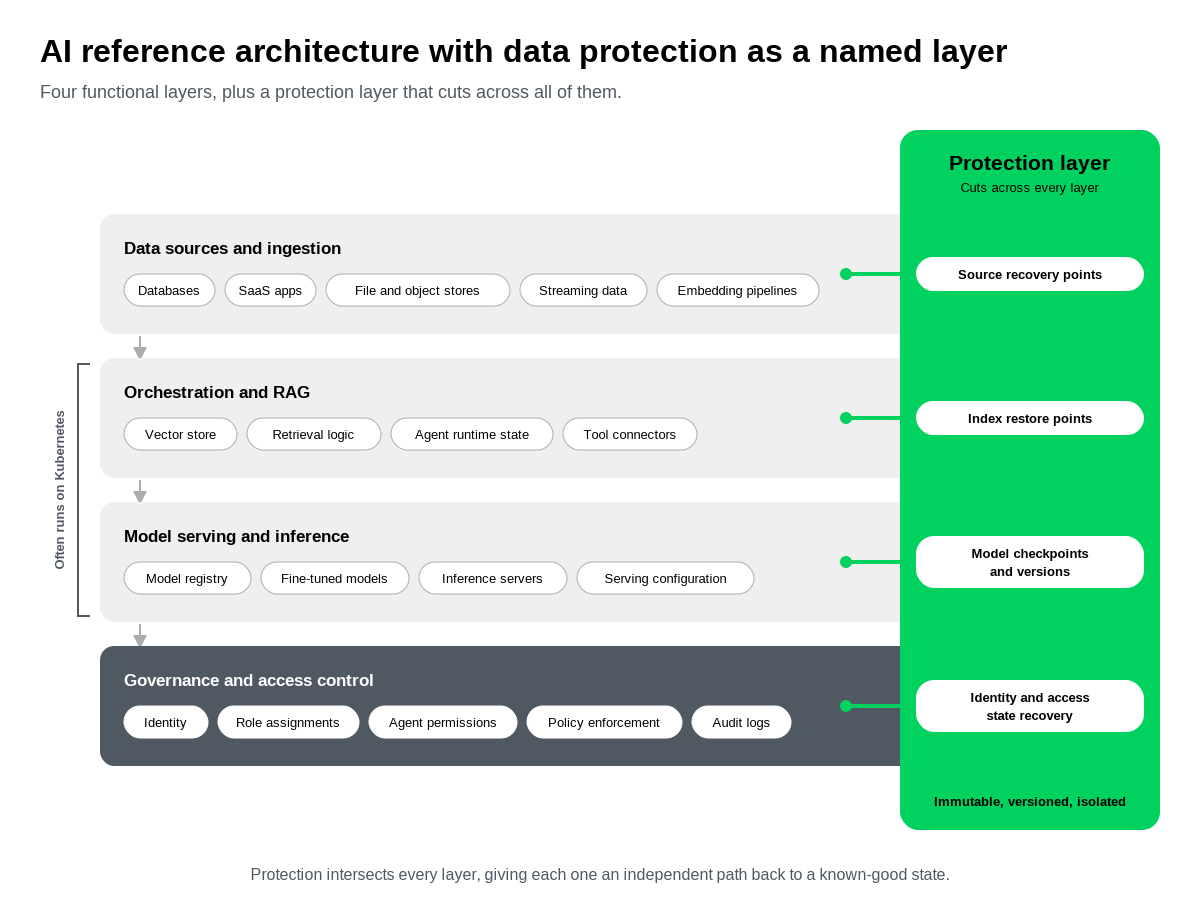
Data sources and ingestion. Protection starts here, because embeddings, indexes, and fine-tuned weights all inherit the state of their sources. Most AI data architecture problems begin here too.
Orchestration and RAG. The vector store, retrieval logic, and agent runtime state need recovery points separate from their sources, which change on different schedules.
Model serving and inference. In the AI server architecture of the stack, recovery means returning to a known model version: the checkpoint, its weights, and the serving configuration.
Governance and access control. Role assignments and agent permissions are state too, and a compromised identity can change them as easily as it changes data.
Protection. Immutable, versioned recovery points span every layer, giving each one an independent path back to a known-good state. Published architectures either omit this layer or fold it into “storage,” which holds bytes but defines no recovery points, owners, or guarantees. If your AI platform architecture lists storage but not recovery, that’s the gap.
| Layer | What must be recoverable | The question to ask in review |
| Data sources and ingestion | Source datasets and unstructured content at known-good points in time | Can we roll back one corrupted source without touching anything built on it? |
| Orchestration and RAG | Vector indexes, retrieval configuration, and agent runtime state | Can we restore the index independently of its sources? |
| Model serving and inference | Model checkpoints, weights, and serving configuration | Can we name and redeploy the last clean model version today? |
| Governance and access control | Identities, role assignments, and agent permissions | Can we unwind a compromised identity’s changes without reverting unrelated work? |
| Protection | The recovery points themselves, kept immutable and isolated | Could an agent or attacker with production access alter our backups? |
Mapping the protection layer to concrete controls
Here are the four controls the recovery layer needs to function. Use them to evaluate your own stack:
- Immutable, versioned backups for every data source. The usual gap is the unstructured content that feeds most RAG pipelines. Immutability keeps writers from altering backups, and versioning lets you roll back one source without touching what’s built on it.
- Point-in-time recovery for vector stores and RAG indexes. Keep it separate from source recovery, and treat the index as a protected asset, not a cache you plan to rebuild.
- Kubernetes-native protection for AI and ML workloads. Model serving and agent runtimes increasingly run on Kubernetes, so recovery has to be application-consistent, capturing data, configuration, secrets, and custom resources together.
- Recovery scoped to identity and access state. Backups of role assignments, service accounts, and agent permissions let you unwind a compromised identity without rolling back legitimate work.
Then apply one test: does each control recover faster than an agent can cause damage, and precisely enough to restore only what was affected? Speed without precision just restores the wrong thing faster.
How this differs from data governance and zero-trust AI security
Maybe you’re wondering if governance, or a zero-trust AI security model, already covers this? Governance and zero trust are preventive and detective: they decide who can act and verify every request. Protection is corrective: it gets you back to a known-good state after an action has already happened. Strong access control on a production database never removed the need for backups. Governance decides who gets the keys. Protection decides what happens after someone uses them wrong.
| Governance | Zero-trust AI security | Data protection | |
| Question it answers | Who is allowed to access what? | Is this request verified, right now? | How do we get back to a known-good state? |
| Control type | Preventive and detective | Preventive and detective | Corrective |
| When it acts | Before and during access, plus audit | On every request | After an action has changed or destroyed something |
| What it can’t do | Reverse an authorized but incorrect change | Stop a verified identity from making a bad change | Prevent the incident in the first place |
Established frameworks draw the same line:
- NIST AI RMF calls for procedures to respond to and recover from previously unknown risks (MANAGE 2.3).
- NIST CSF 2.0 gives recovery its own function, Recover.
- ISO/IEC 27001:2022 includes information backup as a control (Annex A 8.13), which ISO/IEC 27002:2022 classifies as corrective.
- The EU AI Act (Article 15) notes that for high-risk AI systems, robustness may be achieved through technical redundancy, including backup or fail-safe plans.
See how Veeam and Securiti AI support the NIST AI Risk Management Framework.
Where Veeam fits in this architecture
Veeam covers the recovery layer and the layers that feed it, not just a single point in the stack. As the Data & AI Trust Company, Veeam starts from one premise: an AI system is only as recoverable as the data and identity layers underneath it. Since acquiring Securiti AI, Veeam has been building at the intersection of data resilience, data security, and AI governance, so one platform can see the data, govern who touches it, and bring it back.
Here’s how that maps to the architecture:
- Data sources and unstructured content: Discovery and classification, so you know what’s feeding the AI system and what’s sensitive in it.
- Kubernetes-native workloads: Veeam Kasten provides application-consistent protection for model serving and agent orchestration, including blueprints for vector databases such as pgvector.
- The protection layer: Immutable, versioned recovery across data sources and vector data. Precision resilience on the DataAI Command Platform is designed to undo exactly what went wrong without rewinding the whole system.
See how Veeam DataAI Command Platform brings detection, protection, and precise undo together across every layer. Request early access. You can also read about AI-powered detection and data management in Veeam.
Most reference architectures show you who can change the data. This one shows you how to change it back.
Frequently asked questions
An AI reference architecture is the layered blueprint showing how data sources, orchestration and RAG, model serving, and governance connect, and where control is enforced at each boundary. Most published versions stop at governance and leave out recovery as a distinct layer.
A typical enterprise AI architecture has four layers: data sources and ingestion, orchestration and RAG, model serving and inference, and governance and access control. A complete architecture adds a fifth layer: a recovery layer that cuts across the other four with immutable, versioned restore points.
AI governance is preventive and detective: it defines who can access what and records that they did. Data protection is corrective: it restores a known-good state after something goes wrong. Mature governance reduces reliance on protection but doesn’t remove the need for it.
A RAG architecture diagram should show the vector store and retrieval layer as a recoverable component with its own versioning, not a pass-through between source data and the model. Otherwise, sources and indexes drift out of sync.
Agents with write access shift the risk from unauthorized reads to authorized but incorrect writes, which access control doesn’t fully solve. Orchestration and protection have to be designed together, with point-in-time recovery wherever agents can change data.
In a machine learning model architecture, data protection covers both the training data pipeline and versioned model checkpoints, so a poisoned fine-tuning run or corrupted model artifact can be rolled back to a known-good version instead of retrained from scratch.
They can, but conventional backup often skips vector stores and agent state because teams treat them as regenerable. Regenerating a vector index from a compromised source doesn’t recover it. It rebuilds the compromise. That’s why AI data needs purpose-built recovery.