
Every comparison of on-premises AI and cloud AI evaluates the same four things: Cost, latency, scalability, and control. Almost no one evaluates who restores the data when something breaks. That gap matters more than the comparison does, because on-premises AI (e.g., the full model lifecycle on infrastructure you own) and cloud AI (e.g., that same capability consumed as a service) both change where your data sits without changing who carries the recovery obligation.
This page won’t re-run that decision, which usually gets made above the person who operates the result. Rather, it covers what each model makes you responsible for, and the baseline that holds either way.
Key takeaways
- The standard on-premises versus cloud AI comparison omits recoverability, so a model gets chosen based on cost and latency with nobody owning restore.
- Every AI deployment creates four new data classes (e.g., vector stores, model artifacts, inference logs, agent action history) that no backup policy covers.
- Protection responsibility follows the data, not the infrastructure, so “the provider handles it” and “we own the hardware” misconceptions fail for the same reason.
- The protection line is missing from nearly every AI business case, and an uncosted requirement becomes unfunded, then unmet.
- Embeddings and models derived from regulated records inherit their source’s obligations, but most teams haven’t mapped which.
On-premises AI and cloud AI: What each one means for your data
The useful distinction to make isn’t who owns the servers. It’s where the model’s weights, training data, and inference traffic reside, because that determines which copies exist and what it takes to get them back.
- On-premises AI runs the full lifecycle inside infrastructure you own. This could be an on-premises AI server or GPU cluster in your own data center, with an on-premises AI platform over it. Most on-premises AI solutions exist because something about the data ruled out external processing.
- Cloud AI is consumed as a service, and the operational split matters more than the label. On a cloud-based AI platform running on rented cloud infrastructure for AI, you control the models and data but not the substrate. With cloud-based AI services reached through a hosted model API, you control neither, and your prompts sit under someone else’s retention terms.
- Hybrid is where most enterprises land, though few chose it. This includes training where GPUs are cheapest and infering where the latency is, assembled by accumulation rather than design.
The conventional comparison covers cost, scalability, latency, control, and staffing, all of which is documented elsewhere. What it never does is assign responsibility for backing up, recovering, or retaining what the AI system produces.
Comparison Factor | On-Premises AI | Cloud AI |
| Cost structure | Capital expenditure, front-loaded GPU spend | Operating expenditure, consumption-based |
| Scalability | Bounded by procurement cycles | Elastic, bounded by budget and quota |
| Latency and data gravity | Low, compute sits next to the data | Variable, depends on where data travels |
| Control and residency | Physical control of hardware and location | Contractual control, region selection |
| Staffing | Requires in-house MLOps and infrastructure skills | Shifts platform operations to the provider |
Who holds the recovery obligation | You | You |
The last row is the key finding. Every line above it is a real trade-off, but none of them changes who restores the data. The deployment model moves the workload, the bill, and the skills requirement, not the recovery obligation.
Every AI deployment creates four new data classes
An AI system doesn’t just read your data; it manufactures new data no backup policy anticipated. You can have flawless coverage of the repository that feeds a retrieval system and still hold no copy of the index that was built from it, the model that was tuned on it, or what the AI system did with either.
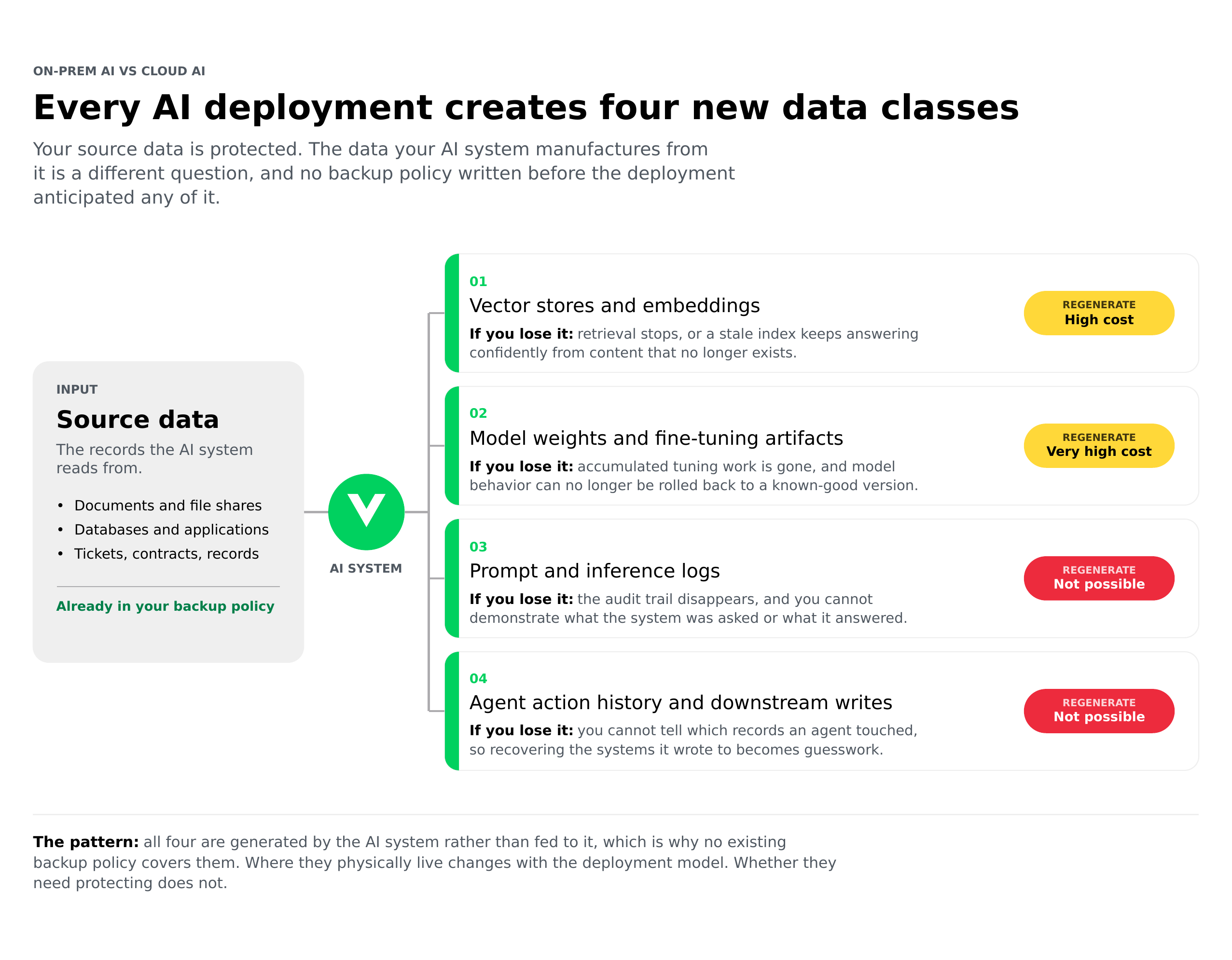
| Data class | What breaks if you lose it | Cost to regenerate |
| Vector stores and embeddings | Retrieval stops, or a stale index answers confidently from content that no longer exists | High. Includes the cost of re-embedding compute plus downtime, and only if the source corpus is intact |
| Model weights, checkpoints, and fine-tuning artifacts | Accumulated tuning work is gone and behavior can’t be rolled back | Very high. Full retraining, and only if the original training set still exists |
| Prompt and inference logs | The audit trail disappears and you can’t demonstrate what was asked or answered | Not possible. These can’t be reconstructed after the fact |
| Agent action history and downstream writes | You can’t tell which records an agent touched, so you can’t target a recovery | Not possible. Without it, recovering connected systems becomes guesswork |
Vector stores and embeddings
An embedding is the indexed, numerical representation of source content that makes retrieval possible, and the vector store is what a retrieval-augmented system queries. Teams treat it as disposable because it can be rebuilt from the source. That treatment fails in three ways:
- Compute. Re-embedding a large corpus is a real expense, not a background job.
- Downtime. Retrieval is degraded until the rebuild finishes.
- Drift. Source documents have been revised or deleted since the original run, so what you rebuild isn’t what you lost.
A partial restore is worse than an outage because it doesn’t look like one. An index that no longer matches the corpus returns confident answers from retired content, and nothing alerts. However, embeddings from regulated data may carry that sensitivity.
Model weights, checkpoints, and fine-tuning artifacts
A fine-tuned model isn’t a file you can redownload, it’s accumulated compute spend and proprietary work product, lost through mundane scenarios like a checkpoint corrupting mid-run, a production version overwritten by a staging deployment, or a training set that no longer exists. Versioning inside an ML platform is not backup, because it shares a failure domain with the platform holding it. Rollback matters here too: A degrading model keeps answering rather than failing visibly, so the version you need may be several revisions back.
Prompt and inference logs
This class accumulates fastest and is almost never scoped, because nobody creates it on purpose. It is both the audit trail a regulator will ask for and one of the most sensitive stores in your estate, since users paste source material straight into prompts.
- Volume. Production-scale logging outgrows naive retention within months, and a default nobody chose starts truncating the oldest entries.
- Dual obligation. Retain enough to prove what was asked and answered, without keeping sensitive content longer than policy allows.
- Hosted models. Retention follows the provider’s terms. That’s a contract question, not a configuration setting.
- Legal floor. Under the EU AI Act, logging is an obligation, not a best practice. Article 12 requires high-risk AI systems to record events automatically, and Article 26(6) requires deployers to keep those logs for at least six months.
See AI data security.
Agent action history and downstream writes
This is the newest class, and the one that conventional backup design handles the worst, because it isn’t really a store. Rather, it’s the record of what an autonomous system did to other systems, and the damage lands in the CRM, the ticketing system, and the database it was connected to. Restoring a system to a point before a bad agent ran discards every legitimate change made in the same window, which is why these incidents often end in manual cleanup. Knowing which records an agent touched is the prerequisite for recovery. See the Data Trust and Resilience Report.
What each deployment model makes you responsible for
Cloud teams assume the provider protects their data. On-premises teams assume owning the hardware means it’s covered. Both are wrong for one reason: Protection responsibility follows the data, not the infrastructure. The split below follows the published shared responsibility models from AWS, which assigns customer data to the customer, and Microsoft, whose AI agent model extends that explicitly to agent memory and vector stores in every deployment model.
| Responsibility | On-premises AI | Cloud AI | Hosted model API |
Physical infrastructure and hardware integrity | You | Provider | Provider |
Platform availability and uptime | You | Provider | Provider |
Storage durability against hardware failure | You | Provider | Provider |
Backup of vector stores and embeddings | You | You | You |
Backup of model weights and fine-tuning artifacts | You | You | Not available to you |
Retention of prompt and inference logs | You | You | Provider’s terms |
Recovery from deletion, corruption, or misconfiguration | You | You | You, where possible |
Reversing a bad agent run in connected systems | You | You | You |
Demonstrating recoverability to an auditor | You | You | You |
The top three rows are what a provider genuinely takes off your hands. Everything below stays with you in every column, and “not available to you” is not “covered.”
What cloud AI providers actually protect
The provider is responsible for the platform’s availability and integrity. You are responsible for the data inside it. That shared responsibility model hasn’t changed for AI services.
The distinction causing the most trouble is between platform durability and customer recoverability. A storage tier advertising 11 nines of durability promises your object won’t rot on a failing disk. It does not promise to return an object that you, a compromised account, or an agent with write access deliberately deleted. Default retention windows are measured in days or weeks and cannot meet a multi-year requirement. See cloud data protection.
What running it yourself does not automatically solve
The characteristic on-premises failure is a GPU cluster that was procured on a compressed timeline that never entered the backup scope covering the rest of the estate. Nobody decided to leave it out. No one was assigned to put it in. This is structural rather than negligent: AI infrastructure is often funded outside the normal lifecycle and handed to a team outside operations. The deeper conflation is between control and recoverability, since physical control satisfies residency requirements and says nothing about whether you can restore anything. See the data resilience maturity model.
Why hybrid multiplies the gap rather than splitting it
Hybrid is the production reality for most, and the intuition that it splits your exposure is backwards. Hybrid actually compounds it. The four data classes end up spread across environments with different tooling, different retention settings, and no single view of coverage. A partial recovery then returns a system that runs, working from a model restored to one point against an index restored to another. An outage announces itself, but this won’t. The requirement that follows is one protection policy that an span multiple environments. See hybrid cloud security and compliance.
The costs that never reach the AI business case
A standard AI business case contains compute, storage, licensing, and headcounts. It almost never contains a line for protecting what the deployment produces.
| Cost | Type | On-premises AI | Cloud AI | In the standard business case? |
Protected storage for four new data classes | Recurring | Capacity purchase and refresh | Monthly consumption | Rarely |
Extended retention for compliance | Recurring | Capacity plus media management | Tiered storage charges | Rarely |
Retaining training data per model version | Recurring | Capacity purchase | Tiered storage charges | Almost never |
Egress and retrieval during recovery | Event-driven | Largely internal | Billed per restore | Almost never |
Regenerating unprotected embeddings | Event-driven | GPU time plus downtime | Compute plus downtime | Almost never |
Recovery testing and documented verification | Recurring | Engineering time | Engineering time | Almost never |
Two stand out. Egress charges appear only during recovery, so they never reach a planning spreadsheet and land mid-incident. Recovery testing is underestimated most reliably, because the first attempt is where you find the dependencies nobody documented. All are real in both models, they’re just billed differently.
Regulated verticals: Where the decision is already made
For financial services, healthcare, and the public sector, the deployment question is frequently settled by obligation rather than preference, which is why the operational question matters more. One theme runs through all three: Regulators are increasingly interested in derivative artifacts, and most organizations have not mapped what those inherit.
- Derivation is not separation. An embedding generated from a regulated record is derived from it, and the location of the source does not determine the location of the derivative unless someone designed it that way.
- Sovereign infrastructure is not sovereign data. Region-locking answers where data sits, not who can be compelled to produce it, which depends on the operating entity’s jurisdiction.
See data sovereignty, governance, risk, and compliance.
Financial services
Operational resilience regulation has moved toward demonstrable capability rather than stated intent, meaning documented evidence of recovery testing for critical business services. An AI system inside one of those processes inherits its recovery expectations.
- Recovery testing, evidenced. A model supporting credit decisioning carries the recovery time expectations of the process it serves.
- Auditability. Reconstructing what a model was asked, what it answered, and which version answered requires inference logs and version history to both exist and be correlatable.
- Third-party risk. A hosted model provider faces the scrutiny of any critical service provider for concentration risk, exit planning, and evidence of what happens if it goes away.
See Veeam’s DORA resources and solutions for financial services.
Healthcare
Handling obligations attached to protected health information extend to any derived representation of it, so an index over clinical records carries the same access controls and audit requirements as the records themselves.
- The vector store inherits the access model. A retrieval system returning content to users who could not have opened the source document is a governance failure regardless of the backup.
- Retention pulls both ways. Clinical records carry long mandated retention, while policy requires minimizing how long sensitive content sits in logs.
- Clinical workflow tightens recovery time. A scheduling assistant being down is an inconvenience. A decision support tool that’s answering from a partially restored index is not.
See Veeam solutions for healthcare.
Public sector
Residency and classification requirements most often rule out hosted commercial models outright, which settles the deployment question before it’s asked and constrains protection design in ways commercial deployments aren’t.
- Isolation changes the recovery path. An air-gapped requirement means recovery cannot depend on an external service or support channel reaching outside the boundary.
- AI outputs may be records. A generated response informing a decision can carry retention schedules and disclosure obligations.
- Protection belongs in procurement. Specify it at acquisition, because adding it later is a contract modification, not a configuration change.
See compliance requirements for IT and security.
The protection requirements that do not change with deployment model
The deployment choice determines almost nothing about what protection your AI stack requires. The requirements below apply identically to on-premises, cloud, and hybrid. The model only changes how each is implemented.
- Complete scope. All four data classes named explicitly in the protection policy, not ones assumed covered by the systems that hold them.
- Immutability on at least one copy of model artifacts and the data behind them, so a compromised account cannot remove the recovery path.
- Retention aligned to the source data’s obligations, not platform defaults.
- Granular recovery, meaning restoring a specific artifact or set of records rather than reverting an entire environment.
- Verified recoverability, meaning a documented restore of the AI stack has actually been performed, not assumed.
- Visibility across environments, so coverage gaps appear in one place, not during an incident.
The last two are most often missing, and the gap between a protection policy and a proven restore is where AI recovery plans fail. None of it requires revisiting the deployment decision. See air gap versus immutable backups.
Where Veeam fits
These requirements have to hold across whatever mix of environments you ended up with, which is the problem the deployment decision creates and does not solve.
Veeam is the Data and AI Trust Company, and the relevance here is protection consistency: Coverage that doesn’t fragment along the same lines as the deployment did. That means policy-based protection spanning on-premises, cloud, and hybrid environments, immutable and isolated copies of the artifacts an AI deployment depends on, granular recovery so an unwanted change can be reversed without reverting the environment around it, and automated recovery verification through SureBackup that turns an assumed restore into a demonstrated one. For AI workloads specifically, Veeam Kasten adds application-consistent backup for AI databases and vector stores on Kubernetes, and Veeam DataAI Agent Commander, in early access since February 2026, is designed to reverse unwanted AI agent actions without rolling back entire environments.
The deployment model was never the protection strategy. Whatever was decided above you, the baseline is still yours to hold. Explore data resilience.
FAQs
On-premises AI runs the full model lifecycle inside infrastructure your organization owns and operates. Cloud AI consumes that capability as a service, either as models on rented infrastructure or through a hosted model API. The distinction most comparisons omit is the recovery obligation for AI-generated data sits with you either way.
Advantages include elastic scalability without procurement cycles, no capital expenditure on GPUs, and platform operations handled by the provider. Disadvantages include consumption costs that scale with usage, retention and residency terms you don’t fully control, and the one most often omitted, which is that platform durability covers hardware failure, not deletion, corruption, or a bad agent run. None of them transfer the protection responsibility.
Location determines residency, not security or recoverability. The assumption persists because physical control is easy to demonstrate and recovery capability is not. What decides security is how data is classified, controlled, and recoverable in either environment.
Yes. The counterargument is that it can be rebuilt from source, but rebuilding is not a recovery plan. Re-embedding a large corpus costs significant compute, retrieval is unavailable while the rebuild runs, and source content may have changed since.
The provider protects the platform. You are responsible for the data inside it. A default retention window is an operational convenience measured in days or weeks, not a backup policy, and cannot meet a multi-year compliance requirement.
An embedding or fine-tuned model derived from regulated data carries that data’s sensitivity, and the source’s location does not determine the derivative’s location unless the deployment was designed that way. Region-locking answers where data sits, not who can compel its production.