

Key Takeaways
- Business continuity (BC) keeps critical operations running during disruption, while disaster recovery (DR) restores IT systems and data after an incident.
- A strong BCDR strategy combines planning, documentation, testing, and automation to minimize downtime and data loss.
- Regular testing and immutable, verified backups are essential for resilience against ransomware and outages.
- Veeam solutions — includingVeeam Backup & Replication, Veeam Disaster Recovery Orchestrator — and Veeam ONE enable automated recovery and visibility across hybrid environments.
- Align BCDR planning with business priorities, recovery time objectives/recovery point objectives (RTOs/RPOs), and compliance requirements to achieve true operational resilience.
Business continuity and disaster recovery (BCDR) work hand in hand to keep organizations resilient when disruption strikes. While closely connected, each serves a different purpose. BC takes a proactive approach and ensures critical operations can continue during and after an event, whether the challenge is a supply‑chain interruption, power outage, or staff shortage. DR is the reactive component, defining how to restore IT systems, applications, and data once the immediate crisis has passed. Together, BCDR form the foundation of a recovery strategy that minimizes downtime and helps the business return to normal as quickly and safely as possible.
Historically, business disruptions were primarily caused by power outages, physical damage, or natural disasters. While cyberattacks occurred, they were less frequent and technologically limited. Today, however, attacks that once took months to plan can now be executed in minutes, leaving businesses vulnerable and scrambling for recovery solutions.
To mitigate these risks, organizations must implement robust BCDR strategies to ensure seamless recovery and minimize downtime.
Veeam helps businesses strengthen both pillars through automated backup, testing, and recovery solutions that protect workloads across on‑premises, cloud, and hybrid environments.
This guide explains what BCDR means, why it matters, and how to develop a plan that keeps your business running, no matter what happens next.
Understanding Your IT Environment
Before developing a BCDR strategy, organizations must:
- Identify critical applications and infrastructure: Map out essential business applications and how they interact.
- Analyze data sensitivity and accessibility: Determine which data requires the highest levels of protection.
- Establish response protocols: Identify key contacts and define escalation processes in case of an incident.
- Assess risks and impact: Evaluate potential disruptions and their business consequences.
By thoroughly understanding these factors, organizations can craft a tailored resilience strategy that aligns with their specific needs.
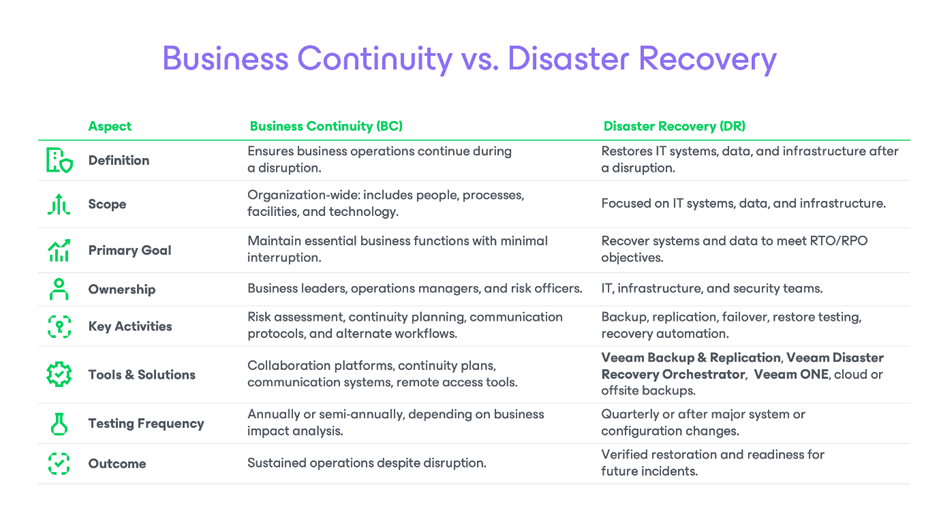
BC vs. DR: Do You Need Both?
What is a BC plan?
A BC plan is a proactive strategy that ensures an organization can continue operating despite disruptions. It defines how people, processes, and technology will adapt to keep critical functions running.
A strong BC plan includes:
- Communication plans to coordinate teams and stakeholders.
- Role assignments that clarify who is responsible for making technical and business decisions. This includes a primary and secondary point of contact for each defined role.
- Risk mitigation tactics such as redundant systems, alternate sites, and remote‑work capabilities.
- Testing and documentation to verify that plans work as intended.
What is a DR plan?
A DR plan is a reactive strategy focused on restoring IT infrastructure, applications, and data after an incident. It typically includes backup strategies, system failover protocols, and recovery objectives.
While BC keeps operations moving, DR brings your technology back online.
An effective DR plan typically includes:
- Backup and replication strategies to protect workloads and minimize data loss.
- System failover protocols that automatically switch operations to standby sites.
- RTOs and RPOs that define how quickly systems must be restored and how much data loss is acceptable.
- Regular testing to validate that recovery procedures work under real conditions.
Which One Do You Need?
Both! A BC plan and a DR plan serve distinct but complementary purposes.
- The BC plan focuses on keeping people and operations functional during a disruption.
- The DR plan focuses on restoring systems and data afterward.
Many organizations integrate both into a unified resilience strategy but skipping either one leaves critical gaps.Without a structured recovery plan, businesses risk regulatory non‑compliance, customer dissatisfaction, and significant financial losses.
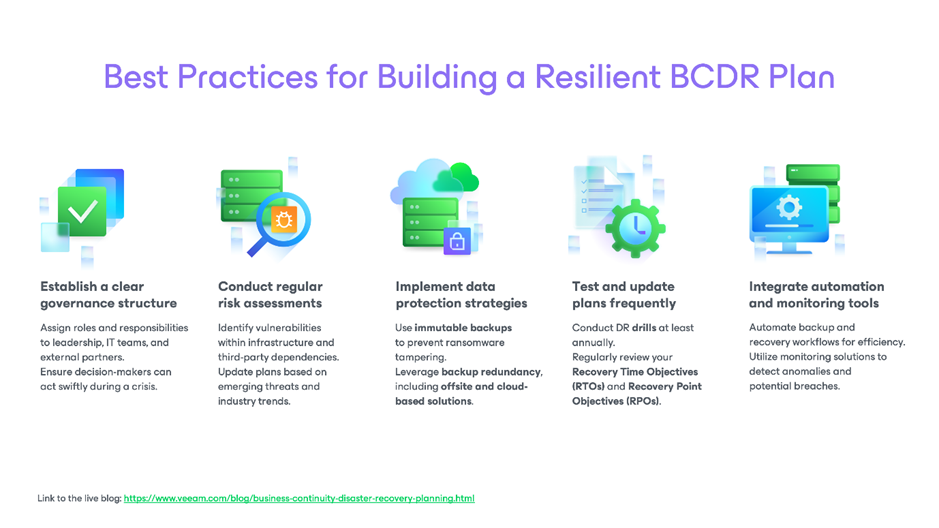
Best Practices for Building a Resilient BCDR Plan
Creating a BCDR plan is about building confidence that your organization can withstand disruption and recover fast. A resilient plan combines people, processes, and technology, all working together before, during, and after an incident.
How Veeam Supports BCDR
Veeam supports BCDR in a couple different ways. The first way, which is included in all licenses, is replication. You can easily set up replication between two sites and have a quick failover process in the event of an outage.
Additionally, you have the capability for Instant VM Recovery to the original location and to other hypervisors. Veeam premium licenses include an automation tool called Veeam Recovery Orchestrator that gives you the capability to create recovery plans that can be tested as often as your environment allows. When an outage does occur you now have an easy button to failover, test, and validate your environment and quickly bring your systems back online.
Backup and Replication Features
At the heart of Veeam’s approach is Veeam Backup & Replication, which provides continuous data protection across virtual, physical, and cloud workloads.
Key capabilities include:
- Automated backup scheduling: Protects critical workloads without manual intervention to ensure data consistency.
- Replication for high availability: Creates ready‑to‑failover replicas of virtual machines (VMs) or servers at secondary locations.
- Immutable backups: Safeguard data from ransomware or accidental deletion by preventing alteration or deletion during retention periods.
- Granular restores: Instantly recover individual files, applications, or entire systems to minimize disruption to operations.
- Cross‑platform flexibility: Works seamlessly across VMware, Hyper‑V, cloud, and hybrid environments to unify the recovery process.
These features ensure that both BC (keeping operations running) and DR (restoring systems after an incident) are supported by the same resilient data foundation.
Rapid Recovery and RPO/RTO Optimization
Speed matters when systems go down. Veeam Data Platform is built for rapid recovery, helping organizations meet their RPOs and RTOs with precision.
- Instant VM Recovery: Launch entire VMs directly from backup storage to get critical systems online in minutes.
- SureBackup and SureReplica Testing: Automatically verify backup integrity and replica readiness, so you can trust your recovery points before an outage happens.
- Automated orchestration: Streamline complex recovery workflows with pre‑defined plans and reporting, making failover fast and repeatable.
- Performance optimization: Dynamic resource management ensures recovery processes meet tight RTO targets without impacting production workloads.
Together, these capabilities allow IT teams to reduce downtime, maintain compliance, and prove readiness, all key components of a mature BCDR strategy.
Here is more information on these solutions:
Veeam Backup & Replication: Replication – User Guide for VMware vSphere
Instant VM Recovery for BC: VM Recovery – User Guide for VMware vSphere
Orchestrator for automated failover and reporting: Overview – Veeam Recovery Orchestrator User Guide
Bringing It All Together
BCDR is the foundation of organizational resilience. With Veeam, teams gain the visibility, automation, and speed they need to turn recovery plans into real, reliable outcomes.
From protecting workloads to verifying backups and orchestrating failover, every capability is built to keep your business running, even when the unexpected happens.
Ready to strengthen your continuity and recovery strategy?
Explore the full power of Veeam Data Platform and learn how to build a proven plan for resilience.
Recommended Resources for BCDR
For additional guidance on developing your BCDR plans, explore:
FEMA’s Business Continuity Planning Guide: ready.gov/business/emergency-plans/continuity-planning
FEMA’s DR Plan Framework: ready.gov/business/emergency-plans/recovery-plan
FAQs
What is the difference between BC and DR?
Business Continuity (BC) focuses on keeping operations running during a disruption, while Disaster Recovery (DR) focuses on restoring IT systems and data afterward.
BC is proactive, maintaining workflows and communications. DR is reactive, bringing technology back online quickly. Together, they form a complete resilience strategy that minimizes downtime and data loss.
Do small businesses need both BC and DR plans?
Yes. Disruptions affect organizations of every size, and small businesses often feel the impact more severely. A BC plan keeps essential operations moving, and a DR plan ensures critical data and systems can be recovered.
How often should BCDR plans be tested?
Testing should occur at least twice per year, or whenever major infrastructure, personnel, or regulatory changes occur. For certain regulatory frameworks, such as PCI Compliance or specific government mandates, organizations may need to conduct testing monthly. Regular tests validate recovery procedures, uncover gaps, and build team confidence.
