

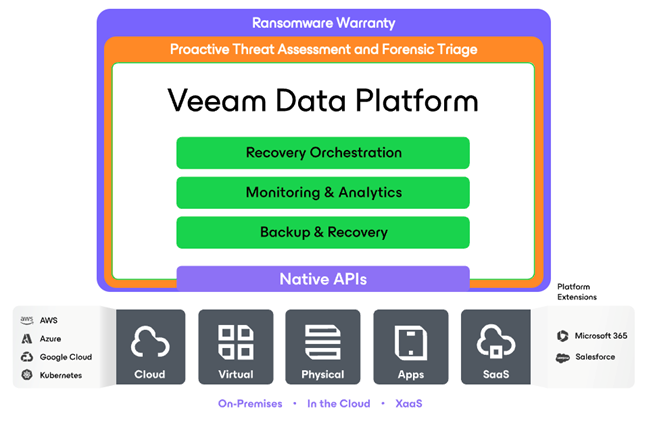
At Veeam, our story begins with Veeam Data Platform. This platform delivers backup and recovery, monitoring and analytics, and recovery orchestration across your enterprise. It’s the foundation that enables organizations to protect their data, maintain compliance, and recover quickly when disruptions occur.
As Anton Gostev, Veeam Chief Product Officer, recently highlighted in a LinkedIn post, the industry is seeing a rapid emergence of new hypervisor alternatives, particularly KVM-based platforms. Customers are adopting these platforms to improve flexibility and cost efficiency, and Veeam’s long-standing motivation has always been to meet these customers where they are.
From our VMware roots to expanded support for Hyper-V, Nutanix, cloud workloads, Kubernetes, and now KVM-based environments, we’ve consistently evolved to keep pace with customer needs. The next natural extension of Veeam Data Platform is support for HPE VM Essentials.
Why Virtualization Strategy is Evolving
Virtualization was once a solved problem. For years, most organizations were standardized on a single platform, but times have changed. Costs have risen, licensing has shifted, and for a time, customer choice in virtualization was more limited.
That period of limited choice has now given way to renewed innovation. A wave of KVM-based hypervisors has entered the market, giving customers more freedom, better economics, and new flexibility. Amid all the new KVM options, HPE VM Essentials stands out for its maturity and enterprise support. It’s not a hobby project or a niche platform; it’s a serious contender which could become the next production-grade, enterprise-supported solution. Built on the strength of HPE’s ecosystem and vision, and now protected by Veeam, it offers customers a clear path toward sustainable modernization and choice.
Workloads have diversified too. A typical environment now mixes legacy VMs with modern containerized applications and even bare-metal servers. IT leaders are expected to manage everything without expanding their teams or budgets.
That’s why HPE developed a private cloud portfolio designed to support every runtime model: Virtualization, containerization, and bare metal. These offerings are built on HPE Morpheus software, and they scale from edge to core to cloud through GreenLake.
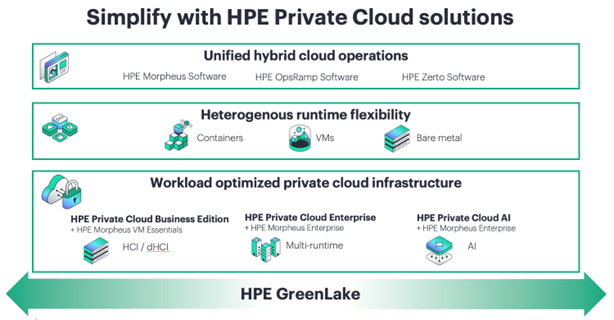
This portfolio includes:
- HPE VM Essentials : A virtualization-only foundation built for simplicity and cost efficiency.
- HPE Private Cloud Business Edition : Engineered systems based on HPE SimpliVity or dHCI with integrated management.
- HPE Private Cloud Enterprise : Built on Morpheus Enterprise with full multi-runtime orchestration.
- HPE Private Cloud AI : Optimized for AI workloads and automation.
No matter how your customers deploy them, whether on their own or as part of a larger HPE Private Cloud setup, each solution is fully supported and protected through Veeam.
HPE VM Essentials: What it is and Why it Matters
HPE VM Essentials isn’t just a hypervisor; it’s a virtualization management platform that’s built to manage HPE’s HVM hypervisor. It combines predictable licensing, essential features, and enterprise-class support to deliver a strong value proposition for organizations that are looking to modernize without overspending.
Design Principles
- Simplicity and cost efficiency: Licensed per CPU socket, regardless of cores, with no incremental feature costs.
- Enterprise capabilities: Includes advanced functions such as live migration, integration hooks for data protection, and secure secret management.
- Automation flexibility: Supports PowerShell and Bash scripting for deployment workflows.
- Upgrade path: Seamless transition to HPE Morpheus Enterprise for full multi-runtime management.
- Trusted foundation: Backed by HPE’s global ecosystem and enterprise-grade support.
HPE VM Essentials can be consumed in multiple ways: As standalone software (agnostic to hardware vendors), integrated into HPE engineered systems, or delivered as-a-service through GreenLake. No matter where customers begin, there’s a clear, scalable path forward.
When paired with Veeam, this offering brings together virtualization efficiency and data protection resilience to ensure workloads can be run, managed, and protected with the same confidence customers expect from enterprise infrastructure.
The Veeam Plug-In: From Agents to Native Integration
Customers who are currently deploying HPE VM Essentials can already protect their workloads using Veeam Agents. These agents provide the same reliable and application-aware backups, immutable backups, and simple management experience that Veeam users know well. This offers a consistent path forward as native integrations become available.
The forthcoming Veeam Plug-in for HPE VM Essentials takes this a step further with hypervisor-level integration.
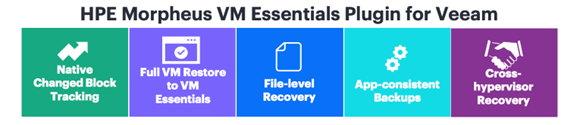
Key capabilities include:
- Native changed block tracking (CBT) for faster incremental backups.
- Application-consistent checkpoints.
- Centralized management and policy control through Veeam Data Platform.
- Dedicated worker processes that act as proxies for HVM workloads to handle compression, encryption, and data transport.
- Support for familiar Veeam transport modes such as HotAdd and NBD for efficient data movement.
The plug-in brings the full Veeam experience (e.g., scheduling, immutability, encryption, and monitoring) directly to HPE’s hypervisor stack.
Cross-Platform Recovery and Data Mobility
Customers increasingly operate across multiple environments. Whether running VMware in one data center and HVM in another or leveraging public cloud for disaster recovery (DR), Veeam ensures data mobility for all.
Workloads protected on HPE VM Essentials can be restored to:
- Other on-premises hypervisors.
- Alternate data center locations.
- Public clouds such as AWS or Microsoft Azure for DR scenarios.
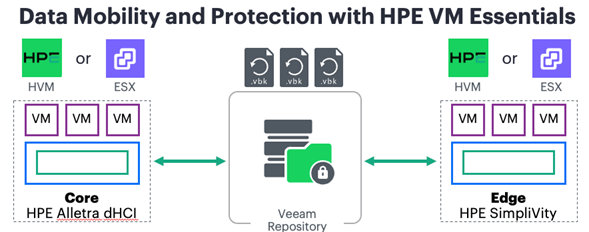
This is all about flexibility for the customer. If a data center becomes unavailable, backups can be restored anywhere to ensure business continuity.
Under the Hood: How the Plug-In Works
The plug-in architecture has two main components:
- Plug-in module: Installed directly on Veeam Backup Server with no additional appliance. It manages integration, coordinates checkpoints, and oversees backup and restore jobs too.
- Workers: Lightweight proxy VMs that are responsible for data movement, compression, and encryption.
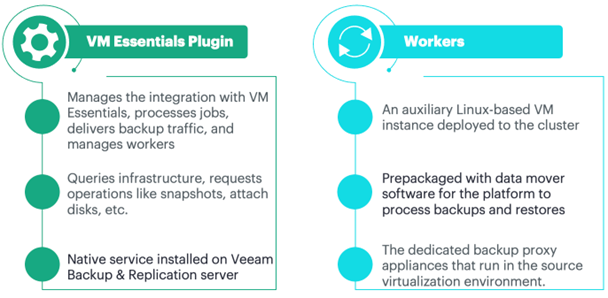
During backup operations:
- The Veeam Backup Server triggers a VSS snapshot (Windows) or application-aware quiescence via the QEMU Guest Agent.
- Veeam communicates with HVM to create a checkpoint, then compares checkpoints to identify changed blocks.
- Only changed data is transmitted to the repository to minimize I/O impact.
Regardless of the underlying architecture, whether you’re using HPE SimpliVity, HPE Alletra dHCI, or another HPE Private Cloud configuration, the plug-in delivers consistent, reliable protection for HPE VM Essentials environments. This flexibility ensures that customers can protect their workloads with confidence, no matter where they run within the HPE ecosystem.
Integrating into Veeam Data Platform
From a customer perspective, this integration feels natural. The same familiar workflow applies:
- Choose the hypervisor (HVM).
- Select the VMs you want to protect.
- Configure storage, processing, and scheduling options.
No new interface, no separate deployment, just Veeam Backup & Replication extended to another platform. This plug-in communicates directly with HPE Morpheus Manager to simplify configuration and remove the need for manual registration or extra components. With HPE VM Essentials now supported by Veeam Data Platform, customers can manage protection in the same way they do for other environments while gaining access to core Veeam strengths like immutability, encryption, and observability.
Initial support focuses on core backup and recovery workflows. Storage snapshot integration for HPE Morpheus environments is already under evaluation as part of an ongoing roadmap. It also puts HPE VM Essentials on a clear development path. As new platform releases arrive, this integration will continue to grow, adding more depth and functionality for the HVM hypervisor over time.
This approach keeps data protection consistent across virtual and cloud environments while positioning customers to take advantage of what’s next.
The 3-2-1-1-0 Framework and HPE Storage Options
Every Veeam + HPE architecture aligns to the 3-2-1-1-0 rule:
- 3 copies of your data.
- 2 media types.
- 1 off-site.
- 1 immutable copy.
- 0 backup verification errors.
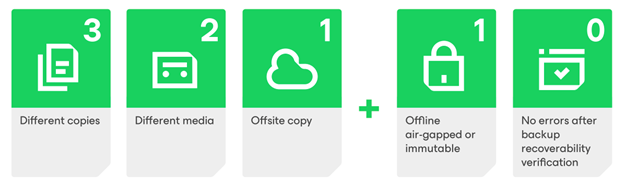
HPE’s storage portfolio gives customers the flexibility to build this architecture their way:
- HPE Alletra Storage MP X10000: All-flash, high-performance S3 storage that’s ideal for reuse and AI workloads.
- HPE Alletra Storage Server 4120/4140: General-purpose building blocks for scalable repository design.
- HPE StoreOnce Gen4+ and Gen5: Improved Catalyst OS and hardware architecture that delivers high-performance deduplication and replication.
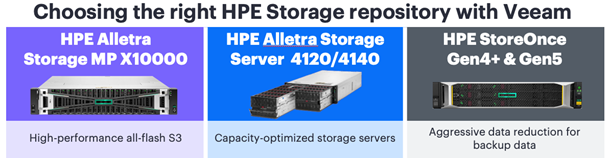
These systems provide the physical HPE foundation for Veeam’s immutability and data protection infrastructure, delivering secure, high-performance storage for backup and recovery operations. Together, they enable resilient architectures that can evolve as new integrations and capabilities are introduced.
Try the Beta
You can try the beta version of the Veeam plug-in for HPE VM Essentials today by engaging your Veeam sales team. They can provide access to the beta and work with you throughout testing to capture technical feedback and ensure a smooth evaluation experience. We recommend running the beta in a non-production environment to avoid any leftover components or configuration artifacts before the GA plug-in is released.
Your input during this stage helps us refine performance, validate feature behavior, and deliver the high level of reliability customers expect from Veeam integrations with HPE.
Looking Ahead
With HPE VM Essentials, customers gain a modern, cost-efficient virtualization foundation. With Veeam, they gain the trusted data protection layer that ensures business continuity, ransomware resilience, and cloud portability.
Together, HPE + Veeam are delivering consistent, flexible protection across hybrid environments to help customers build confidence in their data protection strategies today and prepare them for the platforms of tomorrow.
Resources
- Download our Veeam Plug-in for HPE Morpheus VM Essentials
- Press Release – Veeam and HPE Extend Strategic Partnership and Unveil Next-Gen Data Protection to Supercharge Enterprise Resilience
- Video – Discover 2025 HPE Private Cloud Business Edition, VM Essentials and Veeam Data Platform Explainer
- Veeam Alliance Webpage on HPE.com
