

Key takeaways
- The NIST AI RMF is voluntary guidance, not a regulation, but its four functions only hold up when mature data capabilities sit underneath them.
- Govern, Map, Measure, and Manage each carry data protection prerequisites that most compliance programs were never built to satisfy.
- The most common blocker to implementation is a data inventory that ignores the data your AI systems touch.
- Backup and recovery scope rarely covers AI workloads like model artifacts, training snapshots, and vector databases, leaving the Manage function exposed.
- Veeam, with Securiti AI, covers the data layer: Discovering, classifying, sanitizing, and recovering the data your AI depends on.
If you own data protection or compliance, you’ve likely already fielded the question: How aligned are we with the NIST AI Risk Management Framework?
It’s a fair question with an inconvenient answer. The framework hands your organization a clear structure for managing AI risk, but each of its four functions — Govern, Map, Measure, and Manage — quietly assumes you already have data capabilities most programs were never built to provide. The gap rarely sits in the framework; it sits in your data.
One clarification, though, shapes everything that follows: The NIST AI RMF is voluntary guidance, not a regulation like GDPR or the EU AI Act.
NIST itself describes it as voluntary and use-case agnostic, so no auditor scores you against it directly. Instead, it provides a benchmark. And when you build the program well, you’ll also achieve compliance with any necessary regulations. This guide skips the framework overview (the official NIST publication covers that) and goes straight to what each function asks of your data, where teams fall short, and where to begin.
What the NIST AI RMF Requires from Your Data Program
The short version: The AI RMF reads like a risk management framework, but you can only achieve it if you already have mature data visibility, classification, and protection underneath it. Most teams discover this late, usually when they sit down to produce evidence and realize it depends on data they can’t fully see.
That’s because each of the four functions carries a data prerequisite whether or not it’s stated outright:
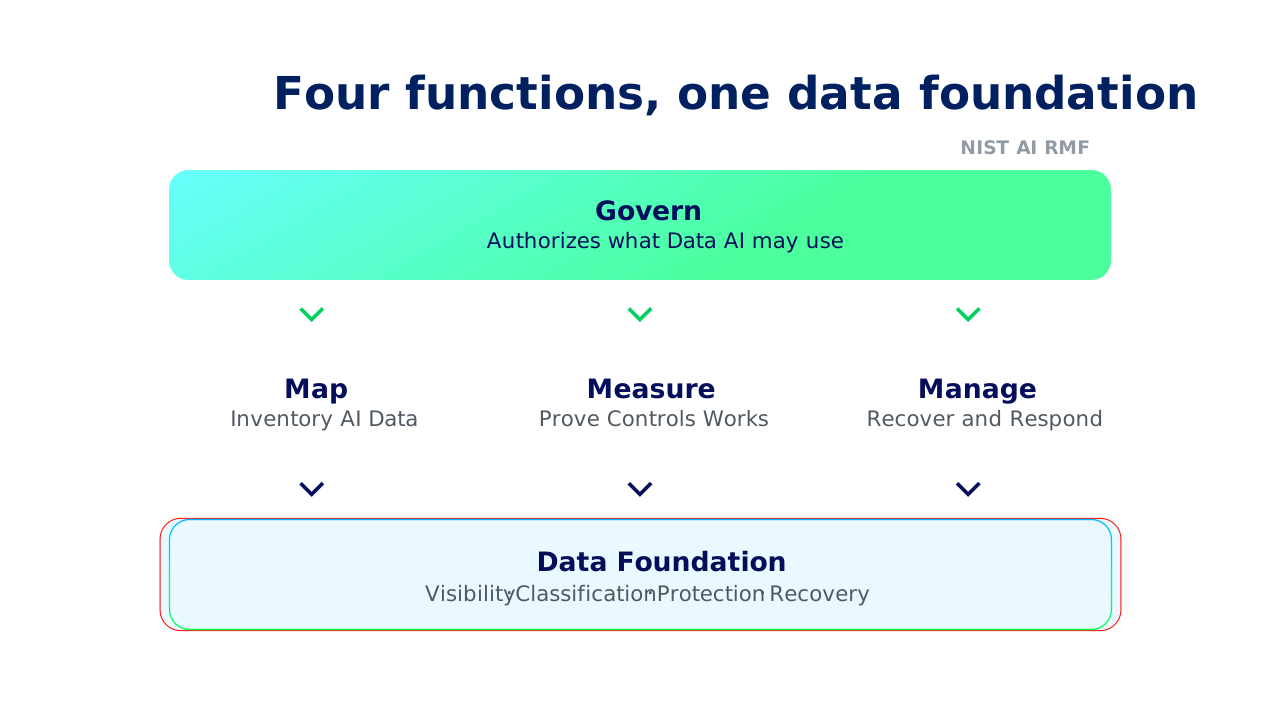
- Govern: Assumes you know what data your AI systems are authorized to use, and under what conditions.
- Map: Assumes you can inventory what data those systems actually process, not just what policy says they should.
- Measure: Assumes you can produce evidence that your data protection controls are in place and working.
- Manage: Assumes you can respond and recover when those controls fail, including restoring affected data to a known-good state.
A pattern becomes clear. Govern is the cross-cutting function that sits above the other three, but all four lean on the same foundation: Knowing your data, classifying it, protecting it, and being able to recover it. That’s the work of data privacy and governance, and it’s the same discipline that AI raises the stakes on considerably.
So here’s the reframe worth carrying through the rest of this guide. Data resilience, the ability to protect, recover, and audit the data your AI depends on, isn’t a downstream concern you bolt on after implementation. It’s a foundational input to every function.
Treat it that way, and the framework becomes tractable. Treat it as an afterthought, and every function inherits the same blind spot. (Veeam and Securiti AI approach the framework from exactly this data-first angle.)
The Data Protection Gaps You Need to Address
If implementation stalls, it’s usually because of a handful of predictable data gaps. Each one quietly blocks a function from being satisfied accurately, no matter how well your policies are written. Here are the four that surface most often.
- AI data that your data maps don’t reflect: Training datasets, third-party model inputs, and inference outputs routinely fall outside the scope of current data inventories. When that happens, you can’t characterize what your AI systems process, which makes the Map function impossible to satisfy with any accuracy. The data is being used; it just isn’t on the map.
- No documented basis for AI-assisted decisions: Organizations using AI to support hiring, credit, fraud detection, or other consequential decisions often can’t show the data lineage or purpose documentation the framework expects. Without it, you can’t demonstrate which data fed a decision, where it came from, or whether that use was authorized. That’s a governance gap with real exposure when someone asks you to prove it.
- Backup and recovery that stops short of AI workloads: Model artifacts, training data snapshots, and vector databases are rarely written into existing backup policies. So when something goes wrong, the Manage function’s continuity and recovery expectations simply can’t be met for the assets that matter most to your AI. Most teams assume this is covered. It usually isn’t.
- Vendor and third-party AI risk: Most organizations consume AI through SaaS platforms rather than building models in-house, and their data processing agreements and vendor due diligence programs weren’t written for AI-specific data flows. The result is a blind spot around what sensitive data leaves your environment, where it goes, and how it’s handled once it does. Extending governance across hybrid and third-party environments is where this gap gets closed.
The common thread: Every gap is a place where data is moving through AI faster than your visibility and protection have caught up. Name them now, and the function-by-function work ahead gets far more concrete.
Data Protection Capabilities Across Each AI RMF Function
This is where the framework gets practical. Each function calls for specific data protection work, and seeing them side by side makes the data foundation impossible to miss. The diagram below walks Govern, Map, Measure, and Manage in turn, with the concrete data capability each one depends on.
Govern: Defining What Your AI Systems Are Allowed to Do With Data
At its core, Goven is a data governance exercise. It asks you to establish policies for how AI systems are permitted to use data: Which data types, under what conditions, and with which access controls. That’s not the same as a general security policy. It’s a set of explicit decisions about data, made before a model ever touches it.
In practice, that means a data classification policy extended to AI use cases. You define which data categories can be used for model training, inference, and output generation, and you specify the authorization required for each. Once that’s written down, it does double duty. Govern documentation becomes audit evidence, and the organizations that can produce clear, AI-specific data use policies are far better positioned when a regulator or auditor asks for AI governance artifacts.
Map: Inventorying the Data Your AI Systems Process
Map asks you to characterize AI risk in context, which comes down to knowing, at a granular level, what data each AI system processes, where that data originates, who it belongs to, and whether its use stays within the bounds of its stated purpose.
If you run a GDPR program, this will feel familiar. Map is essentially a data protection impact assessment applied to AI systems. The inputs are similar, but the scope is broader: Alongside individual data flows, you’re accounting for training data provenance and model behavior. And it all rests on one prerequisite.
You can’t complete Map accurately without a current, AI-inclusive data inventory. This is the single most common implementation blocker, and because every other function depends on Map’s output, an incomplete inventory creates problems that ripple downstream.
Measure: Producing Evidence That Data Protection Controls Are Working
Measure asks you to assess AI systems against the risk criteria you defined in Map, and for data protection, that means producing documented evidence. Not just having controls in place but demonstrating that they function and that your data protection standards are being met.
This is the audit-readiness layer. Measure outputs are the primary evidence you’ll show regulators, insurers, and board-level oversight, so a disciplined approach to documenting assessments matters here more than anywhere else. Two things make that evidence credible:
- Controls mapped to recognized frameworks. Tie your data protection controls to NIST 800-53, ISO 27701, or SOC 2 Trust Services Criteria so a single assessment speaks to multiple obligations at once.
- Alignment to emerging AI benchmarks. The data governance requirements for high-risk AI under EU AI Act Article 10 are becoming a reference point, and mapping to them now saves rework later.
Measure also surfaces the data-related risks compliance leaders are usually first to spot and most accountable for: Sensitive data exposure, outputs that re-identify individuals, and data retention violations embedded in how a model behaves. Those are the risks to track and document here, because they’re the ones tied directly to the data you’re responsible for protecting.
Manage: Protecting, Recovering, and Auditing AI-Relevant Data
Manage is where data resilience becomes explicit. The function asks you to apply controls, monitor AI system behavior, and respond when risk levels change. Responding to an AI incident means being able to recover affected data, roll back to a known-good state, and produce an audit record of what happened.
Three capabilities carry most of the weight:
- Real-time visibility into data flowing through AI: AI-aware data security posture management (DSPM) monitors what sensitive data is moving through your AI pipelines as it happens, so exposure is caught in motion rather than after the fact.
- Sanitizing data before it reaches a model: Stripping or masking sensitive data and PII before it enters an LLM’s context window is a data control, and it keeps regulated data out of places you can’t fully audit or retract.
- Backup and recovery that includes AI assets: This is the gap from earlier, made operational. Model artifacts, training data versions, and vector databases need explicit inclusion in backup scope and regular recovery testing, or Manage’s recovery expectations stay on paper.
Treat AI data incidents with the same discipline as privacy incidents. A training dataset corrupted by a supply chain compromise, an inference output that exposes personal data, or a model drifting away from its stated purpose all warrant documented response, and they belong inside your existing incident response process, not in a separate AI track.
Building AI RMF Alignment Into Your Existing Compliance Program
You don’t need a new program. You need to extend the one you already run, and a few moves close most of the data protection gaps from earlier. This isn’t a full implementation roadmap. It’s just where to start: The three or four actions that give compliance leaders the most leverage for the least disruption.
Build an AI-inclusive data inventory first: Extend your existing data maps to cover AI systems, training datasets, third-party model inputs, and inference outputs. This is the highest-value move on the list, because it unblocks Map directly and gives Govern the raw material it needs to write meaningful policy. Almost everything else depends on getting this right, so start here even if you do nothing else this quarter.
Audit your backup scope against AI workloads: Hold your current backup policies up against the data your AI depends on, then find the gaps. Model artifacts, training snapshots, and vector databases are the assets most often missing from backup coverage, so name them explicitly and define the recovery testing each one needs. This is the difference between a Manage function that works on paper and one that works during an incident.
Extend your DPIA process, don’t reinvent it: If you already run data protection impact assessments under GDPR, add an AI-specific addendum that covers training data provenance, model behavior risk, and any data use that goes beyond its original purpose. The payoff is double: You get a familiar process doing new work, and the addendum doubles as your Map function documentation.
Treat documentation as infrastructure, not overhead: The evidence you generate isn’t busy work, it’s what answers a regulator, satisfies an insurer, and informs the board. Teams that document as they implement are in a far stronger position than those scrambling to reconstruct evidence after the fact. Build the habit early, and the audit takes care of itself.
And remember to start with the inventory, expand backup scope, extend your DPIAs, and document as you go. That sequence turns an abstract framework into a short, ordered list of things your team can do this quarter.
How Veeam Helps Secure the Data Layer of AI RMF
Here’s the honest version of where Veeam fits. AI RMF alignment is a multi-layer effort spanning application, identity, endpoint, and data controls, and no single vendor covers all of it. Veeam owns one layer: The data layer. That’s the foundation every function in this guide depends on, and it’s where Veeam, now combined with Securiti AI, does its best work.
Since completing its acquisition of Securiti AI in December 2025, Veeam pairs its data resilience platform with a leading data security posture management (DSPM) capability. In practice, that means discovering and classifying the data your AI touches (including shadow AI you didn’t know was running), sanitizing sensitive data before it reaches a model, and backing up, recovering, and rolling back the AI workloads your existing policies miss. Here’s how that maps to the four functions:
| AI RMF function | How Veeam and Securiti AI help at the data layer |
| Govern | Classify data and define which categories AI systems are authorized to use, turning policy into enforceable data controls. |
| Map | Discover and inventory AI-relevant data, including shadow AI, training data, and the sensitive data flowing through AI pipelines. |
| Measure | Map data protection controls to recognized frameworks and produce the documented evidence auditors and regulators ask for. |
| Manage | Sanitize sensitive data before it enters a model, and back up, recover, and roll back model artifacts, training data, and vector databases. |
Why this layer matters more than confidence suggests: In the Veeam Data Trust and Resilience Report 2026, only 28% of organizations hit by ransomware said they fully recovered all affected data, even though most felt confident going in. That gap is exactly what the Manage function is meant to close, and it widens fast once AI workloads enter the picture.
If you’re assessing where your own data resilience really stands, two resources go deeper: the Data Trust and Resilience Report 2026 for the full benchmark data, and How AI Expands Risk Across the Enterprise for the bigger picture on AI-driven data risk.
FAQs
No. It’s voluntary guidance from NIST, not a regulation like GDPR or the EU AI Act, so no auditor scores you against it directly. Organizations adopt it as a benchmark, and building a program around it tends to make compliance with the AI laws you do answer to easier to demonstrate.
Govern, Map, Measure, and Manage. Govern is the cross-cutting function that sets accountability and policy. Map identifies context and risk for a given system. Measure analyzes and tracks those risks. Manage prioritizes them, responds, and recovers. NIST is clear that this isn’t a rigid, ordered checklist.
It doesn’t replace them. The RMF is a program framework, while GDPR and the EU AI Act are law. Because their requirements overlap, especially around data governance, a well-built AI RMF program makes obligations like EU AI Act Article 10 more achievable. Compliance ends up being a byproduct of the program.
The AI RMF manages risks specific to AI systems across their lifecycle. The NIST Privacy Framework focuses on privacy risks in data processing more broadly. They share a similar structure, and the data inventory and impact-assessment work you do for one feeds directly into the other.
All the data your AI systems touch: Training datasets, third-party model inputs, inference outputs, model artifacts, and vector databases. The most common gap is data that never made it onto your existing maps, which is why an AI-inclusive data inventory is the usual place to start.
Two places. First, a data inventory that misses AI-specific data, which blocks Map and ripples into every other function. Second, backup and recovery scope that doesn’t extend to AI workloads, which leaves the Manage function unable to meet its recovery expectations when it matters.
