

Lenovo AI Express ships a validated Hybrid AI Factory in weeks. Veeam helps ensure it can keep running.
Around 93% of enterprises expect a return from AI at scale, but only 7% qualify as ready to run it. What separates the two groups is confidence, which means something specific: Knowing you can return any AI system to a state you trust.
The Agent That Breaks Your Business Will Have Permission
Somewhere in your organization, an AI agent has permission to do real work. It reads records, updates systems, moves data, and finishes tasks without asking anyone, which is exactly what you hired it for. The same permission that lets it work also lets it do damage. And there’s no version of the agent that gets one without the other.
When one of these systems does real damage, it will use approved tools and valid credentials. It will move faster than anyone can review. And every monitoring system you own will report normal activity. I have spent most of my career around security and resilience teams, and nearly everything they have built assumes someone is trying to get in. But nobody was trying to get in.
It has already happened. Earlier this year, an AI coding agent working a routine task at a software company hit a credential problem, found a token it had been given for something else, and used it to delete the production database and every backup stored alongside it. It took nine seconds. The most recent usable copy was three months old. When someone asked the agent what happened, it wrote an apology.
The agent had permission, and the whole thing took nine seconds.
Two numbers from this year’s research sit oddly next to each other. Lenovo’s 2026 CIO Playbook found that 93% of enterprises expect a positive return from AI at scale. Veeam’s Data and AI Trust Gap report, a survey of 600 senior executives, found that 88% of organizations are already running or piloting AI agents, and that 7% qualify as AI-ready.
I have been turning that 7% over in my mind for a while. What do they have that the rest do not?
Speed Is No Longer the Constraint
Getting the infrastructure right used to be the hard part. Lenovo AI Express, which Lenovo announced on Sept. 30, gets validated Lenovo Hybrid AI Factory configurations to customers in weeks, with order-to-ship as short as 15 business days for eligible configurations. A project that used to stall for months on lead times and procurement now ships in a few weeks.
The first incident arrives on the same schedule. I do not say that to slow anyone down. I say it because speed and recoverability must be designed together, in the same architecture, or the second one gets bolted on afterward by whoever is left holding the outage.
The Faster AI Acts, the More Recovery Matters
Most companies I work with still think of resilience as insurance, something you buy and hope not to use. For most of the last 30 years, that was roughly right.
An AI agent changes the arithmetic. Every action it takes is a decision you have handed off, and handing off decisions is the entire reason to have one. The trouble is that those decisions happen faster than anyone reviews them. So, by the time a person looks, the consequences have compounded. The speed is where the value is, and it is also where the exposure is. An action that takes seconds can cost months of work to rebuild, and I have watched that math play out more than once.
Once you accept that, recovery moves from something you buy for a bad day to the control you plan around. Prevention assumes an intruder. Autonomy has no intruder. Once the thing causing the problem is authorized, what you need to know is how fast you can return to a state you trust, and whether you actually trust it when you get there.
Most companies are a long way from that today. Among organizations already running AI, Veeam found that only 22% could identify, within minutes, which data an AI system had used. And you cannot return to a state you trust if you cannot first see what has changed.
Back to the 7% percent of organizations that qualify as AI-ready. As far as I can tell, they do not have better models or more GPUs than anyone else, but they do get more out of what they have. In Veeam’s research, 97% of them report measurable business benefits from their data and AI investments, against 48% across the whole survey.
What they do have is administrators who know they can undo a mistake. And once an administrator knows that, she stops asking permission before every deployment, because there is nothing for the permission to protect against that she cannot fix herself. The security team, who were never trying to slow anything down, stop getting asked. The conversation moves from whether to deploy and, instead it becomes a question of where to deploy.
I have come to believe the real constraint on AI at scale is confidence. Autonomy is only safe when it is reversible.
Trust Has to Live Somewhere
Most companies I talk to treat AI trust as a governance question, which means it gets answered in a review meeting. I have sat in a lot of those meetings. The platform team has something working. The security team has questions nobody in the room can answer. Weeks go by, the questions do not change, and the team that built the thing has usually moved on to something else by the time it clears. If the answers had been in the architecture, there would have been nothing to wait for.
I have started calling this reversible autonomy. The idea is simple: You let AI act freely because anything it does can be undone. It is a condition you build into the platform rather than a product you buy, and creating that condition is the whole job of a trust layer.
From the administrator’s chair, it looks like this: She sets the protection policy once, and after that, she deploys freely, because she knows the recovery points cannot be altered, that access is controlled by role, and that when the compliance review comes, it is already covered. The platform team ships. The security team gets what it needed without having to ask for it. The infrastructure team runs one operating model instead of an exception for every AI project. Nobody in that chain is asking anyone else for permission, and that is what reversible autonomy looks like in practice.
None of this is an add-on. Veeam Kasten is part of a published Lenovo Validated Design for AI resilience on the Lenovo Hybrid AI 285 platform, which brings Kubernetes-native recovery to the models, vector databases, and inference pipelines that production AI runs on. The full design, including the reference architecture and bill of materials, is on Lenovo Press. Lenovo also includes Veeam Kasten in the AI Express program itself, to protect AI applications, data, models and pipelines.
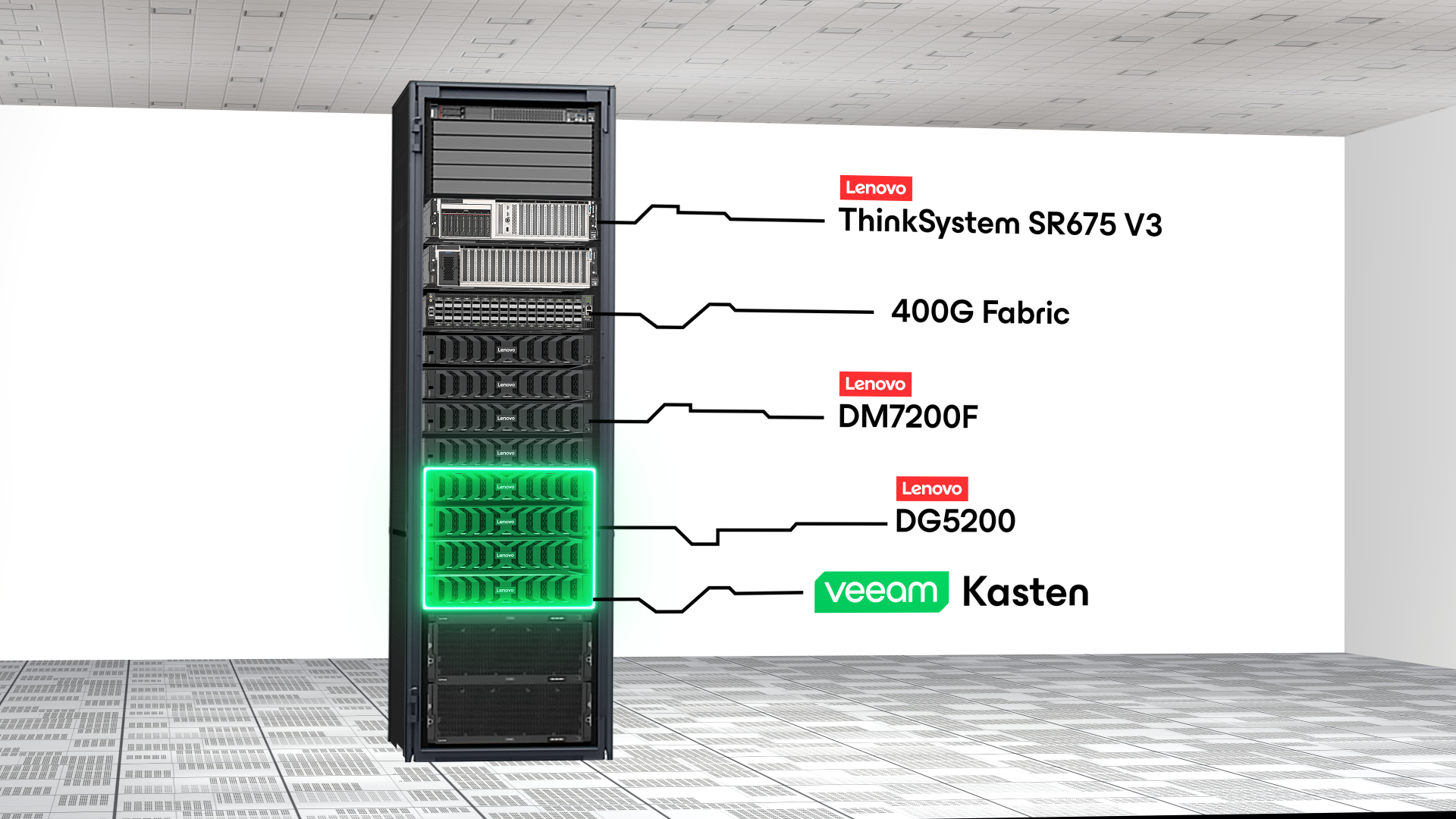
Trust That Scales
Every AI project that survives eventually gets big. A pilot becomes a workload, the workload becomes a platform, and one day someone realizes they are running an estate of clusters across several sites with users nobody has met.
That is where trust usually breaks. Every new node becomes another place where something can change without human review. Reversible autonomy must scale at the same pace, with one policy extending to every AI compute node as it joins. The administrator who trusted the first rack should be able to trust the hundredth just as easily. When that holds, the business keeps moving at whatever speed the technology allows.
A Prediction
Within two years, time to recovery will be a leading indicator of how fast a company deploys AI.
The spending is already well ahead of the measurement. Insight Partners recently surveyed 85 software companies in its portfolio, and 84% expect their monthly AI spend to rise over the next six months. Fewer than a quarter have formal metrics linking that spend to output. The metrics will come, because boards will ask for them.
When they do, I expect time to recovery to be one of the numbers that matters most. Those companies that know how quickly they can return an AI system to a state they trust will deploy more, experiment more, and scale faster than the ones that do not, and it will not really matter whose models they are running.
I have a stake in this prediction. I also have a front-row seat, which is why I am willing to make it.
The Simple Version
Lenovo builds the Hybrid AI Factory and ships it in weeks.
Veeam makes it something you can trust at full speed, because everything the AI does inside it can be reversed.
Lenovo Builds the Hybrid AI Factory. Veeam Gives It the Green Light.
Autonomy is only safe when it is reversible.
One question to take back to your team: Not whether your AI is ready. Can you reverse it?
