

Key Takeaways
- Veeam Data Cloud Vault is immutable and logically air-gapped from production by default, with no manual locking to configure and no window where new backups sit unprotected.
- It integrates natively with Veeam Data Platform and Veeam Kasten, so the Azure backups you already create can target Veeam Vault directly, with no extra tooling to deploy.
- Pricing is flat and per-TB, with storage, API calls, reads, restores, and egress all included, so there are no separate line items to forecast.
- Choosing Foundation or Advanced comes down to your read/restore needs, durability, and data residency, not the size of your company.
For most Azure architects, going offsite with backups isn’t the question. The real decision is where those backups land, and how much ongoing work it takes to keep that landing zone secure, immutable, and isolated from production.
Veeam Data Cloud Vault for Azure is a fully managed, immutable cloud storage target for backups created with Veeam Data Platform and Veeam Kasten, logically air-gapped from production by default and billed at one flat per-TB rate. It gives Azure-protected data a resilient place to land without the setup, tuning, and lifecycle management of a storage layer you build yourself.
That landing zone matters more than ever. Ransomware attacks now target backups directly, so a recovery copy is only useful if attackers can’t reach or alter it.
If you’re an architect who already knows Veeam Vault and is just deciding how it fits, this article is for you. We’ll cover what self-managing Azure backup storage really takes, what Veeam Vault adds for Azure backup data, the requirements to connect it, how to choose between Foundation and Advanced, and how to get started in minutes.
The Real Work of Self-Managed Azure Backup Storage
You can build backup storage yourself in Azure, and plenty of teams do. It works. But standing up storage that’s durable, immutable, and truly isolated is an ongoing engineering effort, not a one-time setup. You’re designing lifecycle rules, configuring and locking immutability, managing access controls, and keeping all of it current as your environment and compliance requirements change. All of that is specialist time spent maintaining storage instead of focusing on recovery and outcomes.
Three realities tend to surface once a do-it-yourself approach is in production:
- Configuration is manual and continuous. Immutability, retention, and access policies have to be set correctly, then revisited whenever something changes. A missed setting is a gap you might not notice until you need the backup.
- Isolation takes deliberate design. A backup copy is most resilient when it lives outside the same account or subscription as production. That way, a single compromised identity can’t reach both at once. Achieving that separation yourself means extra architecture and governance.
- Costs arrive as separate line items. Storage, write and read API calls, and egress are billed individually, and they’re easy to under-forecast. That’s the kind of bill shock that makes storage spend hard to plan.
There’s also a quieter cost: Seams. When your backup software and storage come from different vendors, every integration point is one more thing to manage, monitor, and troubleshoot.
Consolidating with a single trusted vendor removes those seams, and if you’re already a Veeam customer, it’s one less thing to stitch together. These are the same challenges cloud storage for backups teams run into whenever they weigh building their own target against a managed one.
Veeam Vault flips that model. Instead of designing and maintaining the storage layer, you get a target that’s preconfigured for resilience from day one, which is where the next section picks up.
What Veeam Vault Adds for Azure Backup Data
Veeam Vault is a purpose-built, fully managed storage target designed to receive your Veeam backups and keep them resilient, with no infrastructure for you to run. It integrates natively with Veeam Data Platform and Veeam Kasten, so if you already back up Azure with Veeam (Veeam Backup for Microsoft Azure runs inside Veeam Data Platform), those backups can target Veeam Vault directly. There’s no new tooling to deploy or integration to build.
What sets it apart is that resilience is the default, not a configuration project:
- Always immutable. Every backup lands in a write-once, read-many (WORM) state and stays there. Immutability can’t be turned off, so there’s no locking step to remember and no reversible window.
- Logically air-gapped. Veeam Vault is logically air-gapped from your production environment by default, with secure access control, keeping a recovery copy separated from a compromised account.
- Encrypted end to end. Backup data is protected with AES 256-bit encryption in flight and at rest, and you alone hold the keys.
- Built on proven cloud storage. Veeam Vault uses Microsoft Azure Blob storage under the hood, so you get familiar, durable object storage delivered as a managed service.
Together, these help you satisfy the 3-2-1-1-0 rule without assembling the pieces yourself. For a fuller product overview, see Veeam Data Cloud Vault.
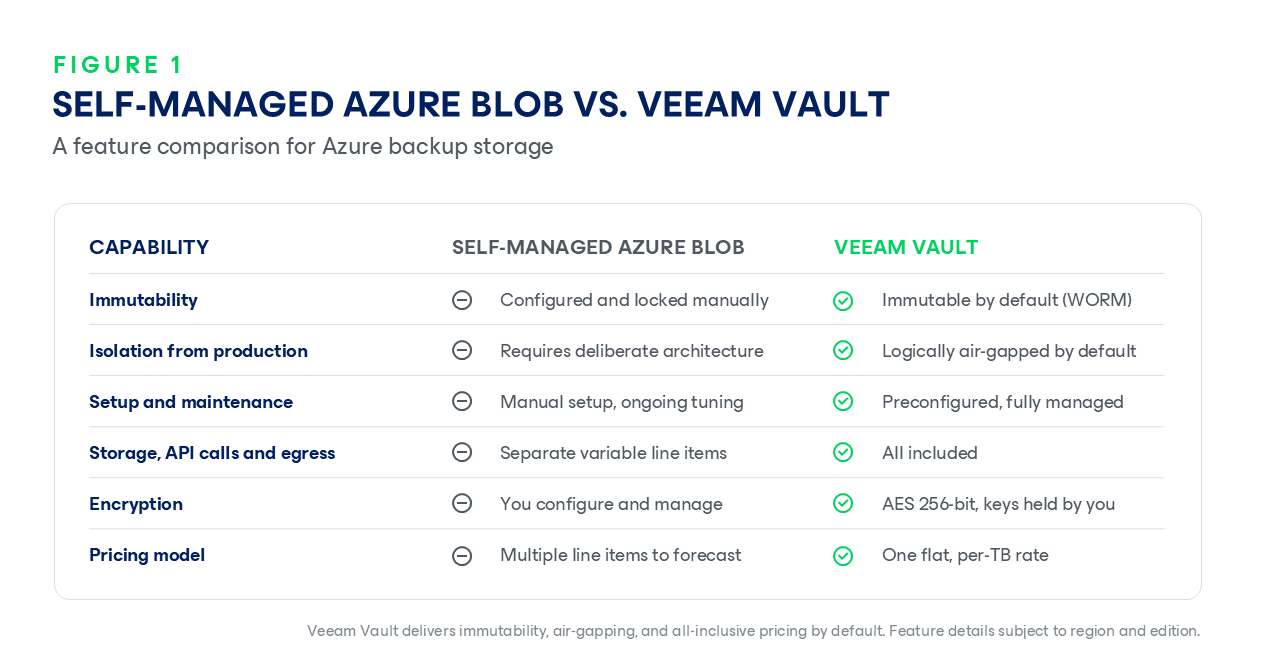
Here’s how a self-managed Azure Blob approach compares with Veeam Vault, feature by feature:
Requirements for Veeam Vault for Azure
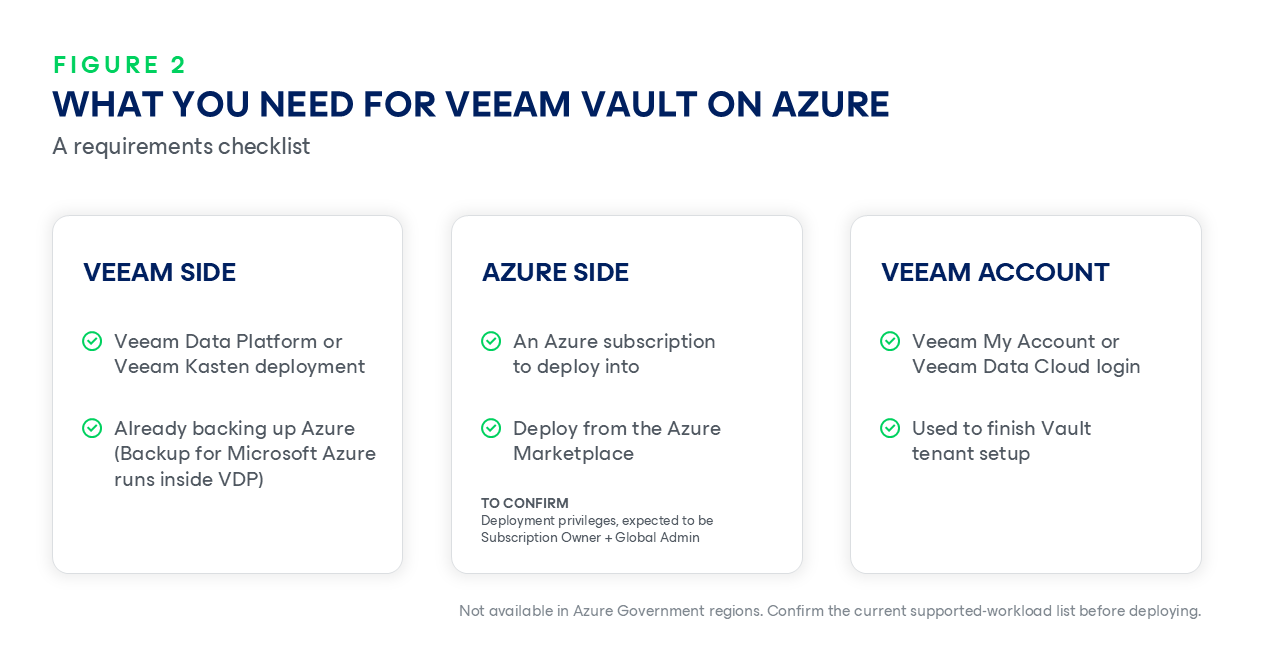
Getting Veeam Vault ready for Azure is mostly a matter of having the right Veeam product in place and an Azure subscription to deploy into. Because Veeam Vault is a storage target rather than a separate backup tool, it plugs into the backup workflow you already run.
Here’s what you need on each side:
- A supported Veeam deployment. You need an existing Veeam Data Platform or Veeam Kasten environment that’s already backing up Azure. Veeam Backup for Microsoft Azure runs inside Veeam Data Platform, so backups you already create there can target Veeam Vault directly, with no connector or add-on to install.
- An Azure subscription. You’ll need your own subscription to run Vault. If you buy through the Azure Marketplace, Vault deploys into that subscription; if you purchase through a reseller or the Veeam Online Store, you connect it without the Marketplace deployment step.
- A Veeam account to finish setup. You’ll complete Vault tenant setup with a Veeam My Account or Veeam Data Cloud (cloud.veeam.com) login.
On workloads, Veeam Vault stores whatever your connecting Veeam product protects. For an Azure environment, that typically includes image-level Azure VM backups and Azure database workloads.
One exclusion to flag up front: Veeam Vault isn’t currently available in Azure Government regions. If you operate in a public sector or otherwise regulated Azure Government environment, confirm regional availability before planning a deployment.
For authoritative, always-current setup details, the Veeam Help Center is the source of record.
Which Is Right for You: Foundation, Advanced, or Archive
Veeam Vault comes in two editions, Foundation and Advanced, and the right one depends on how you’ll use it, not on the size of your company.
Plenty of large enterprises run Foundation because they don’t restore often, while some smaller teams choose Advanced for the headroom. Both editions share the essentials: Backups are immutable by default, encrypted with AES 256-bit, and held to a 30-day minimum retention. The differences come down to durability, how much you read and restore, and how precisely you control where data lives.
For the complete specifications, see the Veeam Vault edition comparison.
Foundation is right for you if:
- Cost predictability matters more than frequent restores.
- Recovery testing happens occasionally rather than continuously.
- A single-country data residency requirement is enough.
- Vault is a secondary or tertiary copy, not your primary recovery source.
Advanced is right for you if:
- You run frequent recovery tests or DR drills and want read and restore costs off the table.
- You have a region-level, not just country-level, data residency requirement.
- Your workloads are business-critical and warrant the highest available durability tier.
- You operate in a region where Azure ZRS is available and want to use it.
Where Vault Archive fits
Foundation and Advanced hold your recent, recovery-critical backups on performance-optimized storage. For data you must keep for years but rarely touch, Veeam Vault Archive completes the picture. It’s a fully managed, archival-class tier for secure, compliant, long-term retention at the lowest cost, and it runs under the same platform at the same predictable pricing model, so there are no new tools to bolt on.
The two work together rather than competing. Recent backups stay on Foundation or Advanced, while aged backups tier automatically into Vault Archive through policy-based tiering, with no manual data shuffling between tiers. Archived data keeps the same security posture you’d expect from Vault: Immutable by default, AES 256-bit encrypted, logically air-gapped, and stored in a region you choose, with every byte verified clean and backed by malware scanning for NAS and cloud workloads in Veeam Data Platform v13.1.
Vault Archive is right for you if:
- You need compliant, long-term retention without over-provisioning premium primary storage.
- You want to tier cold data, including redundant, obsolete, and trivial (ROT) data, into low-cost archive and reclaim capacity you’ve already paid for.
- You’re looking to retire physical tape for a fully managed cloud archive that stays accessible on demand.
- You need a validated, cyber-resilient clean archive as a last line of defense after an attack.
- You’re archiving large unstructured NAS data sets and want to cut capacity and power demands while keeping the data retrievable.
Getting Started with Veeam Vault
The whole point of a managed target is speed, and Veeam Vault is built to be usable in minutes rather than days. There’s no capacity to plan, immutability to configure, or separate egress billing to set up. You subscribe, point your backups to it, and you’re protected.
You can buy Veeam Vault four ways: Through the Azure Marketplace for self-service, through the Veeam Online Store, through a preferred reseller, or through a service provider. Vault is billed annually upfront on a per-TB basis, so your storage spend is set and predictable from the start.
For a self-service setup through the Marketplace, the flow is short:
- Subscribe to Veeam Vault through the Azure Marketplace listing for your region.
- Choose your edition, then specify the country (Foundation) or region (Advanced) where your data will live.
- Sign in with your Veeam My Account or Veeam Data Cloud login to finish tenant setup.
- In your Veeam console, select Veeam Vault as the backup repository and target your Azure backups to it.
That’s it. From there, every backup that lands in Vault is immutable and air-gapped by default, with nothing further to harden.
Want to see it before you buy? Veeam Vault has a live interactive demo that walks through connecting it to Veeam Data Platform and targeting your backups, so you can watch the setup end to end.
Ready to get started? Get Veeam Vault on the Azure Marketplace in minutes, or learn more about Veeam Vault.
FAQs
Yes. Every backup written to Veeam Vault is immutable by default, placed in a write-once, read-many (WORM) state that can’t be turned off. Vault is also logically air-gapped from production, so a recovery copy stays isolated from a compromised account, with no manual locking to configure.
Yes. Veeam Vault works with Veeam Backup for Microsoft Azure, which runs inside Veeam Data Platform, so the Azure backups you already create can target Vault directly. It also supports backups from Veeam Data Platform and Veeam Kasten. No connector or add-on is required.
Foundation and Advanced share immutability, AES 256-bit encryption, and a 30-day minimum retention. Advanced adds higher durability (up to 12 nines via zone-redundant storage, versus 11 nines), unlimited reads and restores rather than fair use, and region-level data locality rather than country-level. Choose based on how often you restore and how tightly you need to control residency.
Not currently. Veeam Vault is not available in Azure Government regions today. If you operate in a public sector or regulated Azure Government environment, confirm regional availability with Veeam before planning a deployment.
For a full list of available Azure regions, please see our edition comparison (link to edition comparison).