

VeeamON 2026 is in the books, and the product keynote gave us a lot to unpack. Veeam Data Platform v13.1 ships this summer, touching nearly every part of the stack. Looking for an executive summary? Check out our overview of what V13.1 means for customers. For what it looks like under the hood, keep reading.
Veeam Data Platform v13.1: More Workloads, Broader Coverage
Veeam Data Platform v13.1 (coming summer 2026) will continue to push the boundaries of workload coverage. It’s no secret that today’s environments aren’t the same as they were five years ago. With organizations shifting to public cloud and reevaluating their hypervisor choices, the need to move and protect data has never been more pressing.
Veeam is here to continue partnering with customers by meeting them where they are and where they are going, and we’ve shared our plans to do so. Expanding on our breadth of support today, multiple new hypervisors are joining the lineup, including Red Hat OpenShift Virtualization, Sangfor aSV, Vates XCP-ng, and Citrix XenServer. Combined with existing coverage for VMware vSphere, Microsoft Hyper-V, Nutanix AHV, Proxmox VE, HPE VM Essentials, and others, Veeam now covers 95% of the major hypervisors in use today.
This release furthers the Universal Hypervisor API journey, an open integration framework that lets hypervisor vendors build and maintain their own integrations, with Veeam validating and supporting them. For organizations that run mixed virtualization estates — and especially those diversifying away from a single vendor — this is a big deal. You can protect what you run today and what you will migrate to tomorrow without switching backup tools. All new hypervisors also provide cross-platform portable recovery right out of the gate, ensuring that you retain ownership of your data.
End-to-End Cyber Resilience: Before, During, and After an Attack
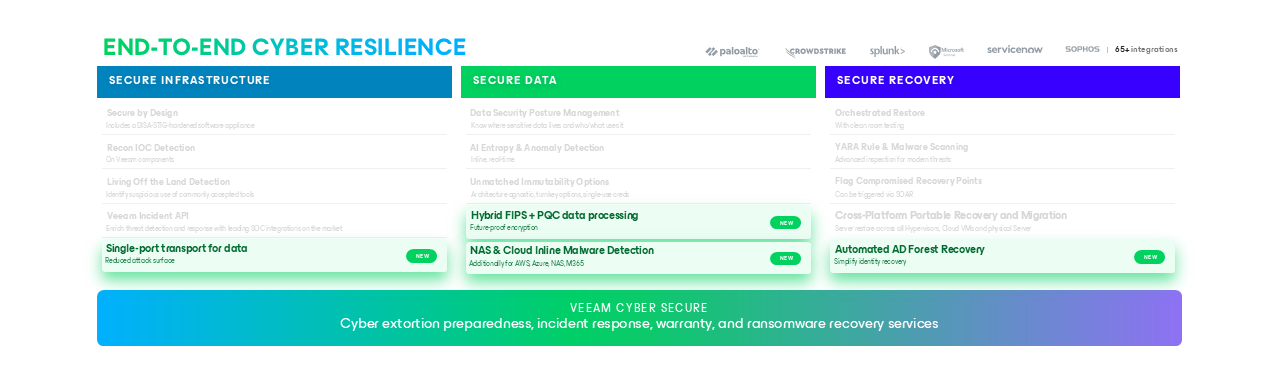
Veeam Data Platform has long been built on a security-first foundation. Immutability, encryption, hardened repositories, and zero-trust architecture aren’t new additions; they’re the baseline. V13.1 expands that baseline across three pillars:
Secure Infrastructure: It all starts with components that you can trust. Veeam Data Platform is built to work alongside existing workflows, not against them. This release consolidates, simplifies, and customizes required network ports — reducing potential attack surfaces, simplifying firewall and security requirements, and driving scalability for modern organizations. This is in addition to the existing secure-by-default configurations on Veeam Software Appliance, Recon detection for Veeam infrastructure components, and open SOC integration through the Veeam Incident API.
Secure Data: Quantum computing changes everything when it comes to securing your data, and organizations should be actively planning for that now. V13.1 introduces early support for a hybrid FIPS and post-quantum cryptography solution, and is designed so organizations can adopt PQC without redeploying their infrastructure or sacrificing FIPS compliance.
But that’s not all. Veeam inspects data in flight as it is being backed up, including Indicators of Compromise (IoC) scanning and AI-powered entropy analysis that runs inline in real time. New in V13.1 are threat detection capabilities for NAS and Azure workloads, with AWS to follow.
Secure Recovery: Recovery is a moot point if your identity is compromised. Attackers often compromise Active Directory for domain-wide control and ransomware at scale, and recovery typically requires restoring it to a known-good state — a painstaking process under the best of circumstances, let alone during an active cyber threat. This release changes that with automated Active Directory Forest Recovery, turning one of the most stressful tasks in incident response into a controlled, repeatable process.
Backing all of this is Veeam Cyber Secure, which bundles cyber extortion preparedness, incident response, and ransomware recovery services.
Automated AD Forest Recovery: Days to Minutes
Active Directory (AD) is the backbone of most enterprise environments, and recovering a compromised AD forest has historically been one of the most painful processes in IT. Microsoft’s own best-practices guide runs hundreds and hundreds of pages and covers 40+ manual steps, including seizing FSMO roles, resetting the krbtgt password (twice), rejoining domain controllers, validating replication, cleaning orphan metadata, and so on. This can take days of coordinated effort and leaves plenty of room for human error.
So why should this be on your radar? AD forest compromise is the most common ransomware end-state; attackers target AD specifically because taking it down prevents the recovery of everything else. Veeam’s new AD Forest Recovery capability compresses that entire recovery into a wizard-driven workflow where you can select a forest’s point-in-time, define domain controllers per domain, specify source backups and target settings, and go. A guest agent collects metadata to map the forest structure, the wizard combines AD-specific restore steps with the existing virtual machine (VM) restore engine, and post-restore activities start Active Directory automatically. The wizard significantly reduces recovery time, with initial testing showing the most dramatic improvements in standard forest topologies. This is a meaningful step toward modern identity resilience and replaces the patchwork of manual runbooks and point products most organizations rely on today.
A Unified Command Center for the Veeam Portfolio
One of the more architecturally significant announcements was around the new DataAI Command Platform. This is the unifying architecture that Veeam is building, bringing together Data Resilience, Security, Governance, Compliance, and Privacy. Within this, we have the DataAI Resilience Module, which offers a singular operation surface for resilience workloads. What does this mean in real terms? Think centralized console that provides visibility and capabilities across the entire Veeam portfolio. A unified pane of glass for custom views tailored around tenants, workloads, and KPIs, covering everything from compliance posture to recovery readiness, all in one place.
At its heart is the DataAI Command Graph, which connects what you’re protecting with who has access, what policies apply, and where risk exists across your environment. Veeam Data Platform v13.1 will be among the first workloads onboarded to this model, with broader portfolio coverage to follow.
The onboarding approach is worth highlighting: no data migration, no rip-and-replace. You activate it and your existing environment lights up. That removes one of the biggest practical barriers to platform consolidation. Veeam ONE also continues to evolve with its own upcoming release, so existing on-premises monitoring investments aren’t going anywhere.
Backup Admin Agent: AI-Assisted Operations
During the keynote, we not only heard about the possibilities of what the DataAI Resilience Module will unlock, but we also saw it in action. Native AI Agents will provide you with not only the data you are looking to restore, but the entire contextual impact of that data. A recording is available at VeeamON.com to see it in action.
Beyond the keynote, Veeam Intelligence is evolving with a new Backup Admin Agent. This AI-powered assistant is designed to help backup administrators with day-to-day operational tasks that go beyond basic configuration-style questions — bringing expertise to your console when you need it most:
- Job session analysis for faster root-cause analysis, removing the burden to comb through logs while providing details in an easy-to-understand dialog. (Think: “Why did the SQL-Prod-01 backup fail last night?”)
- Proactive support and integration that goes beyond reactive troubleshooting. The agent can detect recurring issues and correlate them with known fixes from Veeam’s knowledge base.
- Capacity advisory that analyzes growth trends across your repositories and generates optimized storage sizing reports with recommendations based on actual consumption patterns.
It all adds up to less manual effort managing complex backup environments.
The Backup Admin Agent builds on the existing Veeam Intelligence framework in Veeam Data Platform, so administrators already familiar with the platform will find a consistent experience.
What It All Adds Up To
Across all these announcements, the throughline is platform convergence. Veeam now connects backup, security, and identity resilience into a single operational surface. For existing customers in mid-market and enterprise, the practical implication is straightforward: you don’t have to choose between the Veeam Data Platform you run today and the future Veeam is building now. The Resilience Module activates on your existing environment, so you can take full advantage of SaaS management while keeping your on-prem backup deployments running as-is. No data migration, no rip-and-replace.
On top of that, Veeam Data Platform v13.1 ships this summer with the cyber resilience and identity recovery improvements covered above, and the broader platform fills in around you as 2026 progresses.
For hands-on-keyboard folks, the near-term wins are concrete. Broader hypervisor support, Active Directory Forest recovery in minutes instead of days, single-port secure transport, NAS and cloud malware detection, post-quantum cryptography, and a unified console you activate without migrating. As we get closer to the V13.1 release this summer, we’ll share more details on feature availability across Veeam Data Platform editions, along with upgrade guidance to help you plan your rollout.
