


Key Takeaways:
- Ransomware is on the rise. Nearly 69 percent of organizations faced a ransomware incident in 2024–2025 (Veeam Risk to Resilience Report 2025).
- Traditional backups recover data but cannot detect active threats. Attackers now run slow, stealth campaigns that evade resource‑spike alerts and standard monitoring tools.
- Veeam’s Ransomware Detection Service adds AI‑powered threat intelligence on top of the core/traditional backup workflow. It uses unsupervised machine learning to identify encryption patterns and anomalies before damage spreads.
- Built on Random Cut Forest (RCF) models, it learns continuously without manual training. This efficiency reduces cost while improving accuracy and time to detection.
- Dual attack profiles cover both rapid and stealth encryption attempts. Outputs are combined through ensemble methods for maximum precision.
- Privacy‑preserving and human‑verified. Curated, derived statistics are analyzed by the RCF models, and security operators verify detected anomalies through a controlled API.
Ransomware attacks in 2024–2025 have become far more deliberate. Attackers often spend time stealing credentials, moving laterally, and exfiltrating data before triggering encryption. When the payload finally runs, many variants use intermittent or selective encryption, encrypting only portions of files or skipping large data segments, to disguise activity and accelerate impact. Because of this, detections that rely solely on sudden resource spikes can miss early warning signs, leaving organizations unaware until recovery becomes impossible.
At Veeam, we designed the Ransomware Detection Service to close that visibility gap. It adds an artificial intelligence layer to your backup and recovery strategy, using unsupervised machine learning to spot ransomware indicators directly within backup data. The system learns what “normal” looks like for every protected object and flags anomalies that deviate from historical patterns — whether it’s a sudden burst of file entropy or a subtle change in extensions over time.
Powered by the Random Cut Forest (RCF) models, Veeam’s approach is efficient, granular, and patent‑pending. It runs multiple models per user or protected object, continuously learning and adapting to resource-specific data patterns without manual retraining. Dual attack profiles detect signs of both fast-moving and stealth attack profiles by looking at trends of curated signals over time.
The result is AI‑driven ransomware defense that adapts as fast as attackers do. It delivers early, efficient detection for every object you protect with Veeam backups.
Why Ransomware Detection Needs AI in 2026
Artificial intelligence enables defenses that can adapt to threat actors changing tactics. Veeam’s Ransomware Detection Service uses machine learning models that continuously learn and adjust to new data access patterns. Each model can recognize subtle signals of compromise, such as unusual file modification rates or entropy changes that may indicate encryption activity.
These models employ several advanced techniques:
- Unsupervised training: They learn normal behavior without needing manually labeled examples, reducing operational cost and improving time to detection.
- Online learning: They update continuously as new backup data arrives, improving precision over time without downtime or retraining.
- Ensemble methods: Outputs from multiple models are combined to improve prediction accuracy and minimize false positives.
According to the Verizon DBIR 2025 Report, ransomware now accounts for nearly one‑third of all data‑encryption breaches. AI‑based detection brings the adaptability and efficiency required to identify threats before they disrupt operations, and before recovery becomes the only option left.
How Veeam’s Ransomware Detection Service Works
The Veeam Ransomware Detection Service uses a machine learning technique known as Random Cut Forest (RCF) to identify anomalies in backup data. RCF is an unsupervised machine learning algorithm that detects outliers by analyzing statistical patterns across large data sets. In Veeam’s implementation, the models examine derived metrics from each backup, such as file entropy, file‑type distribution, and modification rates, to determine when activity deviates from normal behavior.
Random Cut Forest Approach
Veeam’s RCF models continuously integrate new data and learn from historical observations. Because the models adapt automatically, they require no manual retraining or rule updates. This unsupervised, continuous learning significantly reduces cost while improving both accuracy and time to detection. Only derived statistics are analyzed, never the raw backup content, ensuring privacy‑preserving detection that complies with data‑residency and confidentiality requirements.
Dual Detection Profiles
Two complementary detection profiles run in parallel to ensure full coverage across different ransomware behaviors:
- Fast Attack Profile: Detects rapid encryption bursts that occur during large‑scale, high‑speed attacks.
- Extended Attack Profile: Monitors gradual, low‑volume encryption across a series of backups to identify stealth or slow‑moving attacks.
Outputs from both profiles are combined using ensemble methods, which merge multiple model results to strengthen prediction accuracy and reduce false positives.
Human‑Verified Threat Assessment
When an anomaly is detected, it is first flagged for review and correlation. Security operators then validate the event through a role‑based‑access‑controlled (RBAC) API before escalation. This human verification ensures that only confirmed threats trigger alerts or workflow responses, maintaining operational continuity, and preventing unnecessary disruption.
Together, these capabilities create a layered detection system that learns, adapts, and validates in real time. By embedding AI directly into backup analytics, Veeam extends data protection beyond recovery, delivering early‑warning visibility into ransomware activity.
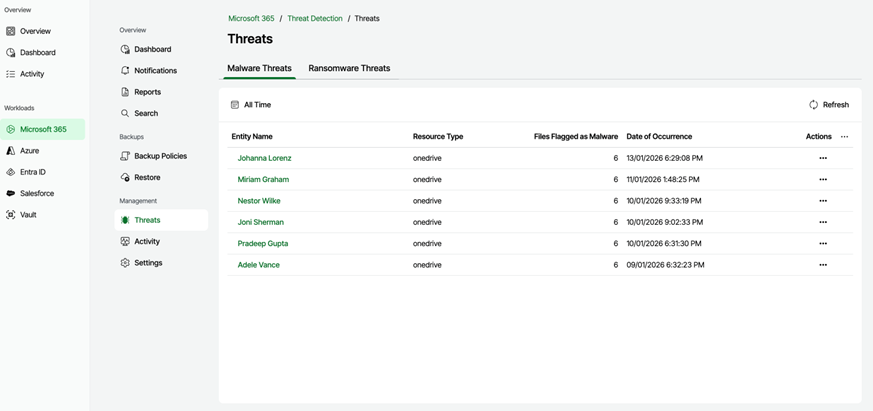
Threat Center
Threats are available to view under the management section in the Veeam Data Cloud UI. This contains two tabs:
- Malware Threats: lists users whose OneDrive, Teams or SharePoint files were flagged as containing malware during a backup session.
- Ransomware Threats: lists resource where anomalous encryption activity was detected.
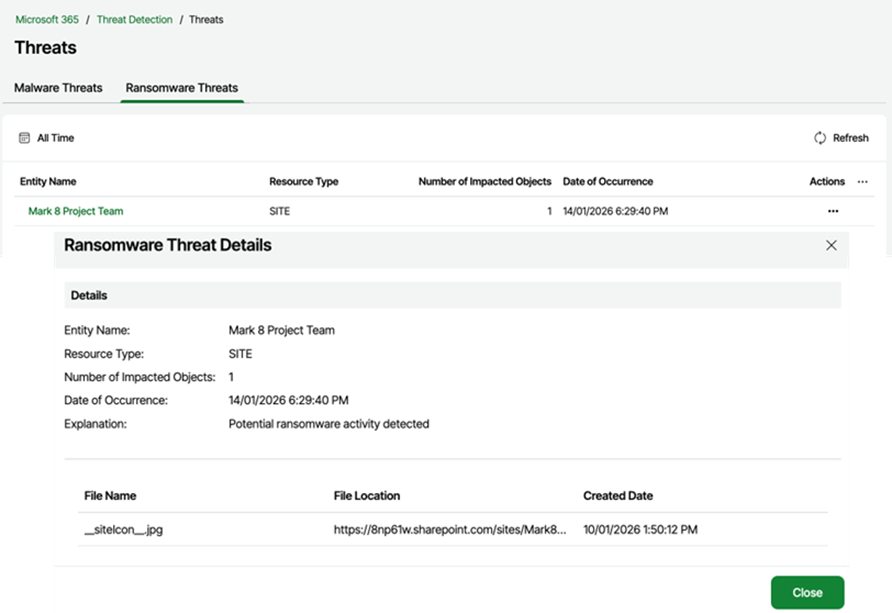
Investigating a Ransomware Threat
In Veeam Data Cloud, you can click the Ransomware Threats tab to see detections based on anomalous backup behavior. To investigate, click any row in the Ransomware Threats tab, or click the 3 button action menu and select View Details. Ransomware detections are scoped at the site or resource level. Details include the Entity Name, Resource Type, Number of Impacted Objects, and Date of Occurrence.
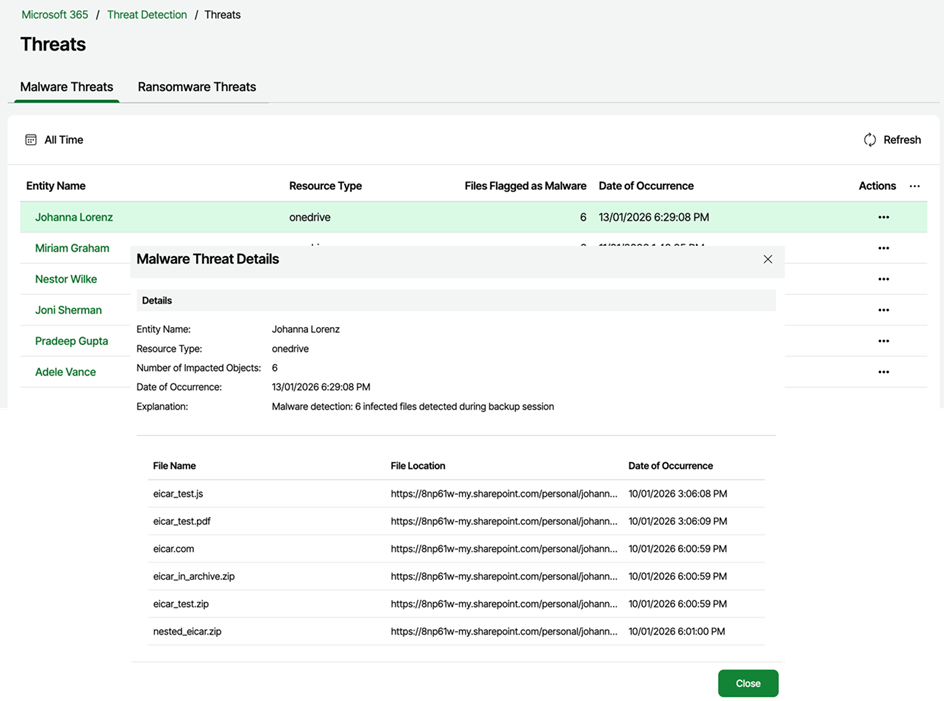
Investigating a Malware Threat
Malware Threats are provided by Microsoft and scoped at the site or resource level. You are provided with similar details to the ransomware threats, including Entity Name, Resource Type, Files Flagged as Malware, and Date of Occurrence.
What Does Veeam Monitor?
Veeam’s Random Cut Forest (RCF) models analyze signals including, but not limited to:
- File entropy: the randomness or disorder within file content, which increases significantly during encryption.
- File change rates: unusual spikes or steady deviations in the number or frequency of file modifications.
- Known malicious extensions: abnormal file‑type patterns or renamed extensions commonly associated with ransomware.
These signals collectively form a statistical fingerprint of each backup over time. When the observed metrics deviate from historical baselines, the model flags a potential anomaly.
How Are Anomalies Flagged?
The RCF models evaluate each backup incrementally, comparing new observations against previous patterns. When a backup shows statistically significant deviation, whether a rapid surge in entropy or a subtle, persistent drift, the system generates an alert. Each alert is automatically categorized by severity and context, ensuring that legitimate system changes (such as normal patch deployments or large file uploads) are not mistaken for ransomware indicators.
How Is Data Protected During Analysis?
All analysis occurs within Veeam’s secure infrastructure perimeter. The models operate exclusively on derived statistics rather than actual customer data, maintaining compliance with privacy regulations and respecting data‑residency boundaries. This approach ensures that ransomware detection never compromises the confidentiality of the information being protected.
Key Benefits for CIOs and CISOs
| Personalized Threat Detection | Each protected object has dedicated ransomware detection models that continuously learn from object-specific data access patterns. This granular, tailored approach catches anomalies that less-granular models would miss. |
| Privacy-Preserving Architecture | Anomaly detection operates solely on derived statistics (file counts, entropy scores). File content stays within the backup system and never enters the ML model. |
| Comprehensive Coverage | Detects multiple strains of ransomware attacks (e.g. fast “blitz” attacks and slow-moving “stealth” attacks). |
| Real-time Unsupervised Learning | Unsupervised learning incrementally adapts to your environment in real-time. No need for manual configuration or re-train models from scratch. |
Real‑World Use Cases
AI‑driven ransomware detection is already helping organizations identify and contain threats before they cause damage. The following examples illustrate how Veeam’s Ransomware Detection Service delivers measurable security and operational value.
Accelerated Detection of Modern Ransomware Threats
Traditional security tools often detect ransomware only after encryption is complete. Veeam’s machine learning models provide early visibility by identifying encrypted files inside backups before attackers spread across systems or environments. This allows organizations to isolate affected data sets and begin recovery immediately, reducing downtime and preventing secondary compromise.
Compliance and Audit Support
Every anomaly detected by the system is documented automatically, creating a verifiable audit trail of detection events. These reports simplify compliance with regulatory requirements such as GDPR, HIPAA, and SOX by showing proactive threat detection and validated response steps. Security teams can export these reports directly for audits or internal risk assessments, improving transparency and accountability.
Strategic Impact
By integrating detection directly into backup workflows, organizations gain continuous ransomware surveillance without adding manual overhead. The models learn and adapt automatically, while human‑verified alerts ensure only confirmed threats require action. This combination of automation and oversight transforms backup data into a live security layer. It helps CIOs and CISOs close the visibility gap between prevention and recovery.
Ransomware is relentless, and recovery alone is no longer enough. In 2025, attackers move quietly, encrypting data over time and targeting backup environments directly. Detection must now happen inside the data protection layer itself.
Veeam’s Ransomware Detection Service Provides That Visibility.
Built on efficient, patent‑pending technology, it analyzes every file that is backed up, without sampling or shortcuts. Using the Random Cut Forest algorithm and dual attack profiles, it recognizes both fast and stealth encryption patterns, adapting automatically as new data arrives.
This approach delivers granular, personalized protection for each user and workload, combined with privacy‑preserving analysis and human‑verified alerts. The result is intelligence that learns continuously, detects threats early, and strengthens resilience before recovery is required.
With Veeam, organizations gain more than backup. They gain a proactive defense that sees ransomware as it happens. Read this white paper to learn more about Veeam’s advanced threat detection capabilities.
Explore how Veeam’s AI‑driven protection can help your business detect, defend, and recover faster.
FAQs
1. What is Veeam’s Ransomware Detection Service and how does it work?
Veeam’s Ransomware Detection Service is an AI‑powered capability that analyzes backup data to identify signs of ransomware encryption before damage spreads.
It uses the Random Cut Forest machine learning algorithm to spot anomalies in signals such as file entropy and modification patterns.
Dual attack profiles detect both rapid and slow encryption attempts, and human review verifies findings for accuracy before alerts are escalated.
2. Why does ransomware detection require machine learning in 2025?
Modern ransomware is stealthier than ever, often encrypting data gradually to bypass traditional alerting based on resource spikes.
Machine learning algorithms like Random Cut Forest learn normal backup behavior and detect subtle deviations that signal malicious activity.
According to the Verizon DBIR 2025 Report, ransomware accounts for nearly one‑third of data encryption breaches, making AI‑based detection essential for early intervention.
3. How does Veeam protect data privacy while using AI for ransomware detection?
The service analyzes derived statistics only, such as entropy scores and file change rates, never the actual backup content.
All processing takes place within Veeam’s secure infrastructure perimeter, maintaining data residency and compliance with privacy regulations.
This privacy‑preserving architecture ensures ransomware detection adds security without compromising confidentiality or performance.

