- Veeam Support Knowledge Base
- How to Remove Missing Restore Points From Veeam Cloud Connect Backups
How to Remove Missing Restore Points From Veeam Cloud Connect Backups
| KB ID: | 3187 |
| Product: | Veeam Backup & Replication | 11 | 12 | 12.1 | 12.2 | 12.3 | 12.3.1 | 12.3.2 | 13 | 13.1 |
| Published: | 2020-05-27 |
| Last Modified: | 2026-07-16 |

Cheers for trusting us with the spot in your mailbox!
Now you’re less likely to miss what’s been brewing in our knowledge base with this weekly digest

Oops! Something went wrong.
Please, try again later.
Purpose
This article documents how to handle a situation in which the tenant of a Cloud Provider needs to forget missing restore points from a backup chain stored in a Cloud Repository. By design, the Forget and Remove operations are not available for restore points in a Cloud Repository.
A restore point can become unavailable, for example, if the backup repository is not available or a backup file is missing in the backup chain. Backup chains that contain missing restore points get corrupted — you cannot perform backup or restore VM data from the missing restore point and restore points that depend on the missing restore point.
Solution
Starting with Veeam Backup & Replication v11 (11.0.0.825), two PowerShell cmdlets were created that allow a Service Provider to find and then forget missing restore points for a specific tenant.
(Usage examples are available in the User Guide)
PowerShell Example Script
The PowerShell commands below are to be performed by the Service Provider on their Cloud Connect (Veeam Backup & Replication) server.
Important: Any restore points that are located on a repository or extent that is inaccessible or in maintenance mode will be considered unavailable. Review the list of unavailable restore points output by the Get-VBRCloudUnavailableBackupFile cmdlet closely to ensure the correct files will be forgotten.
Part 1: Service Provider Actions
- Run the following three commands to list all backup files marked as unavailable for the specified tenant.
Replace "ABC Company" with the tenant name.
$tenant = Get-VBRCloudTenant -Name "ABC Company"$backupfiles = Get-VBRCloudUnavailableBackupFile -CloudTenant $tenant$backupfiles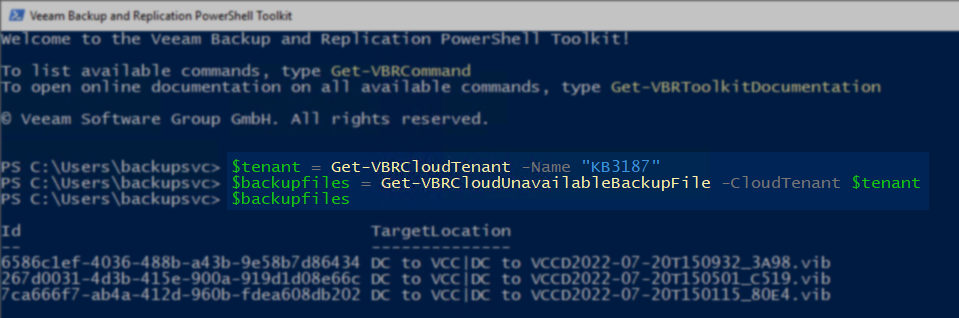
- Review the list of unavailable restore points and ensure it matches the list of unavailable restore points that appear in the tenant's Veeam Backup & Replication console.
Note:- If the list of restore points shown in the PowerShell output does not match what was expected, rescan the repository within the Service Provider's Veeam Backup & Replication console.
- Review the list of restore points carefully. Any restore points that are located on a repository or extent that is inaccessible or in maintenance mode will be considered as unavailable.
- Run the following command to forget the listed unavailable restore points, removing them from the database.
Note: The optional parameter -IncludeDependentFiles can be added to also trigger forgetting restore points that depend upon the unavailable restore points. If dependent backup files are present, they will be displayed in the command output and may be accompanied by the error:Unable to forget the specified backup file <backup_file_name>: there are dependent backup files in backup repository. To forget the backup file anyway use -IncludeDependentFiles
Restore points that are forgotten are not removed from the disk; only the reference to them in the database is removed.
Forget-VBRCloudUnavailableBackupFile -BackupFiles $backupfiles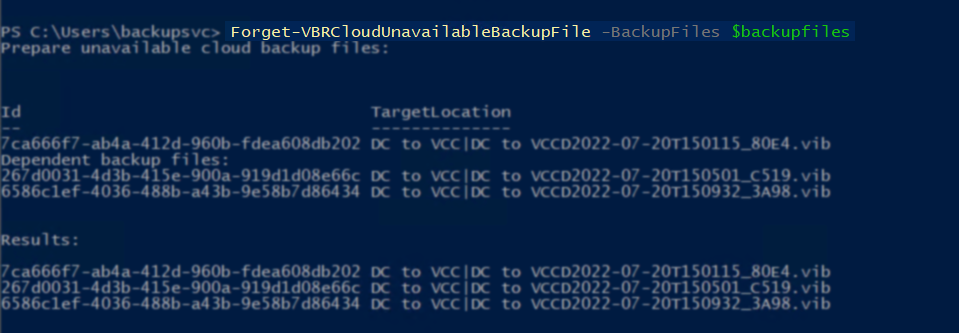
Part 2: Tenant-side Actions
- Ensure that all jobs using the Cloud Repository provided by the Service Provider are stopped and disabled.
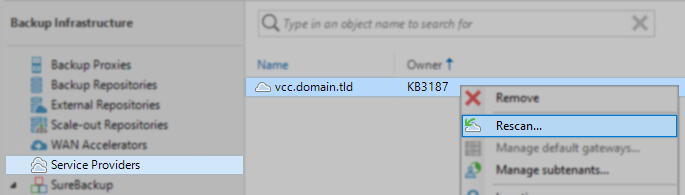
- Once the unavailable restore points have been forgotten on the Service Provider side, the Tenant will need to rescan the Service Provider to receive the updated list of restore points.
In the Tenant's Veeam Backup & Replication Console under Backup Infrastructure -> Service Providers, right-click on the appropriate service provider entry and select Rescan.
If this KB article did not resolve your issue or you need further assistance with Veeam software, please create a Veeam Support Case.
To submit feedback regarding this article, please click this link: Send Article Feedback
To report a typo on this page, highlight the typo with your mouse and press CTRL + Enter.
