

Key takeaways
- Ransomware is a resilience problem, not just a security one. The real question is whether you can recover when attackers get through.
- Having backups is not the same as being able to recover. Completeness, frequency, immutability, and tested restores decide the outcome.
- The hardest part of a response often isn’t technical. Unclear roles and slow decisions cost more time than the malware does.
- Recovery readiness is built before the incident, through clear decision authority, isolated clean recovery, and rehearsed coordination.
- Test your recovery and your response. Many teams are more confident in their ability to bounce back than their results justify.
Here’s the uncomfortable truth: Many organizations have a ransomware plan, but far fewer can execute it, recover cleanly, and make defensible decisions under pressure. That gap, between having a plan and being ready to use it, is where ransomware does much of its business damage.
A ransomware response strategy is the set of decisions, roles, and recovery capabilities you put in place before an attack, so you can contain it, decide fast, and restore cleanly when one gets through. It treats ransomware as a resilience issue, not just a security one. Prevention still matters, but response strategy should assume prevention may fail and that the organization may need to operate through disruption. One major difference between faster and slower recoveries is whether the organization has already tested decision authority, backup integrity, recovery sequencing, and cross-functional coordination.
This guide breaks down what that readiness looks like: How today’s attacks are evolving, why solid-looking plans still fail, the five elements of a response strategy that holds up under fire, what to do in the hours after an attack, and how to keep improving so your confidence matches your actual capability.
Why ransomware response strategy matters more than ever
A ransomware response strategy is necessary because an attack is the worst possible moment to start figuring out what to do. Prevention improves your odds, but it never guarantees the outcome. The organizations that come through an incident with their operations and reputation intact are the ones that worked out their moves ahead of time: How to contain the spread, who makes the critical calls, and how to recover cleanly.
That shift, from focusing primarily on preventing attacks to also proving the organization can survive them, is what’s changed. For years, security strategy treated ransomware as something to keep out. Today, with attackers moving faster and exfiltrating data before they encrypt anything, the more useful assumption is that an attempt will eventually succeed. Once you accept that, the strategic question changes from “how do we stop this?” to “how quickly and cleanly can we recover when it happens?”
There’s also a discipline that rarely makes it into the plan: The ability to make the right call at the right moment. Under pressure, teams are flooded with incomplete information, threat-actor pressure, and competing priorities. Decision discipline means knowing in advance who decides what, what evidence they need, and what triggers each next step, so the response moves at the speed of the incident instead of the speed of a hastily convened meeting.
The most important response decisions are often made before facts are complete. Early in an incident, the organization may not yet know the full scope, whether data was stolen, whether identity is trusted, or which backups are clean. A strong response strategy defines who can act under uncertainty, what evidence is sufficient to move, and how decisions will be documented for legal, insurance, regulatory, and board review.
It’s worth being honest about confidence here. Plenty of organizations believe they could recover quickly, then discover during a real event that their backups were incomplete, their roles were unclear, or their restore process had never been tested end to end. Treating response readiness as a measurable capability, rather than an assumption, is what closes that gap.
What a strong response posture gives you:
- Speed when it counts. Predefined decisions and roles cut the hours teams usually lose to confusion early in an incident.
- Cleaner recovery. A plan built around restoring to a known-good state, not just reacting, reduces the risk of reinfection and rework.
- Business continuity, not just data recovery. The goal is keeping the organization running, which is a broader bar than getting files back.
- A genuine advantage. Recovering in days while peers lose weeks protects revenue, customers, and trust.
How modern ransomware attacks are evolving
Modern ransomware and cyber extortion campaigns are increasingly designed to create multiple forms of leverage at once: Operational disruption, stolen data, damaged recovery options, and reputational pressure. The encrypt-everything-and-demand-payment model still exists, but it’s no longer the whole picture. Attackers often steal data before they encrypt systems, target backup and identity infrastructure that recovery depends on, and tailor pressure to the specific organization in front of them.
A few shifts matter most for how you respond:
- Attack timelines are shrinking. The window between initial access and impact can be short, which leaves less time to detect, contain, and preserve evidence before business disruption begins.
- Data theft raises the stakes. When attackers exfiltrate data, restoring systems does not end the incident. The organization still must manage legal exposure, disclosure analysis, customer communications, and reputational risk.
- Backups and identity are targets. Many campaigns attempt to weaken recovery options by targeting backup infrastructure, privileged credentials, identity systems, hypervisors, and management consoles.
- Smaller organizations are not off the radar. Automation, affiliate models, and repeatable playbooks allow threat actors to pursue mid-market and smaller targets at scale.
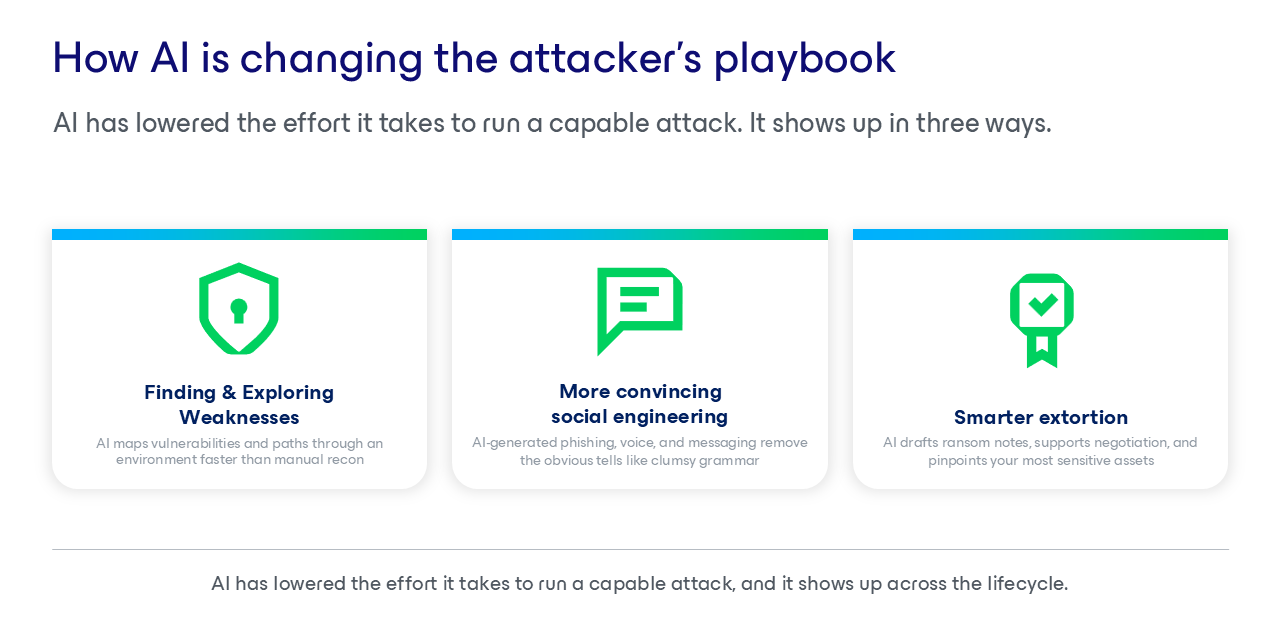
How AI is changing the attacker’s playbook
AI is best treated as an accelerator for specific attacker tasks, especially social engineering, translation, impersonation, content generation, and analysis of stolen data. Its most practical impact is that obvious phishing tells are becoming less reliable.
- Reconnaissance and research support. AI may help attackers summarize public information, generate lures, and process stolen or exposed data more quickly.
- More convincing social engineering. As today’s top ransomware attack vectors show, AI-generated phishing, voice, and messaging make the human entry points harder to spot, since the obvious tells, like clumsy grammar, are gone.
- More scalable extortion. Attackers may use AI to improve ransom notes, translate communications, summarize stolen data, and identify sensitive material that increases pressure on the victim.
The forms an attack can take
Not every ransomware event looks the same, and the shape of the attack changes how you respond. It helps to plan for three common patterns:
- Double extortion, where attackers both encrypt your systems and steal data, forcing you to manage recovery and exposure at once.
- Exfiltration only, where systems stay up but attackers threaten to release stolen data, shifting the response toward legal, disclosure, and communications decisions rather than restoration.
- Encryption with backup targeting, where attackers encrypt critical systems and try to disable or corrupt backups, making pre-validated immutability and clean restore points the deciding factor in recovery.
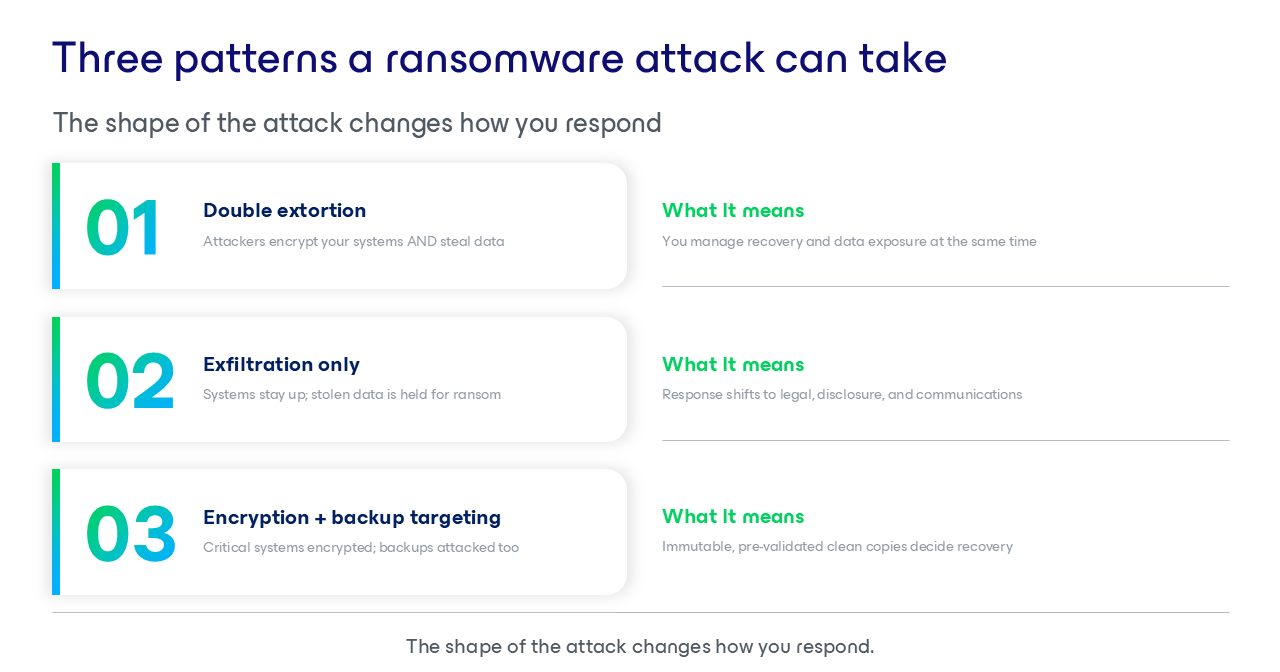
Each pattern puts pressure on a different part of your strategy, which is exactly why the next question matters so much: Why do plans that look solid on paper still fail when one of these hits?
Why ransomware response plans fail in practice
Most plans fail because they were never pressure-tested, and the gaps only surface when the clock is running. A response plan is a starting point, not a guarantee. The organizations that struggle most are usually the ones that assumed the document on the shelf would translate cleanly into action.
A few failure points show up repeatedly.
The plan does not say who decides under uncertainty
A ransomware plan can list the right technical steps and still fail because no one knows who has authority to make high-consequence decisions. Who can isolate a revenue-critical system? Who can approve emergency legal or forensic support? Who decides whether to engage a threat actor? Who briefs the board? Who owns customer and regulator communications? If these decisions are not assigned in advance, the organization is forced to build governance while the incident is already unfolding.
Backups exist, but they have not been proven to restore the business
A backup that exists is not the same as a backup you can recover from. A completed backup job is not proof of business recoverability. Ransomware recovery depends on whether the organization can identify a clean restore point, restore application-consistent data in the right order, rebuild or validate trusted identity, and complete the process within the downtime the business can tolerate. Recovery breaks down when copies are incomplete, when they don’t run often enough to meet the business’s tolerance for data loss, or when critical dependencies, like identity systems and the applications that rely on them, were never included in the plan. Teams then discover, in the middle of an incident, that what they have isn’t enough to bring operations back, and by then there’s no time to fix it.
Roles are unclear, and teams have never worked together under incident conditions
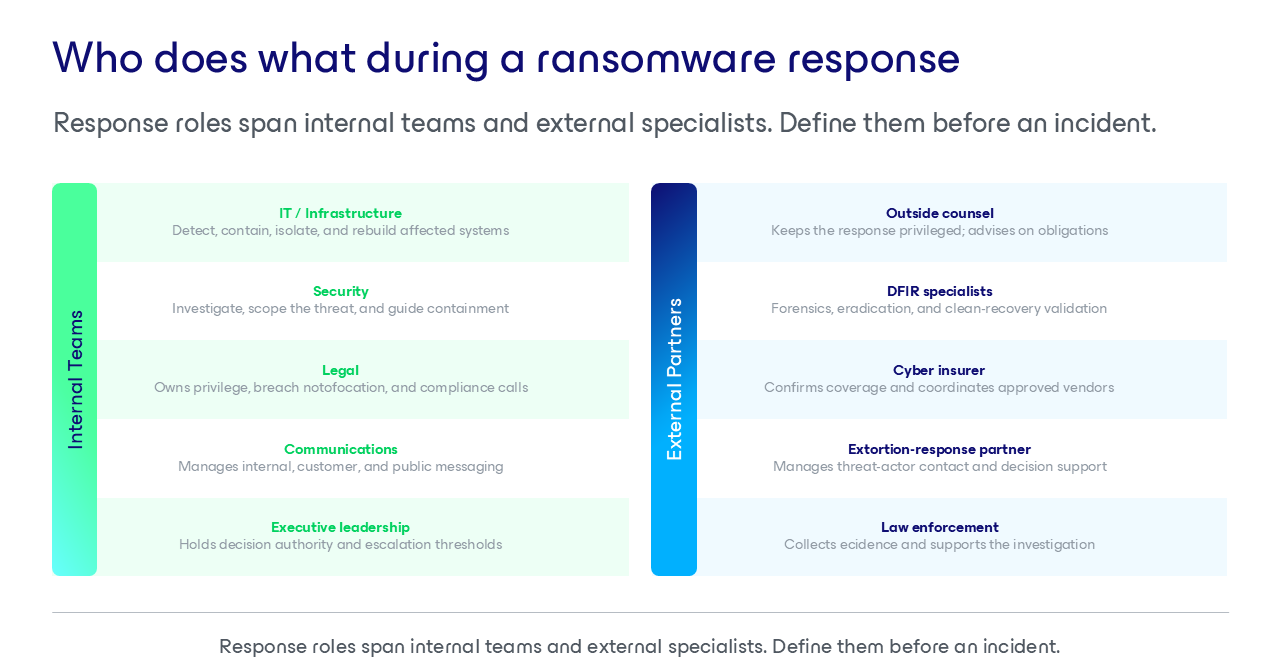
A real incident pulls in IT, security, legal, communications, and executive leadership all at once, often alongside outside specialists. If those groups have never coordinated before, the first hours get lost to figuring out who owns what. The first time these teams meet should not be in the middle of a live event.
Clear, documented ownership (who detects, who contains, who decides, and who communicates) removes that friction before it costs you time. Mapping those responsibilities in advance, across both internal teams and any external partners, is what lets a response move as one effort instead of several disconnected ones.
The extortion path was never defined
Not every ransomware event is primarily a restoration event. In exfiltration-only and double-extortion cases, the organization may need to evaluate threat actor credibility, data exposure, legal notification duties, customer communications, sanctions risk, insurance conditions, and whether engagement is useful. If those decisions are not anticipated, the organization may restore systems but still mishandle the extortion event.
The plan was never rehearsed
A strategy that’s never been exercised is really just a hypothesis. Without tabletop exercises and tested restores, you don’t know whether your runbooks work, whether your people understand their roles, or whether your recovery time is anywhere near what you assumed. Most organizations don’t find the holes until an attacker does.
Five elements of an effective ransomware response strategy
An effective ransomware response strategy comes down to five elements, and the order matters. The first two are about acting and deciding in the moment. The last three are about making sure a clean recovery is actually possible. Get these right before an incident, and the response becomes a sequence you execute rather than a crisis you improvise.
- Containment and isolation. When an attack hits, the first job is to contain the incident, slow the spread, and preserve evidence where possible. That means knowing in advance how to isolate affected systems, segments, and accounts so the malware can’t keep moving while you work. Containment buys you the room to recover safely, because restoring into a still-compromised environment just reinfects what you bring back.
- Clear decision-making authority, set in advance. Speed in a crisis comes from knowing who decides what before the crisis starts. Define who can authorize isolating critical systems, who owns the call to engage outside specialists, who controls internal and external communications, who decides whether to engage a threat actor, and when leadership and the board need to be brought in. When authority is mapped ahead of time, the response moves instead of stalling in committee.
- Backup verification and frequency. Backups only help if they are current, complete, recoverable, and aligned to the business’s actual tolerance for downtime and data loss. Confirm that backups run often enough to meet the business’s tolerance for data loss, that they cover everything needed to bring operations back (including identity systems and their dependencies), and that you’ve actually tested recovery from them, rather than assuming the jobs that completed will restore.
- Clean, immutable copies with verified integrity. Attackers target backups, so at least one recovery copy should be immutable or otherwise protected, logically isolated, monitored, and outside the reach of ordinary production credentials. Just as important, you need confidence that the restore point you recover from is free of malware, so you don’t reintroduce the threat during recovery. Verified integrity is what turns “we have a copy” into “we have evidence this copy is a defensible recovery candidate.”
- Isolated infrastructure for clean recovery. Finally, you need somewhere safe to restore. A clean, isolated recovery environment lets you bring systems back, validate identity and application behavior, monitor for signs of compromise, and make a deliberate reconnect decision before returning systems to production, so recovery doesn’t become the attacker’s second way in. Pre-defining recovery sequences for your most critical systems keeps the restore orderly when the pressure is highest. Clean recovery requires more than a separate network. It needs trusted administrative access, validated or rebuilt identity, rotated credentials, known-good restore points, clean management tooling, logging and monitoring, application owner validation, and a recovery sequence based on business priority.
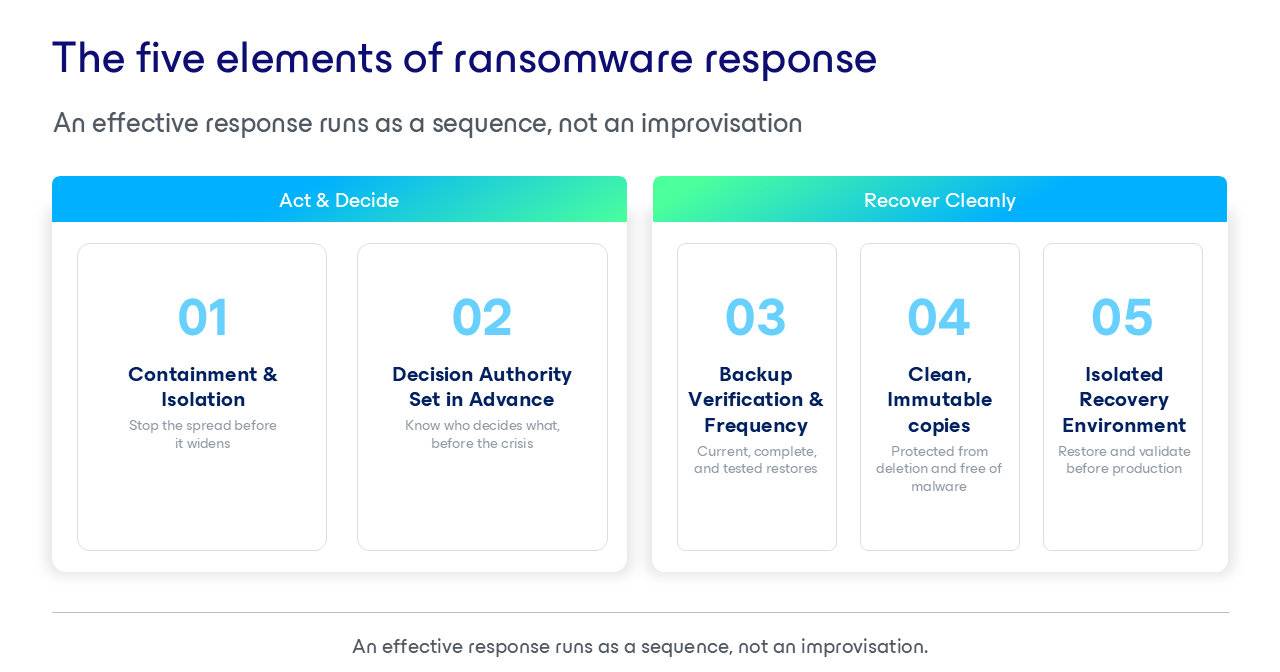
These five reinforce each other. Containment and clear authority let you act fast. Verified, immutable backups and a clean recovery environment make sure that when you do act, you’re rebuilding on solid ground.
What to do after a ransomware attack
When an attack is confirmed, the priority is to slow the damage, understand what you’re dealing with, and recover without reinfecting yourself. The steps below follow a deliberate order. Working them in sequence keeps the response controlled instead of frantic.
- Isolate affected systems immediately. Isolate affected systems, accounts, and network segments to limit spread, but coordinate containment through the incident lead so the team does not destroy evidence, interrupt critical services unnecessarily, or tip off an actor before the response structure is ready. Containment comes before anything else, because every minute of uncontrolled movement widens the blast radius and complicates recovery.
- Activate your incident response team and chain of command. Stand up the response structure you defined in advance and bring in the right outside help early. Most organizations should not expect to handle a serious ransomware or extortion event alone. These incidents often require privileged legal coordination, forensic investigation, recovery expertise, insurer coordination, crisis communications, and possibly threat-actor engagement support. Outside counsel, digital forensics and incident response specialists, cyber insurers, and ransomware negotiation partners each play a defined role. The faster you engage the people who can tell you what’s actually happening, the better your decisions will be. Knowing in advance who these partners are and how to reach them turns a scramble into a phone call.
- Assess the scope and business impact. Before deciding how to recover, develop the best available view of what was affected, whether data was stolen as well as encrypted, whether identity and privileged access can be trusted, and which systems matter most to keep the business running. This assessment shapes everything that follows, from recovery sequencing to disclosure obligations.
- Verify backup integrity before you recover. Verify backup integrity and identify the last known good restore point before you recover. Do not rush to restore into an environment you do not trust. Confirm which restore points are clean and recoverable first, so you’re not reintroducing malware or rebuilding on corrupted data. This single step is the difference between recovery and a second incident.
- Recover in a clean environment, in business priority order. Restore validated systems into an isolated environment, confirm they’re clean, then bring them back to production in the order your business needs them, starting with foundational services such as identity, DNS, network services, endpoint management, and other dependencies required for safe restoration.
- Document everything and capture lessons learned. Record key decisions, owners, timelines, and actions throughout the incident, both for legal and regulatory purposes and for the review afterward. Every incident exposes gaps. Closing them is how the next response goes better than this one.
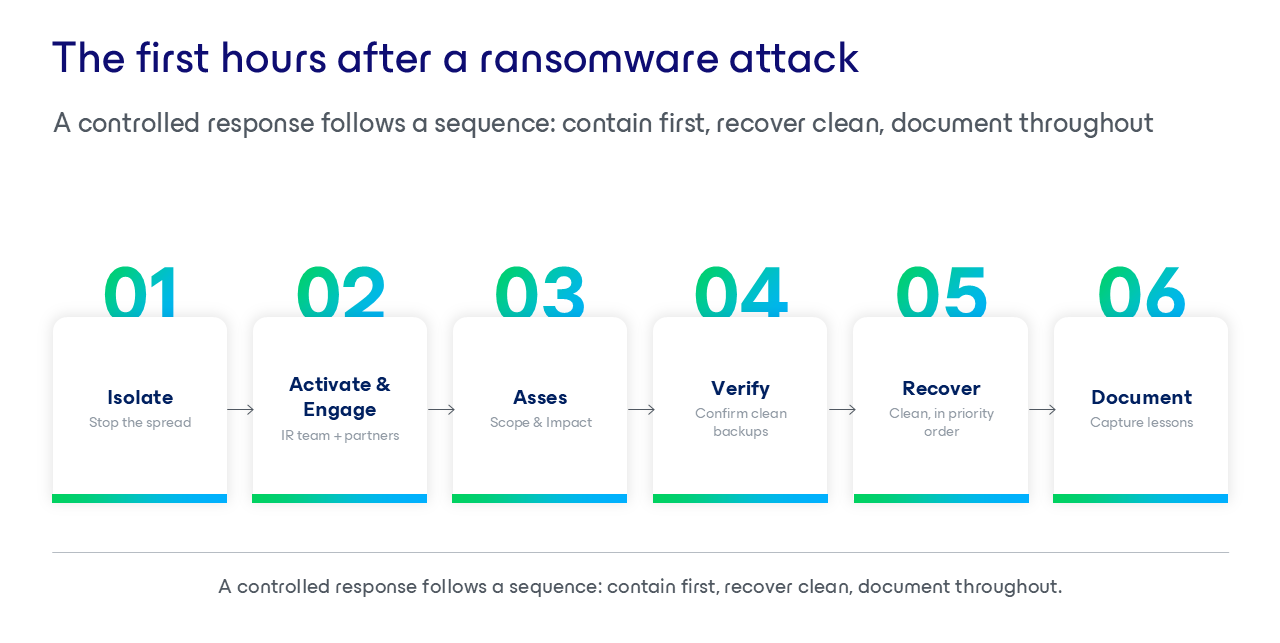
A clear sequence like this only works if the roles behind it are already assigned. That’s why the post-incident view and the pre-incident strategy are two halves of the same plan.
How to improve ransomware resilience over time
Resilience is not a project you finish; it is a capability you maintain, measure, and update as the business and threat landscape change. Threats evolve, your environment changes, and a plan that was solid last year can quietly drift out of date. The organizations that stay ready treat readiness as an ongoing practice, with a few habits doing most of the work.
- Test business recovery, not just backups. A backup job that completes tells you data was copied. It doesn’t tell you that you can restore it, in the right order, within the time the business can tolerate. Run regular recovery tests against representative systems, measure actual restore time and application usability, validate recovery order, and fix the gaps before an incident exposes them.
- Run tabletop exercises with the full group. Technical tests prove the technology works. Tabletop exercises prove the people and the process do. Bring everyone who’d be in a real incident, including IT, security, legal, communications, and executive leadership, and walk through a realistic scenario together. The goal is not to “win” the tabletop. The goal is to expose assumptions, clarify authority, test escalation paths, and practice making decisions with incomplete facts. The first time these groups coordinate should never be during a live attack.
- Get security and backup teams on one playbook. Response and recovery often live on different teams with different priorities, and that seam is where incidents get stuck. Align them on shared plans, terminology, and escalation paths, so containment and restoration move together rather than in sequence.
- Revisit your dependencies before they surprise you. Environments change constantly. New applications, identity dependencies, and critical systems all reshape what recovery requires. Review those dependencies regularly so your recovery plan reflects how your business actually runs today, not how it ran when the plan was written.
- Keep roles and escalation paths current. People change jobs and partners change. Keep your contact rosters, decision authorities, and escalation procedures updated so the plan still works when you need it, not just when you wrote it.
- Use outside perspective to find blind spots. Industry research, peer benchmarking, and external assessments surface the gaps that are hard to see from inside. Comparing your readiness against how others are performing is one of the most reliable ways to catch overconfidence before it costs you.
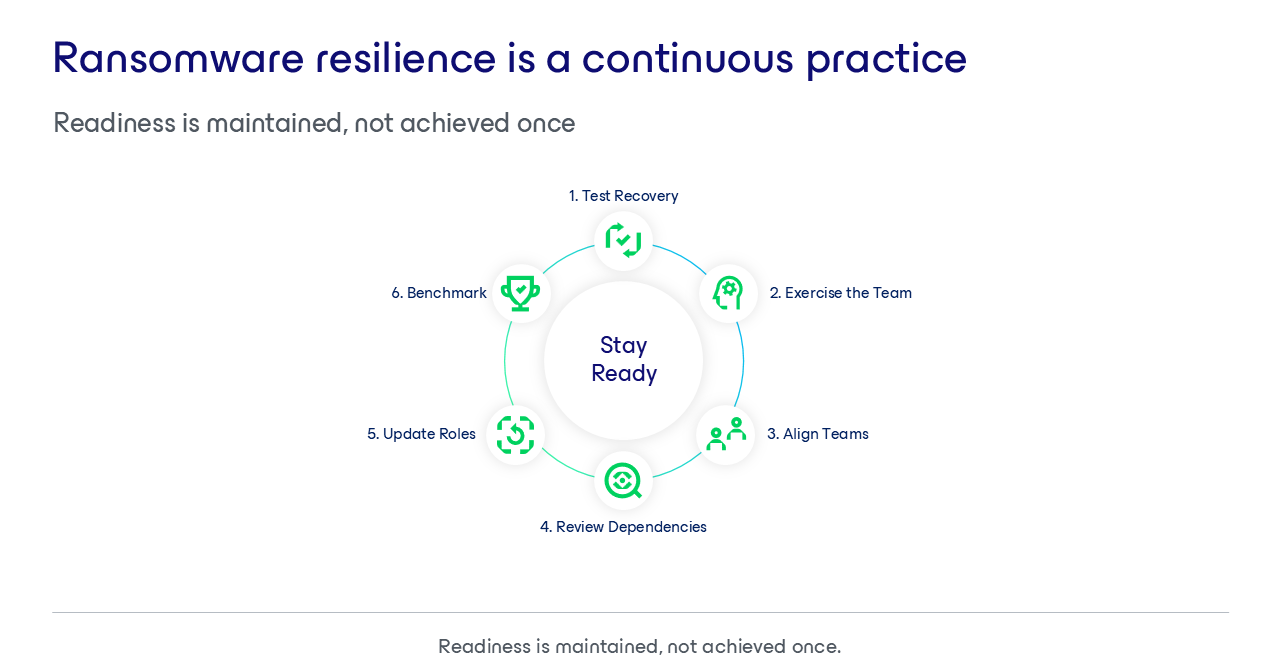
That last point is worth sitting with. The most dangerous position isn’t knowing you have gaps, it’s believing you don’t.
How Veeam helps you recover with confidence
Ransomware readiness comes down to whether you can recover cleanly, quickly, and completely under pressure. That’s the layer Veeam Data Platform strengthens, turning the five elements into capabilities you can prove rather than assume.
|
What recovery readiness requires |
How Veeam helps |
|
A copy attackers can’t delete or encrypt |
Native immutability across hardened Linux repositories, S3 Object Lock storage, tape/WORM, and Veeam Data Cloud Vault. |
|
Proof a backup will actually restore |
SureBackup automates recovery verification to confirm backups are recoverable, not just present. |
|
Recovery that doesn’t reintroduce malware |
Secure Restore scans backups during recovery and can halt or restrict a restore if a threat is found. |
|
A safe place to restore and validate |
Veeam Recovery Orchestrator restores into an isolated clean room and selects the last known good restore point before production. |
|
Confidence in recovery time and order |
Orchestrator runs non-disruptive tests that validate RPO and RTO, and auto-generates runbooks and recovery evidence. |
Veeam helps you move from assuming you can recover to knowing you can, which is the gap that separates recovering in days from losing weeks.
Conclusion
Ransomware is no longer a question of if, but when. And the organizations that come through it intact are the ones that prepared to recover, not just to defend. The hard truth running through all of this is the confidence gap: Plenty of teams believe they’re ready, then learn during a live event that their backups were incomplete, their roles were unclear, or their recovery had never been tested end to end.
Closing that gap is the whole point. Treat response readiness as a capability you build and measure, not an assumption you carry. Get the five elements in place, rehearse them with the people who’d actually run the response, and keep testing until your confidence matches your results. That’s what turns a ransomware attack from a crisis into a contained, recoverable event.
For more information on ransomware and recovery readiness, download the report.
FAQs
A complete plan covers response, recovery, extortion governance, communications, and decision authority. On the response side, that means containment and isolation steps and clear decision-making authority set in advance. On the recovery side, it means frequent and verified backups, at least one clean immutable copy, and an isolated environment to restore into. It should also name the internal teams and external partners involved, including legal, insurer contacts, DFIR, crisis communications, recovery vendors, and extortion-response advisors where appropriate.
Many recovery efforts struggle because backup jobs were treated as proof of recoverability, restore points were not validated, identity could not be trusted, application dependencies were missing, roles were unclear, and the plan had not been exercised under realistic conditions. The common thread is assumption. Teams assume their backups are complete, their roles are understood, and their recovery time is acceptable, then discover otherwise under pressure.
Backups should be verified on a schedule that matches the criticality of the systems, the organization’s recovery point objectives, and the business’s tolerance for data loss. Automated recovery verification confirms that backups are actually recoverable rather than simply present, and running it on a schedule means you catch problems before an incident does. The right frequency depends on how critical the data is and how much data loss the business can tolerate. Verification should include more than job completion; it should test whether systems can be restored, started, accessed, and validated in the expected recovery sequence.
A clean recovery means restoring from a backup that has been assessed as a defensible recovery point, into an isolated environment, before reconnecting systems to production. The point is to avoid reintroducing the threat. Scanning restore points to find the last known good copy, then validating systems in isolation, is what keeps recovery from becoming a second incident. It also requires trusted identity, clean credentials, controlled administrative access, monitoring, application validation, and a deliberate decision about when systems are safe enough to reconnect.
Attackers increasingly target backups directly, trying to delete or encrypt them to remove your recovery options. When properly configured, an immutable backup is designed to prevent alteration or deletion within its retention window, which can preserve recovery options if attackers attempt to damage backup infrastructure. That protected copy is the foundation that makes recovery without paying a ransom possible. Immutability is strongest when paired with isolation, least privilege, MFA, separate administrative credentials, monitoring, and tested restores.
A playbook is a document. Recovery readiness is a tested operational capability involving people, authority, communications, vendors, backups, identity, and recovery infrastructure. The gap between them shows up under pressure when an unrehearsed plan meets unclear roles, untested restores, and decisions no one is sure they own. Readiness comes from rehearsing the plan, testing recovery against real targets, and confirming the people and processes work, not just the paper.
Possibly. A useful test is whether your confidence is based on evidence or assumptions. Many organizations rate their recovery ability higher than their actual results justify, because confidence is based on the existence of a plan rather than proof it works. The way to find out is to test honestly: Run a full recovery against the clock, exercise the response with the whole team, and compare your readiness against industry benchmarks. If you have not tested restoration, decision authority, communications, identity recovery, and external partner engagement recently, your confidence may be ahead of your capability.
Ransomware response planning should include security, IT infrastructure, backup and recovery teams, legal, executive leadership, communications, risk management, cyber insurance contacts, and key external responders such as breach counsel, DFIR, recovery specialists, and extortion-response advisors. The goal is to define authority and coordination before an incident, not discover them during one.
