

Key Takeaways:
- Securing cloud data is your responsibility, not your provider’s. AWS and Microsoft Azure protect the infrastructure; protecting the data is on you.
- Misconfiguration and ransomware are the leading threats to cloud data, and both increasingly exploit weak identity and access controls.
- A strong posture rests on six controls: Discover and classify data, enforce least privilege, encrypt everywhere, monitor continuously, keep immutable backups, and align to compliance.
- Security isn’t complete without recovery. Immutable, offsite backups (the 3-2-1-1-0 rule) turn a breach or deletion into a recoverable event.
- Consistency is what holds up across multicloud and hybrid environments. One protection layer beats the gaps that stacked point products leave behind.
Cloud data security is the set of technologies, policies, and controls that protect data stored in, processed by, or moving through cloud environments. It covers data in all three states: At rest, in transit, and in use.
That sounds straightforward, but it breaks an assumption many teams still carry over from the data center. Traditional security drew a perimeter around the network and defended the edge. In the cloud, that edge is gone. Data moves across regions, providers, SaaS apps, and on-premises systems, and the controls that guarded a fixed network don’t translate to environments where the data never sits still.
Here’s the misconception worth clearing up first: Putting data in the cloud doesn’t make it secure. AWS and Microsoft Azure protect the infrastructure their services run on, but protecting the data itself, controlling who can reach it, configuring it correctly, and making sure you can recover it, is your responsibility. And most cloud breaches happen on the customer’s side of that line.
This guide covers what cloud data security actually takes: Why it matters now, the threats that target cloud data specifically, the controls that cut your exposure, and how to keep data protected and recoverable across every environment you run.
Why Cloud Data Security Matters
Cloud data security matters because cloud adoption has widened the attack surface faster than most security programs have adapted, and perimeter-based defenses no longer cover where data actually lives. When data spans multiple providers, SaaS platforms, and on-premises systems, every connection point becomes something to secure and a single weak link can expose data across all of them.
Security isn’t a solved problem, either. In Flexera’s 2026 State of the Cloud Report, security ranks as one of the top cloud challenges organizations face, second only to managing cloud spend, which is a position it has held for years.
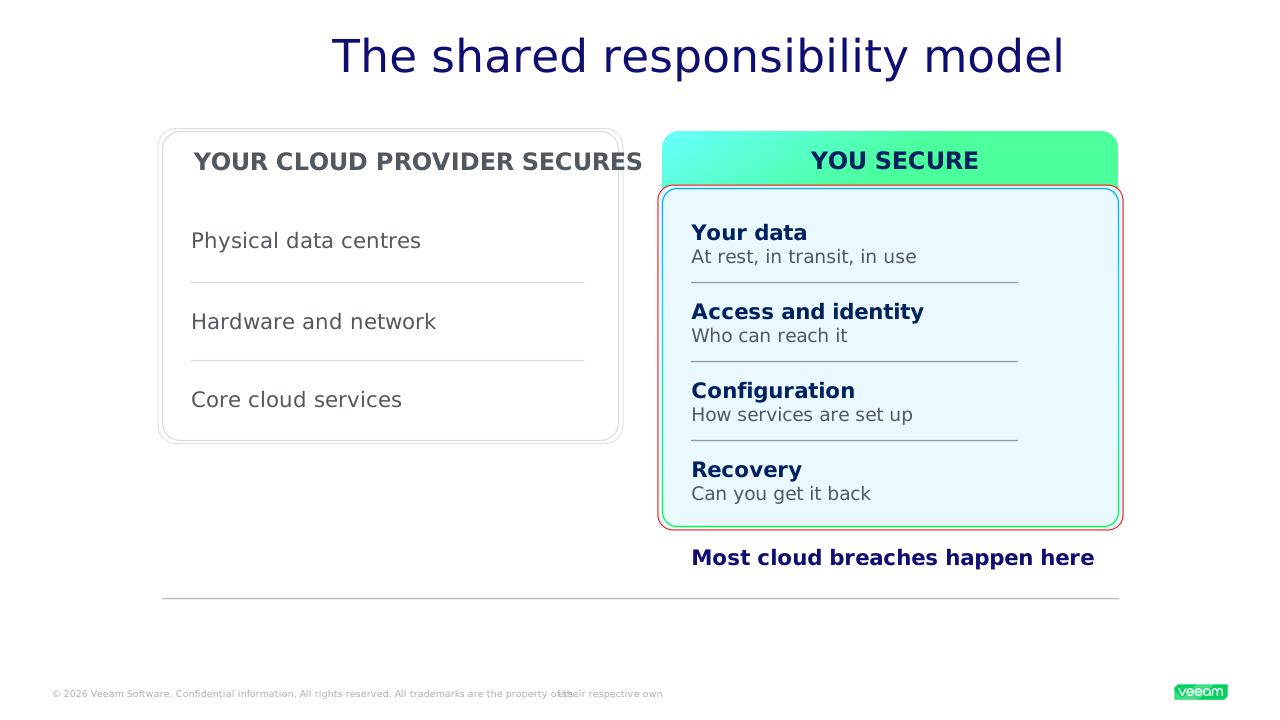
The shared responsibility model is where this gets concrete. Your cloud provider secures the infrastructure: The physical data centers, the hardware, and the core services. You secure everything you put on top: The data itself, who can access it, how services are configured, and whether you can recover after an incident. That second list is where most cloud breaches happen, and it’s the part teams most often underestimate.
Three pressures make this urgent right now:
- Ransomware keeps climbing. Attackers are increasingly using AI to move faster and find weaknesses, often exploiting loose identity permissions to reach cloud data and the backups behind it. The threat comes from outside and inside, both deliberate and accidental.
- Regulators expect provable control. Frameworks like GDPR, HIPAA, SOC 2, and DORA apply to your data, regardless of which provider hosts it or where it physically sits. Compliance follows the data, not the data center.
- One misconfiguration can cascade. In connected cloud environments, a single exposed storage bucket or overly broad permission doesn’t stay contained. It can put sensitive data at risk across every system that touches it.
The point for security leaders is simple: Cloud data security isn’t a feature you switch on with your cloud subscription. It’s a posture you build and maintain, and the cost of assuming otherwise shows up as breach exposure, compliance findings, and data you can’t get back.
Common Cloud Data Security Threats
The most common cloud data security threats are misconfiguration, insider mistakes, ransomware, insecure APIs, and data loss from failed backups. These aren’t the only risks you’ll face, but they account for the majority of cloud data incidents, and most of them trace back to access and configuration rather than sophisticated zero-day attacks.
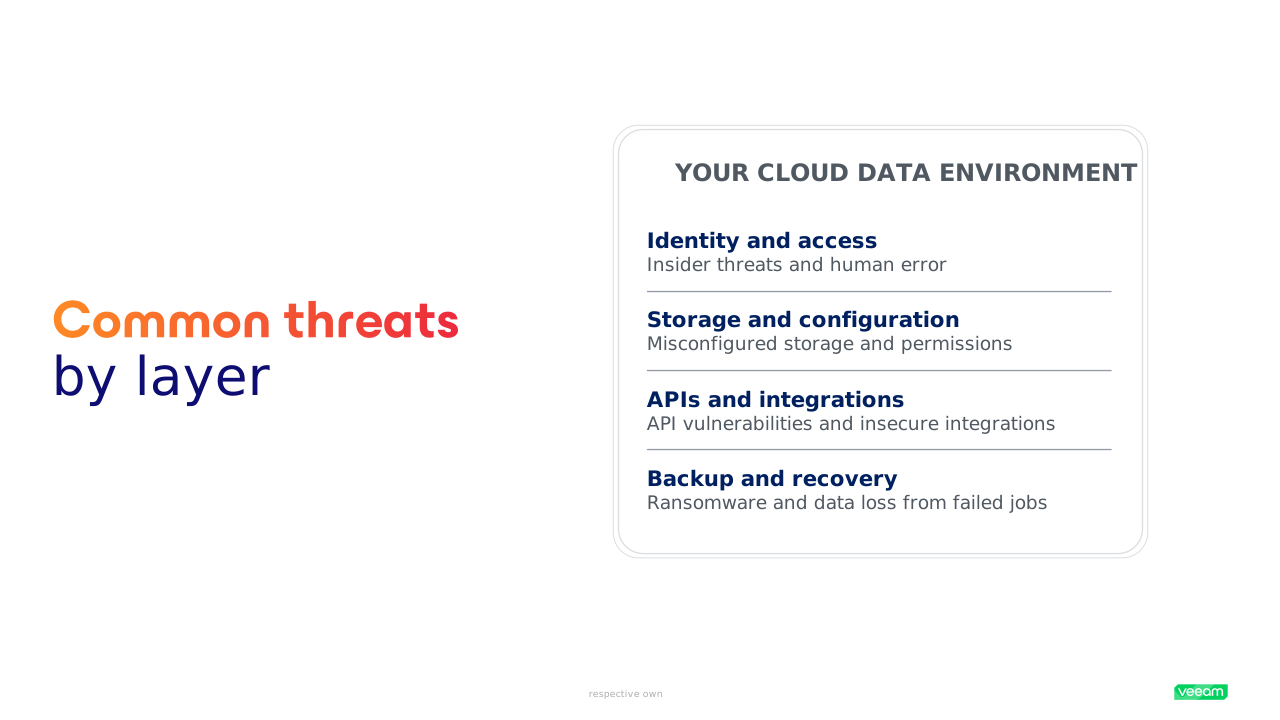
Here’s what to watch for and why each one matters:
1. Misconfigured storage and permissions.
This is the single most common way cloud data gets exposed. A storage bucket left open to the public, an overly broad access policy, or a default setting no one revisited can put sensitive data within reach of anyone who goes looking. As teams connect more tools to their environments, including AI services, an over-permissive setting can quietly extend access far beyond what anyone intended.
2. Insider threats and human error.
Not every threat comes from outside. A mistaken deletion, a misrouted file, credentials shared for convenience, or a departing employee with lingering access can all cause data loss or exposure. Most of these aren’t malicious, which is exactly why they slip past defenses built only to stop external attackers.
3. Ransomware targeting cloud-connected repositories.
Ransomware has moved well beyond the endpoint. Attackers increasingly go after cloud workloads and the backup repositories behind them, since encrypting or deleting your backups removes your ability to recover and strengthens their leverage. These campaigns are faster and more targeted than they used to be, often using automation and AI to find weak identity permissions and move laterally once inside.
4. API vulnerabilities and insecure integrations.
Cloud environments run on APIs, and every integration is another door. Weak authentication, unvalidated inputs, or excessive API permissions give attackers a path to data without ever touching your core systems. The more third-party services and automations you connect, the wider this surface gets.
5. Data loss from accidental deletion or failed backup jobs.
Not all data loss is an attack. A deletion that syncs everywhere before anyone notices, a retention policy that ages data out too early, or a backup job that’s been silently failing for weeks can all leave you without a clean copy when needed. This is the threat teams most often discover at the worst possible moment: During a recovery.
The throughline across all five: Cloud data threats exploit access, configuration, and gaps in recovery far more often than they break encryption or crack a firewall. That’s what shapes the best practices in the next section.
Cloud Data Security Best Practices
These six practices form a practical checklist for protecting cloud data, ordered roughly the way you’d build the program: Know your data, control who reaches it, protect it in every state, watch it continuously, keep recoverable copies, and prove it all meets your obligations. Not one of these best practices is exotic. The discipline is in applying them consistently across every environment you run, not just the one you think about most.
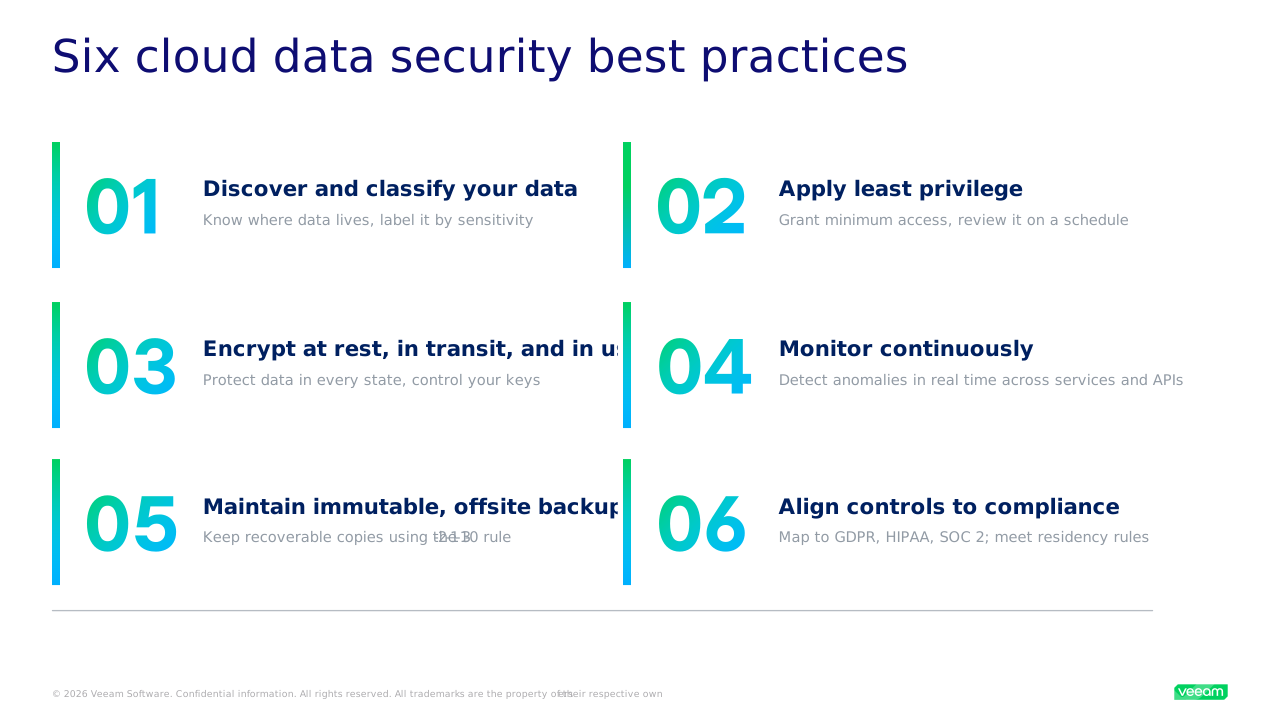
Discover and classify your data first
You can’t protect data you can’t see. Start by finding where your data lives across your cloud accounts, SaaS apps, and on-prem systems, then classify it by sensitivity so the right controls follow the right data. Cloud environments make data sprawl easy: A new bucket here, a copied dataset there, a SaaS export no one tracked. Discovery and classification turn that sprawl into an inventory, and that inventory is what every later control depends on. Without it, you’re securing assumptions instead of data.
Apply the principle of least privilege
Give every user, service, and application the minimum access needed to do its job, and nothing more. Over-permissioning is the most common root cause of cloud data exposure, so this single practice closes a large share of your risk. Use role-based access control, review permissions on a regular schedule, and remove access the moment it’s no longer needed. Pay particular attention to standing access and to non-human identities, including service accounts and any AI tools you’ve connected, since these often accumulate far broader permissions than anyone intended.
Encrypt data at rest, in transit, and in use
Encrypt data in all three states so that even if it’s intercepted or accessed without authorization, it stays unreadable. Most cloud providers offer encryption at rest and in transit by default, but the responsibility for enabling it correctly and managing the keys is yours. Key management is where encryption most often falls down, so control your keys deliberately rather than leaving them to defaults. For your most sensitive workloads, look at confidential computing, which keeps data encrypted even while it’s being processed.
Implement continuous monitoring and anomaly detection
Watch your environment continuously so you can catch a threat while it’s unfolding, not weeks later in an audit. Real-time monitoring across cloud-native services, SaaS activity, and API traffic gives you the visibility to spot the signals that precede a breach: Unusual access patterns, privilege escalations, or large or unexpected data movements. Set behavioral baselines and alert on deviations. Speed matters here, because the gap between compromise and detection is often where the real damage happens.
Maintain immutable, offsite backups
Keep backup copies that can’t be altered or deleted stored separately from your production environment, so you can always recover to a known-good state. This is the practice that completes cloud data security: Prevention reduces the odds of an incident, but recovery is what determines whether an incident becomes a disaster. Immutable backups can’t be encrypted by ransomware or wiped by a bad actor or a bad command, which is exactly why attackers target ordinary backups first. A reliable approach is the 3-2-1-1-0 rule: keep three copies of your data on two different media, with one copy offsite and one copy offline or immutable, and zero errors after verifying your backups are recoverable. Test those recoveries, because a backup you’ve never restored is just an assumption, not a safeguard.
Align security controls to compliance requirements
Map your controls to the regulations that apply to your data, so security and compliance reinforce each other instead of running on separate tracks. Know your industry’s rules, whether that’s GDPR, HIPAA, SOC 2, or others, and build controls that satisfy them as a baseline rather than a final goal.
If you use cloud or object storage, confirm it meets your data residency requirements and supports the policy automation you need to enforce retention and access rules consistently. Compliance done this way isn’t a separate workstream. It’s evidence that the controls you already run are working.
Done together, these six practices move you from reacting to incidents toward a posture where data stays protected and recoverable no matter where it lives. The next section looks at how that posture holds up across different cloud environments.
Cloud Data Security Across Environments
The core principles of cloud data security stay the same across every environment, but where your data lives changes how you apply them. Most organizations don’t run a single, tidy cloud. They run a mix, and each model carries its own assumptions worth examining.
Public cloud
In public cloud, the shared responsibility model is the thing teams most often get wrong. The provider secures the infrastructure, but your data, access policies, and configurations are yours to protect. Visibility is the recurring challenge: As services and accounts multiply, it gets harder to know exactly where sensitive data sits and who can reach it. Strong discovery, least privilege, and continuous monitoring matter most here, because the environment changes faster than manual oversight can keep up.
Private cloud
Private cloud gives you more direct control over infrastructure, but control isn’t the same as safety. The data still needs the same discipline: Classification, encryption, tight access, and recoverable backups. The risk in private environments is complacency, assuming that because the infrastructure is yours, the data is automatically protected. It isn’t. Misconfiguration, insider error, and ransomware reach private clouds too.
Hybrid and multicloud
Most organizations land here, running a mix of public clouds, private infrastructure, and on-premises systems. The practical difference between the two is small: Hybrid simply adds an on-premises component to the cloud mix. What matters for security is the same in both: The more environments you connect, the more handoff points you create, and those connection points are exactly where data gets exposed and consistency breaks down.
A control enforced in one cloud but missed in another isn’t a control, it’s a gap. The goal across hybrid and multicloud isn’t to secure each environment in isolation. It’s to apply one consistent standard for protection and recovery everywhere your data lives, so your security posture doesn’t depend on which platform a given dataset happens to sit in.
That consistency across environments is also what compliance depends on, which is where we turn next.
Cloud Data Security and Compliance
Cloud data security and compliance are closely linked but not the same thing: Security is the set of controls that protect your data, while compliance is the evidence that those controls meet the rules that apply to you. The most efficient programs treat them as one effort, where the controls you run every day also produce the proof your auditors and regulators expect.
Most regulated organizations work within frameworks like GDPR, HIPAA, and SOC 2, and EMEA organizations also face DORA, which carries expectations around operational resilience and keeping protected data appropriately separated from production systems. The specific rules vary by industry and region, but the practical guidance is consistent: Know which regulations apply to your data, and build your controls to satisfy them as a baseline rather than a finish line. (Regulatory requirements evolve, so confirm the current obligations for your industry and regions before treating any list as complete.)
A few areas deserve particular attention in the cloud:
- Data residency and sovereignty. Many regulations dictate where data can physically live. Confirm that your cloud and storage choices keep regulated data in approved regions, and that you can prove it.
- Audit logging and access reporting. You need a clear, retained record of who accessed what and when. Continuous monitoring does double duty here, supporting both security and audit readiness.
- Breach notification. Several frameworks set strict timelines for reporting an incident. Knowing what happened, and being able to recover, directly affects whether you can meet those obligations.
Here’s where environment sprawl becomes a compliance problem, not just a security one. The more clouds and tools you run, the more places a control can drift out of alignment, and stitching compliance together across multiple point products is where gaps appear: Compliant in one tool, while out of step in another. Consolidating protection and recovery under one consistent approach closes those gaps and makes compliance far easier to demonstrate, because you’re proving one standard rather than reconciling several.
Approached this way, compliance stops being a separate burden bolted onto security. Instead, it becomes the natural output of controls you already run well, which is exactly the role Veeam is built to support.
How Veeam Supports Cloud Data Security
Every practice in this guide depends on one thing the cloud provider won’t do for you: Ensuring your data is recoverable when something goes wrong. That’s where Veeam fits. Veeam acts as the protection and recovery layer across your cloud, hybrid, and on-premises environments, so the controls you put in place are backed by data you can always retrieve.
A few capabilities matter most for cloud data security:
- Immutable, recoverable backups. Veeam helps you keep backup copies that can’t be altered or deleted, so ransomware, a malicious insider, or a mistaken command can’t take your recovery option away. When prevention fails, recovery is what turns an incident into a non-event.
- Protection that’s built in, not bolted on. Encryption and immutability are part of how Veeam protects your data, rather than the controls you must assemble from scratch, which keeps your security posture consistent instead of patchy.
- One consistent approach across environments. Instead of stitching together separate point products for each cloud, Veeam gives you a single way to protect and recover data wherever it lives, which also makes compliance easier to prove.
- Cost-efficient, secure cloud storage with Veeam Data Cloud Vault. Veeam Vault is fully managed cloud storage that’s always immutable and logically air-gapped from production, so your backups land somewhere ransomware can’t encrypt or delete. Backups are encrypted in flight and at rest with AES 256-bit encryption, and you hold the keys. Veeam Vault helps you meet the 3-2-1-1-0 rule, supports your data residency requirements with regional storage choices, and uses flat per-TB pricing so cloud storage stays predictable instead of becoming your next surprise bill.
The throughline is simple: Strong security reduces the chance of an incident, and Veeam makes sure an incident doesn’t become a loss. That combination is what keeps your cloud data both protected and recoverable, no matter where it sits or what targets it.
To go deeper, explore Data Sovereignty in the Cloud Era.
FAQs
Cloud data security is the set of technologies, policies, and controls that protect data stored in, processed by, or moving through cloud environments, across all three states: At rest, in transit, and in use. It covers who can reach your data, how it’s configured and encrypted, and whether you can recover it after an incident. Unlike traditional perimeter security, it’s built for environments where data moves across providers, services, and locations.
You are. Under the shared responsibility model, your cloud provider secures the underlying infrastructure, while you’re responsible for protecting the data itself: Access controls, configuration, encryption, and recovery. Most cloud breaches happen on the customer’s side of that line, which is why assuming the provider handles everything is a common and costly mistake.
Protect cloud data by combining several controls rather than relying on any single one. Discover and classify your data, enforce least-privilege access, encrypt data at rest, in transit, and in use, monitor continuously for anomalies, keep immutable offsite backups, and align your controls to the regulations that apply to you. The strength comes from applying all of them consistently across every environment you run.
Cloud data security focuses on preventing unauthorized access, breaches, and misuse. Cloud data protection focuses on keeping data available and recoverable through backup and recovery. They overlap heavily and work best together: Security lowers the chance of an incident, and protection makes sure you can recover when one happens. A complete strategy treats them as two halves of the same goal.
Generally, no. Cloud providers secure their own infrastructure and may offer some redundancy, but backing up your data and being able to recover it is your responsibility. Native cloud tools don’t automatically protect your data the way a dedicated backup and recovery solution does, which is why many organizations add immutable, independent backups they control.
