

Key Takeaways:
- MSP Backup shifts the burden of backup and recovery to expert partners, automating protection, securing data off-site, and simplifying compliance. That allows in-house IT teams to focus on strategic priorities.
- The Veeam Cloud & Service Provider (VCSP) program powers MSP success with flexible licensing, centralized management, and strong support for BaaS/DRaaS.
- MSPs get full coverage with Veeam’s product suite, including Veeam Data Platform, Veeam Data Cloud (for Microsoft 365 and others), Veeam Service Provider Console, and Veeam Cloud Connect — enough coverage to protect virtual, cloud, and SaaS workloads.
- Only 30% of organizations have a predefined chain of command for incident response according to the Risk to Resilience Report. This highlights a critical gap that MSPs can help close with tested recovery workflows and centralized oversight.
- Choosing the right MSP backup solution isn’t just about features. It includes reliability, security, scalability, ease of management, and strong support & compliance tools. Veeam has built capabilities aligned with all these needs.
What is MSP Backup?
MSP Backup is a managed data protection service offered by third-party providers who deliver Backup-as-a-Service (BaaS) and Recovery-as-a-Service (DRaaS) solutions. Rather than organizations building and maintaining their own backup infrastructure, MSPs handle everything from policy setup, automation, monitoring, off-site storage, data encryption, and compliance, across many customer environments using multi-tenancy.
Backup solutions providers take care of the entire backup life cycle, which includes protecting the data in secure off-site storage.
Veeam supports MSPs through its VCSP (Veeam Cloud & Service Provider) Program, offering tools like Veeam Data Cloud, Veeam Service Provider Console, and Veeam Cloud Connect, so MSPs can scale operations, protect cloud and hybrid workloads, and deliver reliable, cloud-powered backup solutions.
Importance of Backup in Managed Services
The process of taking backups, replicating them for off-site storage, and verifying the integrity of the backups can be time-consuming. As companies increasingly rely on cloud services or SaaS solutions for data processing, the process becomes even more complex, as discussed in Cyber Resiliency for the Hybrid Cloud.
Only 30% of organizations have a predefined chain of command for incident response, according to the 2025 Risk to Resilience Report. That means most teams are still improvising during a crisis — a risk that MSPs can help eliminate by delivering structured workflows, centralized oversight, and tested backup strategies.
Outsourcing backup services to a specialist that can ensure high availability and integrity of their data offers peace of mind and frees the in-house IT team to focus on specialized tasks.
For many IT leaders, the real challenge lies in resource limitations, skill gaps, and regulatory pressure. Teams are stretched thin maintaining multiple environments, and specialized backup expertise is often hard to find in-house. At the same time, regulatory audits demand consistent evidence of compliance. It’s something that manual, fragmented backup processes rarely deliver. Add in the rising costs of downtime, cyberattacks targeting backup infrastructure, and the complexity of managing hybrid or multi-cloud environments, and it’s clear why organizations are turning to MSPs to fill these gaps.
Key Features of MSP Backup Solutions
Managed service provider (MSP) backup solutions cover the whole of the backup and recovery process.
- Automation: MSPs ensure backups run automatically at an appropriate frequency for the type of data being backed up. Automation can give clients peace of mind knowing they have a recent backup in the event of hardware failure, accidental corruption/deletion, or other unforeseen events.
- Testing: Testing validates the integrity of backups and confirms the data recovery process works properly so there’s minimal downtime in the event of a data loss incident.
- Encryption and security: MSPs ensure backups are encrypted in transit and at rest to comply with data security policies. An MSP can provide immutable, encrypted off-site backups that comply with data protection regulations and allow access only to authorized individuals.
- Multiple copies: Most disaster recovery plans use the 3-2-1 backup model. Organizations should take three copies of their data on at least two different media, with one copy being off-site. Backups should always be kept in secure locations, and the disaster recovery plan should include how to obtain and restore those copies quickly.
- Monitoring and management: Continuous monitoring of the backup process helps ensure the backup solution works and provides early warning in the event of errors or configuration issues.
- Scalability: As organizations grow, the volume of data they handle multiplies. MSPs offer flexibility, making it easy for businesses to store larger volumes of data as their needs or infrastructure evolves.
- Broader disaster recovery planning: MSPs learn the requirements of their clients and help implement comprehensive disaster recovery plans, considering what data should be preserved and the best way to get cloud applications, databases, or virtual machines back up and running.
Benefits of Managed Service Provider Backup
A managed service provider backup solution offers more benefits than in-house backups.
- Increased reliability: MSPs that specialize in backups and recovery typically have a presence in multiple data centers. This ensures maximum availability and reduces the impact of outages affecting specific geographic areas. Hardware failures and communication issues affecting one data center don’t need to cause a total outage.
- Reduced downtime: MSPs with extensive expertise in cloud backup solutions have the infrastructure and tools required to offer fast recovery times. For businesses with short recovery point objectives, quickly restoring a working copy of mission-critical data is essential for maintaining business continuity.
- Security and compliance: Depending on the territory a business operates in and the type of data it processes, there may be strict requirements for how data can be stored and processed. MSPs implement comprehensive security measures, such as encrypting data during transmission and while it’s stored. They also use backup management software with access control lists to ensure only authorized individuals can manage the backups.
- Frequent updates and upgrades: From security patches to maintaining compatibility with SaaS/cloud solutions, MSPs offer regular updates to keep their software working well. These updates ensure automation remains reliable, lessen the need for manual workarounds, and avoid unpatched security issues.
- Support and SLAs: With SLAs, clients expect a certain level of uptime and availability and that any issues will be addressed within a predefined time frame. This includes customer support services, so if a client has issues with or needs help restoring their backup, they know when they can reach the MSP and how quickly they can expect a response.
- Predictable costs: MSPs may offer tiered subscription pricing or have a pay-as-you-use model so organizations can manage their backup costs based on the volume of data they’re backing up. Outsourcing backups under this type of pricing model can be cost-effective for organizations that don’t want to invest in the time, hardware, and software required to run in-house backup solutions.
See how MSP Backup with Veeam shifts costs, effort, and risk compared to managing everything in-house.
In-house Backup vs. Veeam-Powered MSP Backup
| Feature | In-house Backup | Veeam-Powered MSP Backup |
| Cost Model | High upfront CapEx: hardware, licensing, storage. Ongoing operational & maintenance expenses. | Subscription or usage-based pricing. Pay for what you use. Predictable monthly/quarterly costs. |
| Management & Monitoring | Managed internally; requires staff, specialized skills, manual oversight. | Fully managed or partially managed by MSP with monitoring tools, automation, central dashboards. |
| Recovery Speed & SLA Compliance | Recovery depends on staff availability, hardware constraints; SLAs may suffer during scale or failure. | Higher SLAs, faster recovery times due to trained support, optimized tools, and offsite replicated data. |
| Scalability & Flexibility | Scaling requires adding hardware, dealing with capacity planning, updates. | Scales easily: MSPs can expand storage, add clients, support more workloads/cloud services without large infrastructure investment. |
| Security & Compliance | Internal policies + tools. Risk of misconfiguration; limited redundancy unless built out. | Stronger security controls: encryption in transit & at rest, immutable backups, audit logs, compliance support. |
| Operational Burden | High: staff must handle everything from backup policies to recovery testing & verification. | Lower: burden shifts to MSP. Tasks like testing, patching, verifying integrity handled by experts. |
Best Practices for MSP Backup
Backup solutions must be continuously reviewed and fine-tuned to ensure they protect the right data, align with client SLAs, and stand up against modern cyberthreats. Below are key best practices MSPs should adopt to deliver reliable, value-driven backup services.
The 3-2-1-1-0 Rule for Data Protection
The classic 3-2-1 rule has evolved into 3-2-1-1-0. This means keeping three copies of data on two types of media, with one copy off-site, one immutable or air-gapped, and zero backup verification errors.
- MSPs should standardize this approach across clients to minimize risk.
- Immutable and air-gapped backups, combined with automated backup verification, ensure ransomware cannot alter data and recovery confidence remains high.
Regular Data Audits
Data grows and shifts constantly, so backups must adapt.
- Audit client data regularly. Even small changes in workflows or software updates can redirect where data is stored, leaving blind spots if backups are not updated.
- Review data classification. Apply different policies for critical databases vs. lower-priority archives. Map retention schedules and RPO/RTOs to data importance.
Employee Training and Documentation
A strong backup strategy is only as good as the team implementing it.
- Ongoing training. Ensure MSP staff are trained not just on policies, but on the unique needs of each client.
- Living documentation. Maintain detailed guides on policies, customer requirements, and recovery workflows. Update regularly and make them easily accessible.
Continuous Monitoring and Alerts
Real-time visibility is critical for both MSPs and their clients.
- Proactive monitoring. Track backup health, storage capacity, network performance, and anomalies.
- Configurable alerts. Use automated notifications to flag missed backups, failed jobs, or security anomalies.
- Ransomware monitoring. With ransomware incident costs rising, MSPs must actively monitor for malicious activity. Tools like Veeam Service Provider Console and Veeam ONE can centralize alert collection, malware detection status, and reporting.
Testing Backup and Recovery Processes
A backup is only as good as its last restore test.
- Regular simulations. Test full recoveries and granular restores to prove data integrity.
- Scenario diversity. Include ransomware events, accidental deletion, system crashes, and complete data center outages in your testing.
- Immutable recovery options. Always maintain at least one immutable backup that cannot be altered or deleted.
- Access controls. Apply the principle of least privilege and regularly audit who can perform restores.
Partnering with the Right Technology
Choosing the right technology platform is just as important as process and policy.
- MSP-specific platforms. Look for solutions that provide multi-tenant management, centralized monitoring, and automation—all from one console.
- Integration readiness. APIs and support for hybrid/multi-cloud environments are critical for scaling.
- Client trust. By aligning with proven platforms like the Veeam Cloud & Service Provider (VCSP) program, MSPs can deliver confidence with enterprise-grade backup and recovery that’s easy to scale and secure by design.
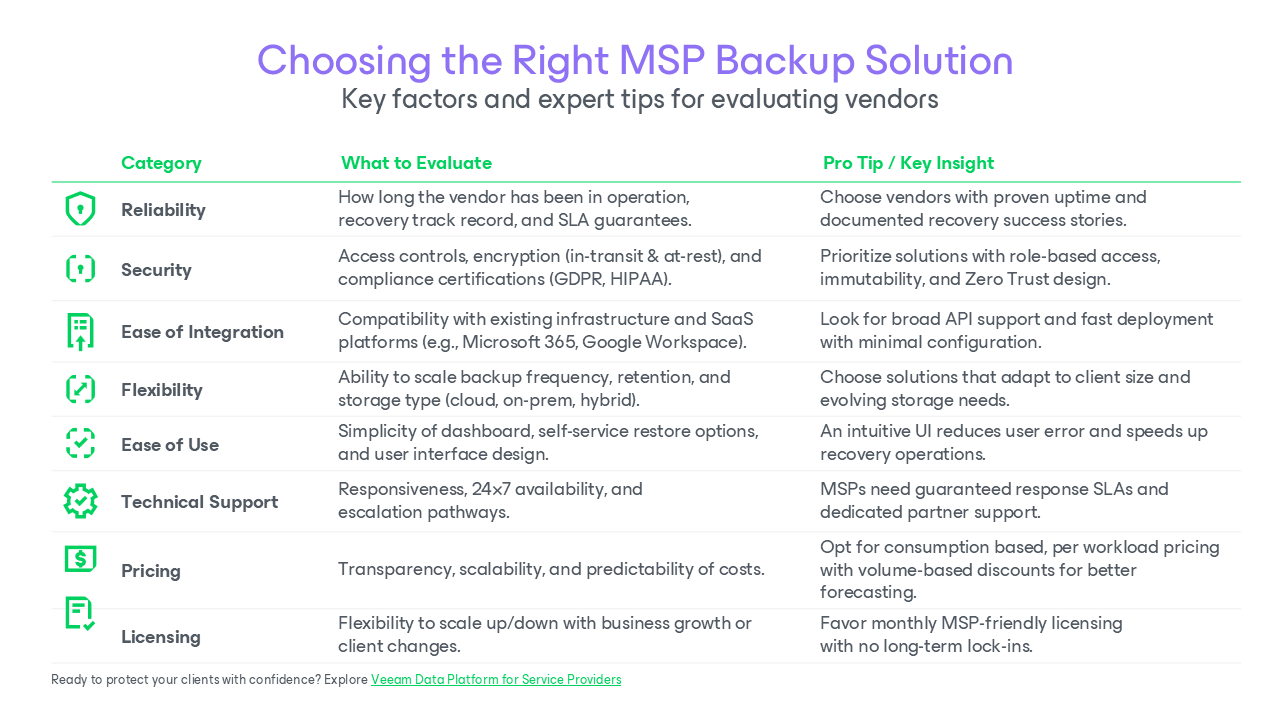
How to Choose the Right MSP Backup Solution
If you’re considering becoming a managed backup solutions provider, you need a solution your clients can depend on. When evaluating providers, consider the following.
- Reliability: How long has the provider been in operation? Does it have a good reputation? Look at review scores and testimonials. Have businesses been able to recover data from the backup provider in an emergency? Do the SLAs offered by the vendor match your clients’ expectations?
- Security: Does the vendor’s software offer access controls? Are the solutions granular, for example, allowing certain users to restore but not delete backups? Are backups encrypted in transit and at rest to ensure compliance with data protection laws and industry-specific regulations?
- Ease of integration: Does the vendor offer software your clients can easily drop in place alongside their existing infrastructure? Does it provide solutions that support common APIs to back up data from popular SaaS services?
- Flexibility: Every business has different needs when it comes to backup frequency, retention, etc. Does the vendor cater to organizations of various sizes, allowing them to manage their backup policies and suit their needs?
- Ease of use: Is the software easy enough for non-IT specialists, such as department heads, to use? Providing an intuitive dashboard helps encourage clients to use the software and reduces the risk of data loss due to user error.
- Technical support: What level of support does the vendor offer? Do they have an out-of-hours helpline available for data recovery emergencies?
- Pricing: Is the pricing structure easy to understand? Do you, as a managed solutions provider, have predictable costs that scale with your client base?
- Licensing: Are the licensing options flexible? Can you scale up or down depending on your business needs, or are you locked into a specific tier?
The Veeam Cloud & Service Provider program is open to partners of all sizes, with scalable offerings to match your organization’s needs. More than 450,000 customers worldwide use Veeam modern data protection solutions. Veeam Software is well-recognized by IT workers worldwide, and that brand recognition makes it a powerful marketing tool for MSPs.
Case Study: MSP Success with Veeam — A1 Telekom Austria AG
Industry: Healthcare / Telecommunications
Region: Europe
Products used: Veeam Data Platform, Veeam Service Provider Console, Veeam Cloud Connect
Business Challenge
A1 Telekom Austria supports ~10,000 healthcare facilities across Austria, including hospitals, labs, doctors’ offices, and pharmacies, for secure digital exchange of patient data. Over time, A1 needed to offer a reliable, secure “online backup service” to these institutions, many of which lacked in-house expertise or infrastructure for backup. Key challenges included:
- Strict legal and regulatory requirements for protecting sensitive health data (patient privacy, GDPR, national health laws).
- Complexity and operational burden of managing backups across spaces with varying infrastructure and client technical capacity.
- The need for a solution that offered high availability, rapid recovery, ease of management, and strong security (encryption in transit and at rest).
Veeam’s Solution
To meet these challenges, A1 chose Veeam’s platform and tools. Key elements:
- Automation & Policy-Driven Backup: Backups are scheduled automatically per customer policies.
- End-to-End Encryption: Data is encrypted at the source (customer premises), transmitted securely via Veeam Cloud Connect, and stored encrypted. Only decrypted during customer-initiated restore, with key ownership maintained by the customer.
- Management Transparency & Self-Service: A1 uses the Veeam Service Provider Console for centralized monitoring of all backup jobs, policy enforcement, and reports. Customers have self-service options for restoring certain content without needing to contact support.
| Benefit | Outcome for A1 & its Healthcare Customers |
| Regulatory compliance | Full alignment with patient data protection laws like GDPR and local Austrian regulation. |
| Faster recovery | Local customer data loss (e.g., accidental deletion) could be remedied swiftly via centralized backups. |
| Operational efficiency | A1’s technical teams spent less time managing backup infrastructure, thanks to centralized policy management and automation. |
| Customer trust & satisfaction | Healthcare institutions appreciated reliability and simplicity of service; feedback was positive. |
Lessons for MSPs
- Regulation Expertise is a Differentiator: For MSPs, especially in regulated verticals like healthcare, compliance + data protection is a key selling point. Encryption, auditable workflows, and transparent policies matter.
- Automation & Self-Service Drive Scale: Tools like the VSPC (Veeam Service Provider Console) not only make life easier for the MSP but also empower customers. That reduces support overhead and improves satisfaction.
- Security from the Ground Up: Customer-controlled encryption, strong off-site storage, and secure recovery workflows build trust and reduce risk.
- Monitoring & Transparent Reporting: Whether it’s for billing, compliance reporting, or customer assurance, having dashboards and auto-reports pays off.
Partner with Veeam: Build Your MSP Business
Delivering reliable backup and recovery isn’t just about technology. It’s about gaining your clients’ trust. As a managed service provider, your clients depend on you to keep their data available, secure, and compliant. With Veeam, you gain a partner committed to your long-term success.
Through the Veeam Cloud & Service Provider (VCSP) program, you can:
- Differentiate your services with Veeam’s trusted brand recognition and innovation.
- Simplify operations with the Veeam Service Provider Console, a single interface for centralized management, monitoring, licensing, and client reporting.
- Scale with confidence, delivering modern protection for virtual, physical, SaaS, Kubernetes, and public cloud workloads.
- Grow your business by offering value-added services powered by actionable insights, multi-layered security, and flexible licensing models.
Veeam makes it possible to meet evolving customer expectations while expanding your service portfolio, all with the simplicity of a platform designed for MSPs.
Ready to take the next step?
Become a Veeam partner and see how our solutions can help you scale your services and build stronger client relationships.
