The Future of Virtualization: Mapping Your Migration to Red Hat OpenShift
Register to watch


As organizations face mounting pressures to modernize their IT infrastructure, the shift from traditional virtualization platforms to modern, application-centric environments is accelerating. Let’s explore this journey from legacy virtualization solutions — such as VMware, Hyper-V, and OpenStack — to Red Hat OpenShift Virtualization and highlight the business drivers, technical considerations, and best practices for successful migration and ongoing data protection.
Red Hat OpenShift Virtualization, powered by KubeVirt, brings VMs into the Kubernetes ecosystem as first‑class citizens. This convergence enables businesses to streamline operations, reduce technology silos, and accelerate application modernization while embracing hybrid and multi‑cloud architectures.
Matt Slotten, Principal Solution Architect at Veeam, and Jokin Schroeder, Senior Product Manager of Virtualization at Red Hat, guide viewers through the migration process, while demonstrating the Migration Toolkit for Virtualization (MTV), and emphasizing the importance of robust data protection in our current cyber landscape. With real-world examples and actionable insights, this webinar equips IT leaders, architects, and operations teams to confidently plan and execute their migration to OpenShift.
Key Insights
- Application modernization is driving a shift from infrastructure-centric to application-centric IT strategies.
- Industry disruption, including the after‑effects of Broadcom’s acquisition of VMware, is prompting businesses to explore alternative virtualization platforms that deliver cost predictability and long‑term flexibility
- Modern platforms like OpenShift allow organizations to manage and protect both VMs and containers within a single environment, which streamlines operations and reduces silos.
- Organizations must assess their environments, prepare their teams for Kubernetes operations, and use validation and automation tooling to ensure smooth transitions.
- The MTV (Migration Toolkit for Virtualization) facilitates mass VM migrations from VMware, OpenStack, and Red Hat Virtualization to OpenShift through an intuitive UI and features like warm migration and validation services.
- Data protection remains critical after migration. Veeam Kasten for Kubernetes delivers enterprise-class backup, ransomware protection, and disaster recovery (DR) for both VMs and containers on OpenShift.
- OpenShift Operator Hub and Veeam Kasten’s operator model make deployment and ongoing management straightforward for both on-premises and cloud-based OpenShift instances.
Migration Strategy and Execution
This webinar outlines the business and technical drivers behind migration, including the need for faster release cadences, cost optimization, and the flexibility to run workloads across hybrid and multi-cloud environments. It underscores the importance of choosing a platform that enables VMs and containers to be managed together, supporting your evolving business needs without vendor lock-in.
MTV is a powerful enabler for migration since it offers:
- Easy-to-use and UI-driven migration planning and execution.
- Compatibility with major source platforms like VMware, OpenStack, and Red Hat Virtualization.
- Warm migration options for minimal downtime.
- Assessment and validation to ensure successful transitions.
The session includes practical advice on how to group related VMs in migration plans, leverage parallel migrations for efficiency, and use OpenShift Operator Hub for rapid deployment.
Ensuring Data Resiliency in Modern Environments
Migrating to OpenShift is only one part of the modernization journey, and the security and recoverability of your business-critical workloads are paramount. Veeam Kasten stands out by providing:
- Immutable backups and ransomware protection.
- Point-in-time recovery and integration with Red Hat Advanced Cluster Security.
- Support for hybrid and multi-cloud DR scenarios.
- Application-consistent backups that leverage open-source blueprints.
- Seamless operations with both block and file storage for optimized performance.
This architecture developed by Veeam and Red Hat demonstrates how organizations can leverage on-premises and cloud-based OpenShift clusters for robust DR and cost optimization.
Getting Started, Resources, and Next Steps
Want to learn more? There are many resources available for hands-on evaluation, including demos and free trials of Veeam Kasten for up to five nodes. Both MTV and Veeam Kasten are also available as operators in the Red Hat Operator Hub to streamline adoption for existing OpenShift users.
Leverage Red Hat’s VMware Migration Assessment and Veeam’s extensive documentation and community resources too! With proven solutions and expert guidance, organizations can confidently navigate their migration journey and unlock the full benefits of modern virtualization.
Watch the Full Webinar for More Advanced Insights
This webinar delivers a strategic roadmap for IT leaders to modernize their virtualization environments, mitigate risk, and ensure data resilience in the cloud-native era.
Frequently Asked Questions
1. What are the main drivers behind migrating from legacy virtualization platforms to OpenShift Virtualization?
Organizations are motivated by the need for application modernization, cost optimization, reduced vendor lock-in, as well as the ability to manage VMs and containers together within a unified environment.
2. How does MTV simplify the migration process?
MTV offers a user-friendly UI, supports mass migration, provides validation services, supports warm migration, and enables the planning and grouping of VMs for efficient, low-risk transitions from VMware, OpenStack, and Red Hat Virtualization.
3. Why is data protection still critical after migrating to OpenShift Virtualization?
Even in modern environments, VMs and containers still require robust backup and DR to protect against accidental deletion, ransomware, and other threats, both internal and external. Veeam Kasten ensures data resiliency and quick recovery for all workloads.
4. Can Veeam Kasten be deployed in both on-premises and cloud-based OpenShift environments?
Yes, Veeam Kasten is available via the OpenShift Operator Hub and can be installed on any OpenShift cluster, whether on-premises or in public cloud environments like AWS (ROSA), Azure (ARO), or Oracle.
5. What differentiates Veeam Kasten from open-source solutions like Velero for Kubernetes backup?
Kasten offers an enterprise Grade UI, robust encryption, ransomware protection, full support model, block and file storage support and a continuous stream of innovation; capabilities not fully provided on open source solutions.
6. Does this solution support hybrid and multi-cloud DR?
Absolutely. This architecture from Veeam and Red Hat enables organizations to run DR across on-premises and public cloud OpenShift clusters and optimizes your environment for both cost and resilience.
7. What resources are available to help plan and execute a migration to OpenShift?
Red Hat’s VMware Migration Assessment, Veeam and Red Hat’s documentation, product demos, and free trials of Veeam Kasten are available to support every stage of your migration journey.
For more in-depth answers and expert guidance, register to access the full webinar.
Speakers
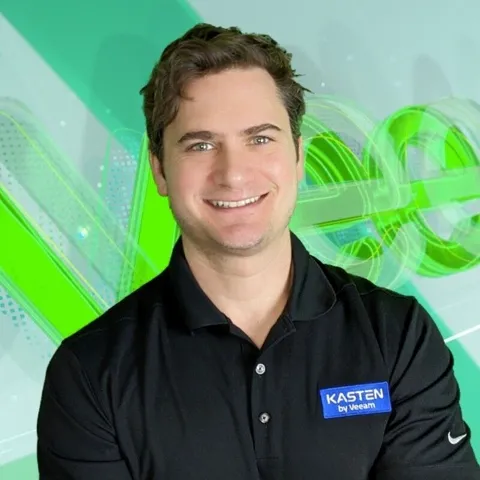
Principal Solutions Architect, Veeam Software

Senior Product Manager Virtualization, Red Hat